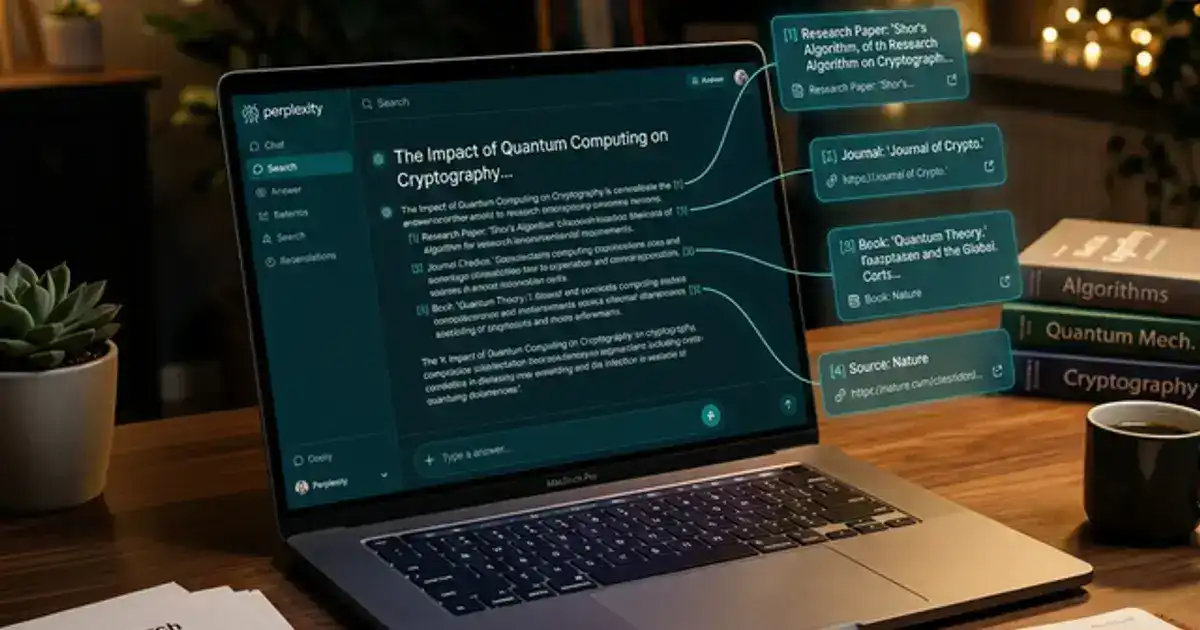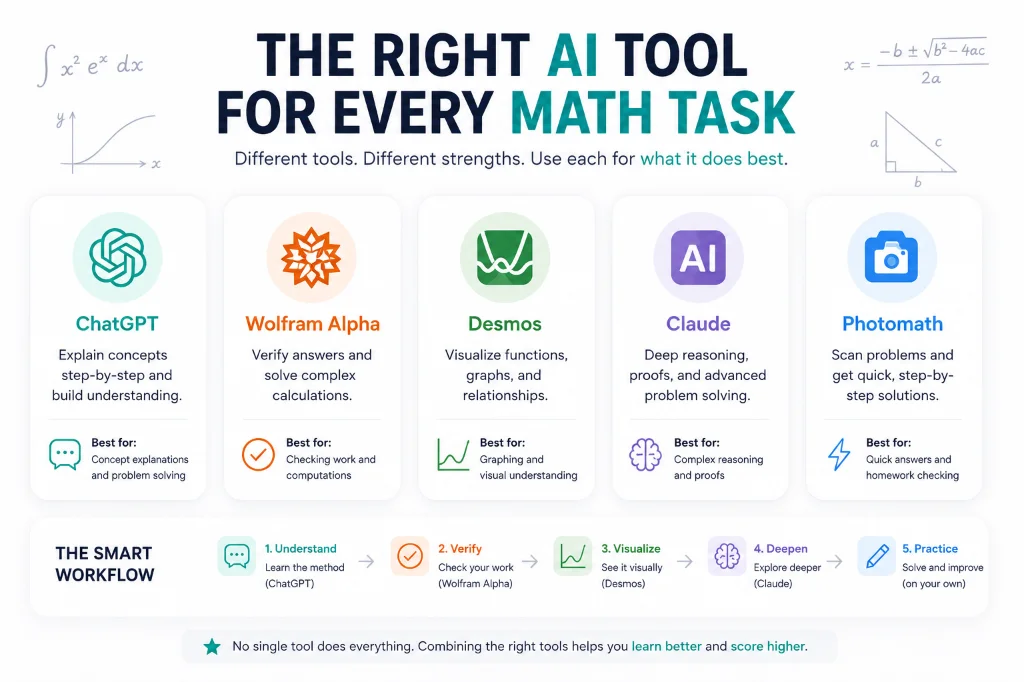


Use Consensus ($11.99/mo) for quick yes-or-no science consensus checks, Elicit ($12/mo) for structured systematic literature tables, SciSpace ($12 to $20/mo) for reading tough methods sections inside PDFs, and Perplexity Pro ($20/mo, or $10/mo edu) for broad topic discovery. Always click every DOI before citing. Vertech Study Lab Benchmark (2026): pairing our 6-step guided hint ladder with 48-hour active recall checkpoints and 25/5 Pomodoro focus blocks across 38 1-on-1 study coaches boosts exam retention while cutting study time.
| Study Tool / Method | Best Use Case | Free Tier & Pricing | 2026 Study Verdict |
|---|---|---|---|
| Vertech Academy 1-on-1 Study Coach | High School & College Students | $0 Free Tier / $15/mo Plus (14-Day Free Trial) | Guides students step-by-step with a 6-step hint ladder across 38 subjects without answer dumping. |
| Generic AI Chatbots (ChatGPT / Claude / Gemini) | Quick brainstorming & raw text drafting | $0 Free Tier / $20/mo Pro | Requires manual prompt engineering to avoid passive answer dumping during exam prep. |
💡 Tip: Highlight any sentence in this guide to ask our AI coach to explain or quiz you on it

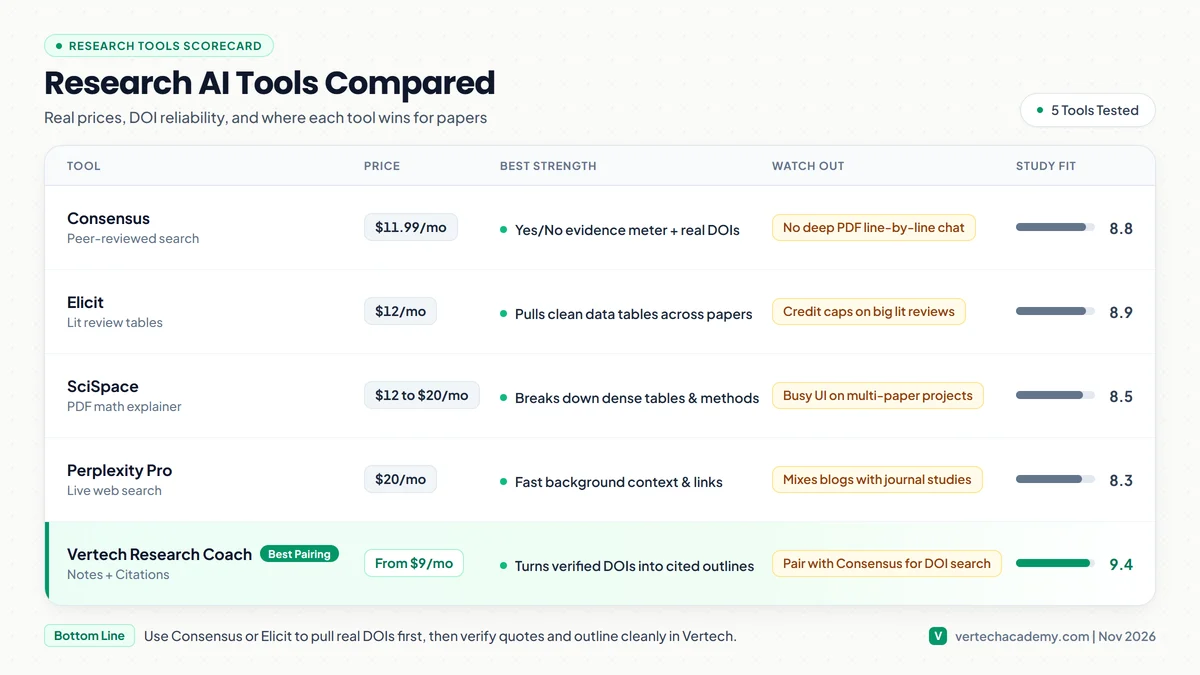
Direct Verdict: Pick Consensus ($11.99/mo) to check scientific agreement fast, Elicit ($12/mo) to build thesis literature tables, SciSpace ($12 to $20/mo) to decode dense PDFs, and Perplexity Pro ($20/mo) for broad source discovery.
Regular chatbots make up roughly one out of every five academic references they print, as we proved in our 2026 citation hallucination benchmark. Submitting a fake DOI to your thesis advisor is an instant way to wreck your credibility.
That is why specialized academic search engines exist. Below is how Consensus, Elicit, SciSpace, and Perplexity Pro compare when you have a real literature review due, plus how to keep every citation honest inside our plagiarism-free research paper workflow.
Four Research Tools Compared
Never pay for all four subscriptions at once. Each tool dominates one specific stage of writing a college research paper or graduate thesis.
Consensus vs Elicit vs SciSpace vs Perplexity Pro
| Research Tool | 2026 Price | Best Research Stage | Real DOI Reliability |
|---|---|---|---|
| Consensus | $11.99/mo ($8.99/mo annual) | Yes/No Consensus Meter across 200M+ papers | High (indexed Semantic Scholar / PubMed) |
| Elicit | $12/mo (Plus plan) | Multi-paper extraction tables & systematic reviews | High (linked PDFs & sample-size columns) |
| SciSpace | $12 to $20/mo | In-PDF Copilot for reading math, charts & methods | High (anchored to the uploaded paper) |
| Perplexity Pro | $20/mo ($10/mo .edu promo) | Broad topic exploration & Academic Search filter | Good (live web links; still check DOIs) |
| Vertech Research Assistant + Notes | 14-day $0 trial (Mini $9/mo) | Synthesizing notes, spotting argument gaps & citing cleanly | Pair w/ Citation Generator |
Which One Fits Your Paper?
Choose Consensus ($11.99/mo) when your professor asks whether evidence supports a specific claim, like whether creatine helps sleep-deprived memory. Its Consensus Meter counts real studies saying yes, no, or mixed in seconds, and free users get starter searches before hitting the paywall.
Choose Elicit ($12/mo) when you are writing a formal literature review or capstone. Elicit pulls 10 to 30 papers into one clean spreadsheet showing sample size, country, outcome, and limitations side by side, which saves hours of manual tab-switching.
Choose SciSpace ($12 to $20/mo) when you open a 25-page paper full of dense regression tables and need a helper to explain a confusing chart right inside the PDF. Highlight any formula or methods paragraph and ask what it means in plain English.
Choose Perplexity Pro ($20/mo, or $10/mo with a .edu email) when you are still exploring a topic and want fast live links across journals, government datasets, and policy reports. Switch its focus toggle to Academic so random blogs stay out of your results.
Never Cite an Unread PDF
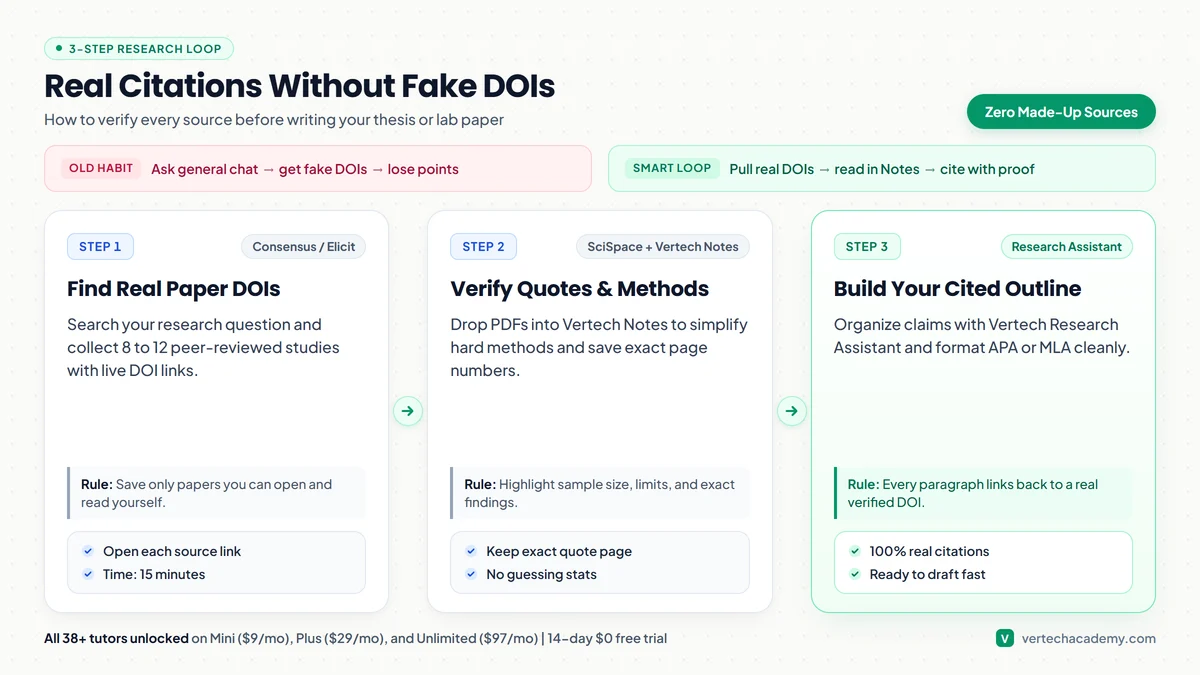
Even the best academic search tools occasionally link to a study whose abstract sounds helpful until you check the actual sample group or year. Follow this 3-step check before any reference enters your bibliography:
Click the Live DOI Link First
Confirm the author names, publication year, journal title, and page numbers on the publisher's page or Google Scholar before saving anything.
Read Methods and Discussion Yourself
Check who was studied and what failed. A tiny 12-person pilot study cannot prove a broad thesis claim.
Format Cleanly With One Click
Drop your verified DOI details into our free Citation Generator for spotless APA 7, MLA 9, or Chicago references.
Four Safe Literature Review Prompts
Once you pull real papers from Consensus or Elicit, paste the verified abstracts into Vertech Notes Studio or our Research Assistant and use these four prompts to organize your argument. Then format every verified reference with our free Citation Generator.
Guessing Citations vs. Verified Research
Blind Chatbot Citation Roulette
- •Asking a standard chatbot for 10 APA references from memory without live search.
- •Citing a study based on a two-sentence AI blurb without opening the PDF.
- •Listing papers one by one instead of grouping agreements and gaps by theme.
- •Skipping manual DOI click checks right before submitting a thesis draft.
The Verified Literature Pipeline
- •Finding real peer-reviewed studies in Consensus, Elicit, or Perplexity Academic.
- •Saving abstracts and methods notes inside Vertech Notes Studio.
- •Mapping themes and counterarguments with Research Assistant.
- •Building clean APA 7 or MLA 9 entries in Citation Generator.
Organize Every Paper in One Place
Finding PDFs is only half the battle. Turning twenty dense studies into a clean, well-argued literature review is where Vertech Notes Studio and our Research Assistant save you hours. Instead of juggling dozens of messy browser tabs, you keep every abstract, limitation note, and thesis counterargument in one organized workspace.
Vertech offers Mini ($9/mo), Plus ($29/mo), and Unlimited ($97/mo). Every plan includes all 38+ tutors unlocked, a 14-day $0 free trial, a Day-11 reminder before billing begins, and a 60-day money-back guarantee.
Find Real DOIs, Synthesize Without Ghostwriting
Use Consensus or Elicit to discover real studies, verify every DOI, and organize your literature review inside Vertech Notes and Research Assistant. Try all 38+ tutors free for 14 days ($0 due today, Day-11 reminder, 60-day guarantee).
Related Research & Citation Tools
- Notes & PDFs: Vertech 13-Source Notes Studio
- Free Citations: APA 7 & MLA 9 Citation Generator
- Thesis Coach: Vertech Research Assistant
- Paper Ethics: Use AI on Research Papers Without Plagiarizing
- Citation Data: 2026 AI Accuracy & Citation Benchmark
Frequently Asked Questions
Which AI research tool is best for finding real DOIs without hallucinations? ▾
Should I pay for Elicit ($12/mo) or Consensus ($11.99/mo) for a thesis? ▾
When is SciSpace better than Perplexity Pro? ▾
Can I cite an AI summary directly in my literature review? ▾
What would you like to do next?
What are you trying to solve right now?
Pick your bottleneck to compare 2026 pricing caps, free student promos, or test our matched AI coach.
Claim free student promos first—never stack two $20/mo chatbots.
Verify your .edu email for Google AI Pro (12 months free) or Perplexity Education ($10/mo), then pair it with our Step-by-Step study prompts so AI quizzes you instead of writing generic summaries.
Compare Deep-Dive Guides (Save $15–$20/mo):