



[3D Chegg, Quizlet, Course Hero icons with “Worth It?” label comparing answers and memorization tools.]
Short answer: all three can be worth it. But only if you match the tool to the right job.
Chegg is for textbook problems. Quizlet is for memorizing. Course Hero is for the rare case where someone uploaded a study guide for your exact class.
If that's your problem, pay them.
If your problem is understanding the material so you can use it on the test, none of them will help you. That's a different fight.
Stick with us till the end. We've got something for that.
Now let's actually break it down.
The Study Subscription Era
Online study tools have exploded over the past decade. Textbook rentals. Flashcard apps. Entire libraries of "homework solutions" sitting one click away.
Paying for help is normal now. Studying stopped being something you did, and turned into something you bought.
"Study subscriptions" are now the default way students try to survive a hard semester. Chegg, Quizlet Plus, and Course Hero have all built billion-dollar businesses on the same promise. Pay us. The work gets easier.
Whether the work also gets learned is a different question.
That's what this article is about.
We've used all three. We test prompts on them every week as part of building Vertech Academy. So this isn't a generic SEO listicle. It's a real comparison.
1) Chegg Study
Chegg is the grandfather of paid homework help. It started in 2005 renting textbooks. Then it pivoted to "ask any question, get a step-by-step answer." That's the model that built the category.
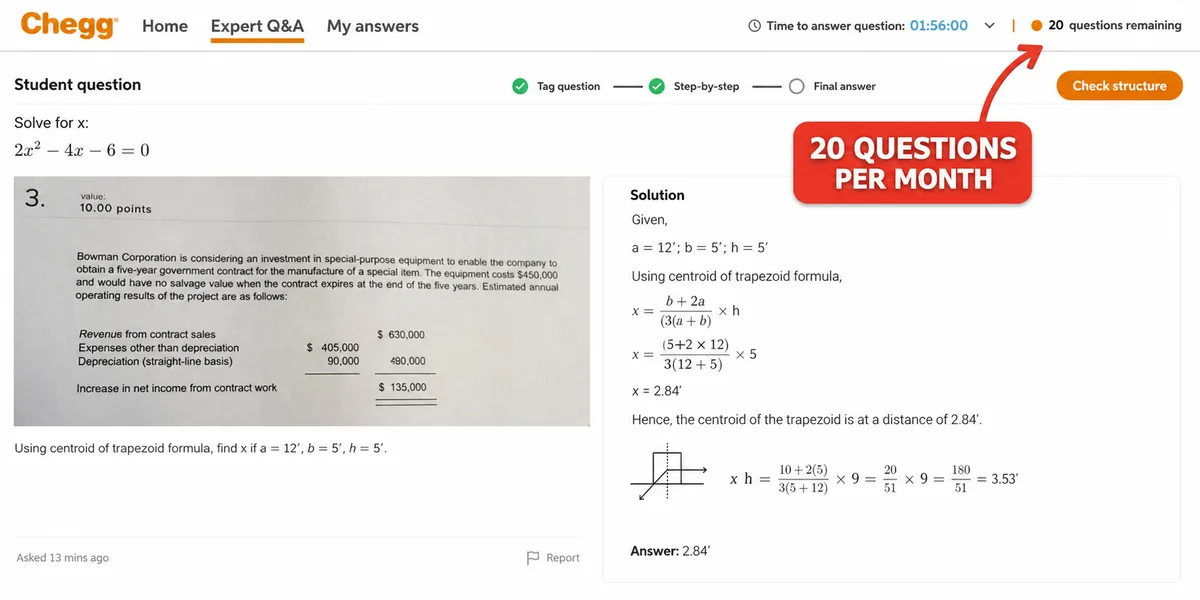
There are two plans. Chegg Study is $15.95/month. You get textbook solutions and 20 Expert Q&A questions per month. Chegg Study Pack is $19.95/month and adds the Math Solver and the Writing tool on top.
Now the messy part.
Chegg's reputation among real students is rough. It sits at 1.2/5 on SiteJabber and 2.3/5 on Trustpilot. Most complaints are about auto-renewal billing, wrong answers, and how hard it is to cancel. That's the public scoreboard. Not us being mean.
There's a bigger pattern in how students use it. A 2023 Forbes survey of 52 college students found that 48 of them admitted to using Chegg to cheat. Forty-eight out of fifty-two.
That's not really Chegg's fault. When you sell answers, students will copy answers. But it tells you something about the gravity of the product. The default move on Chegg is "find answer, paste answer." Fighting that takes real discipline.
So here's the honest take.
Chegg is good at one job. If you're stuck on a textbook problem and you want to see a fully worked, step-by-step solution to learn from, it works. The 20-question Q&A cap on the basic plan is fine for that. Where Chegg falls apart is when students treat it as a homework-finishing service instead of a study aid. The product gives you both options. Most students take the easy one.
2) Quizlet Plus
Quizlet started as a high schooler's flashcard project in 2005 and grew into a study app with over 50 million monthly users. For most of its life it was free.
That's no longer really true.
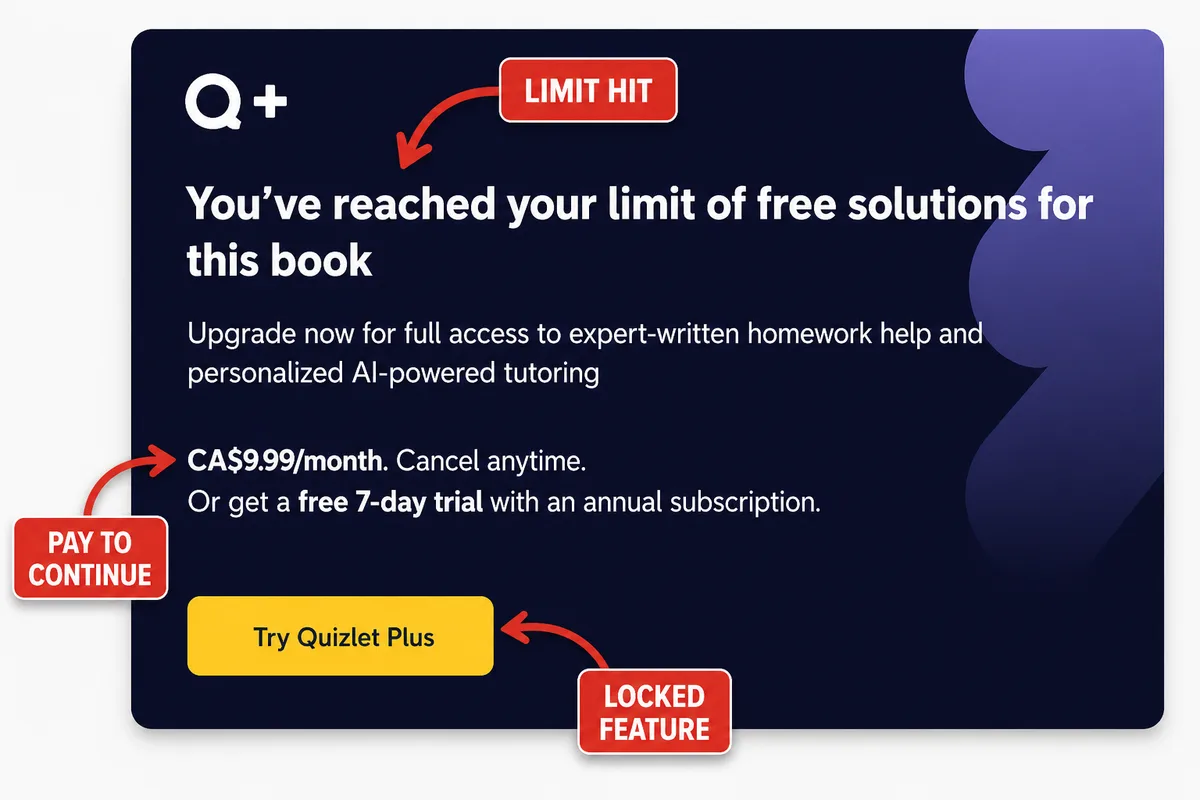
Quizlet Plus is $7.99/month or $35.99/year. There's a higher tier called Plus Unlimited at $44.99/year. The free version still exists. But most of what made Quizlet useful — Learn mode, practice tests, AI features, textbook solutions — has been moved behind the paywall over the past few years.
Now it gets weird.
Even the paid Plus plan has caps. You get 3 practice tests a month, 3 Q&A solutions a month, and 20 rounds of Learn mode a month. Want unlimited? That's the $44.99/year tier.
So "Plus" is a paid plan with limits inside it. That feels like ordering a "large" coffee that comes in a medium cup.
The real issue isn't the price though. It's the model.
Quizlet is, at its core, a memorization machine. Flashcards train recall. Recall is great for vocab, anatomy terms, dates, formulas you need cold. It's almost useless for the stuff students actually struggle with. Understanding why a concept works. Applying a method to a new problem. Writing an argument. Catching your own bad reasoning.
You can memorize 200 flashcards on cellular respiration and still bomb the exam question that asks what would happen if you removed one enzyme.
That's not Quizlet's fault. That's just what flashcards are. But at $36 to $45 a year, the real question is whether memorization is actually the bottleneck in your studying. For most students, it isn't.
3) Course Hero
Course Hero is the one most students sign up for at 2 a.m. the night before a paper is due. It's a database of "study documents" uploaded by other students. Lecture notes. Old homework. Study guides. And yes, sometimes finished assignments.
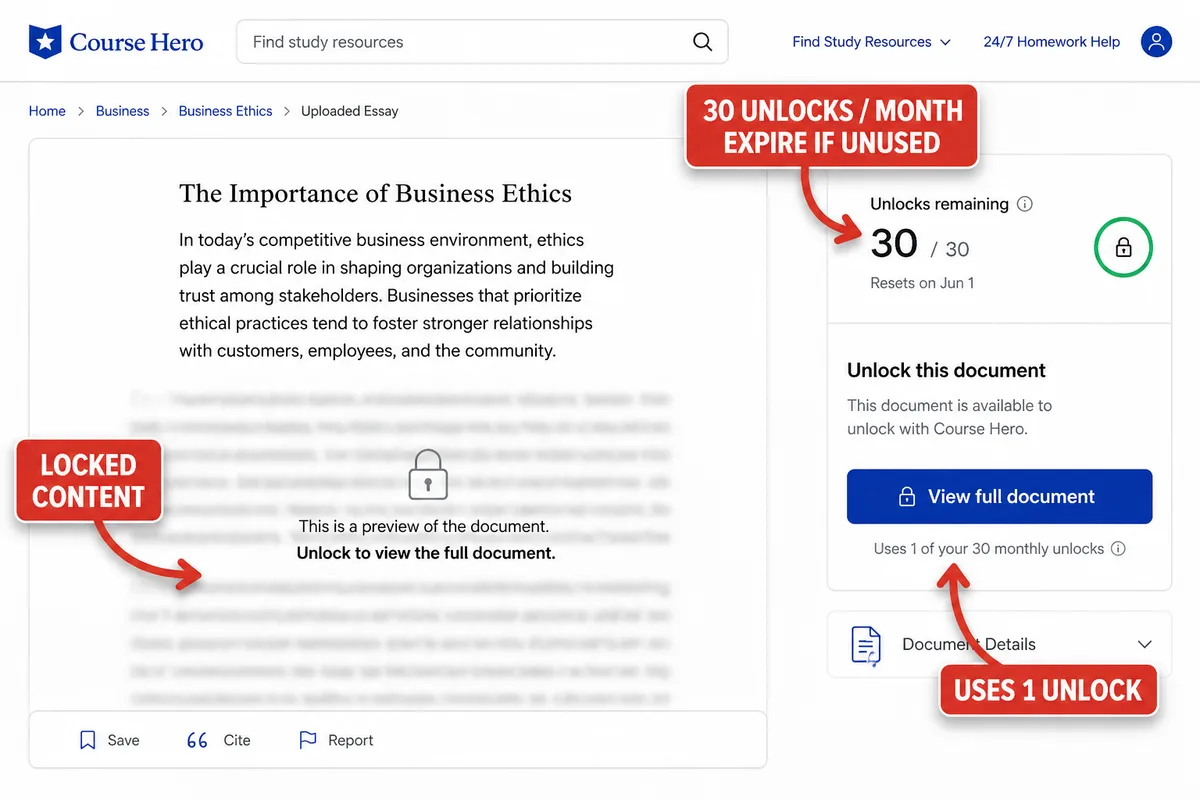
Pricing depends on how long you commit. One month is $39.95. Three months drops to $19.95/month. Twelve months drops to $9.95/month (billed at $119.40 upfront).
Each plan gives you 30 document unlocks and somewhere between 10 and 40 tutor questions a month. Unused unlocks don't roll over. Need an extra tutor question? That's $3 each.
The reviews tell the rest of the story.
Course Hero sits at 2/5 on Trustpilot and 1.3/5 on SiteJabber. G2 reviewers are blunt. Documents are user-uploaded, so quality is all over the place. Some are gold. Many are wrong. A few are just other students' submitted homework, which makes "using" them a fast track to a plagiarism flag.
So here's the honest take.
Course Hero is genuinely useful in one specific case. You're working on an assignment in a course where another student uploaded a strong study guide for the same material. You read that guide as a teaching tool instead of copying from it. When that lines up, it lines up well. When it doesn't, you're paying $40 a month for a library you'll barely use.
So Which One Should You Actually Pay For?
Honest answer: it depends on what you actually need.
- Chegg ($15.95/mo) — Answers: Stuck on textbook problems. Want to see how a worked solution gets from step 1 to step 12.
- Quizlet Plus ($7.99/mo) — Memorization: Bottleneck is memorization. Drug names. Vocab. Pathways. Anything you need in your head, cold.
- Course Hero ($9.95–$39.95/mo) — Examples: Need a worked example for a specific assignment from a specific course at a specific school.
Each of these three has a real use case. If yours matches, go pay for it.
But if you're like most students we talk to, your real problem isn't access to answers. It isn't access to flashcards. It isn't access to documents.
Your real problem is the gap between reading something and being able to use it on a problem you've never seen before.
That's understanding. And none of these three are built to teach it. They're built to deliver content.
The Understanding Gap
This is where we'd usually say "and that's why we built Vertech Academy."
So fine. That's why we built Vertech Academy.
We took the obvious 2026 fact — that ChatGPT, Claude, and Gemini already exist for free — and asked a different question. What if a student's problem isn't access to AI, but knowing how to make AI teach instead of answer?
Because by default, AI does what Chegg does. You ask. It answers. You nod. You move on. You learn nothing.
Vertech is a library of study prompts that turn any free AI tool into something that acts like a tutor. It asks you to explain back. It quizzes you on what you just claimed to understand. It catches the holes. It scaffolds the next step instead of giving you the next answer.
We've tested over 200 prompt variations across Claude, ChatGPT, and Gemini to find the patterns that actually produce understanding instead of dependency.
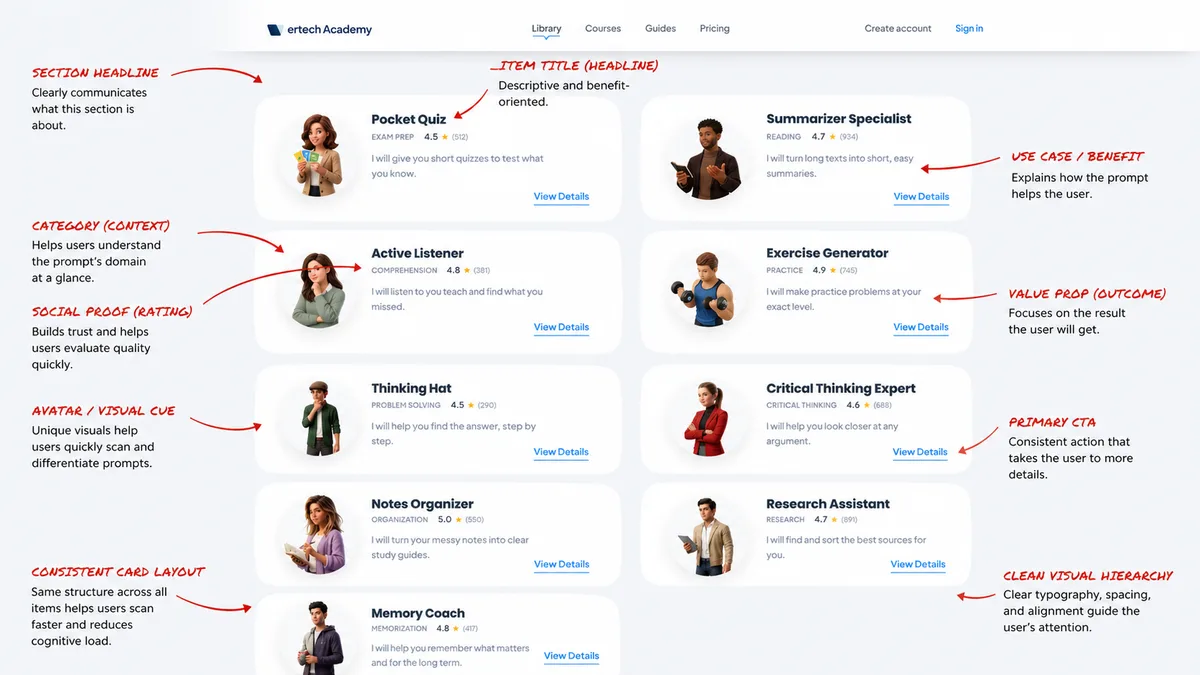
The point isn't that Vertech replaces the other three. If you need a textbook solution, use Chegg. If you need to memorize 400 anatomy terms, use Quizlet. If you need a study guide for ECON 201 at your school, try Course Hero.
But if what you actually need is to understand the material so you can use it on the exam? None of those three will get you there.
That's a different category. That's the one we built.
Before You Pull Out Your Credit Card
There's nothing wrong with paying for help. Tutors are great. Textbooks are great. The right tool at the right moment can save your semester.
What's worth questioning is whether the tool you're about to pay for matches the problem you actually have.
A lot of students sign up for Chegg when what they really needed was a tutor who'd ask them questions back. They sign up for Quizlet when what they really needed was practice applying a concept, not memorizing a definition. They sign up for Course Hero when what they really needed was someone to walk them through why the example works, not hand them the example.
So if you're at the pricing page with your credit card out, ask a different question than "which one is cheapest?"
Ask: what's the actual gap in my studying right now? Is it answers, memorization, examples, or understanding?
Once you know which one it is, the choice gets a lot easier.
And if the answer is understanding, you already know where to go.