

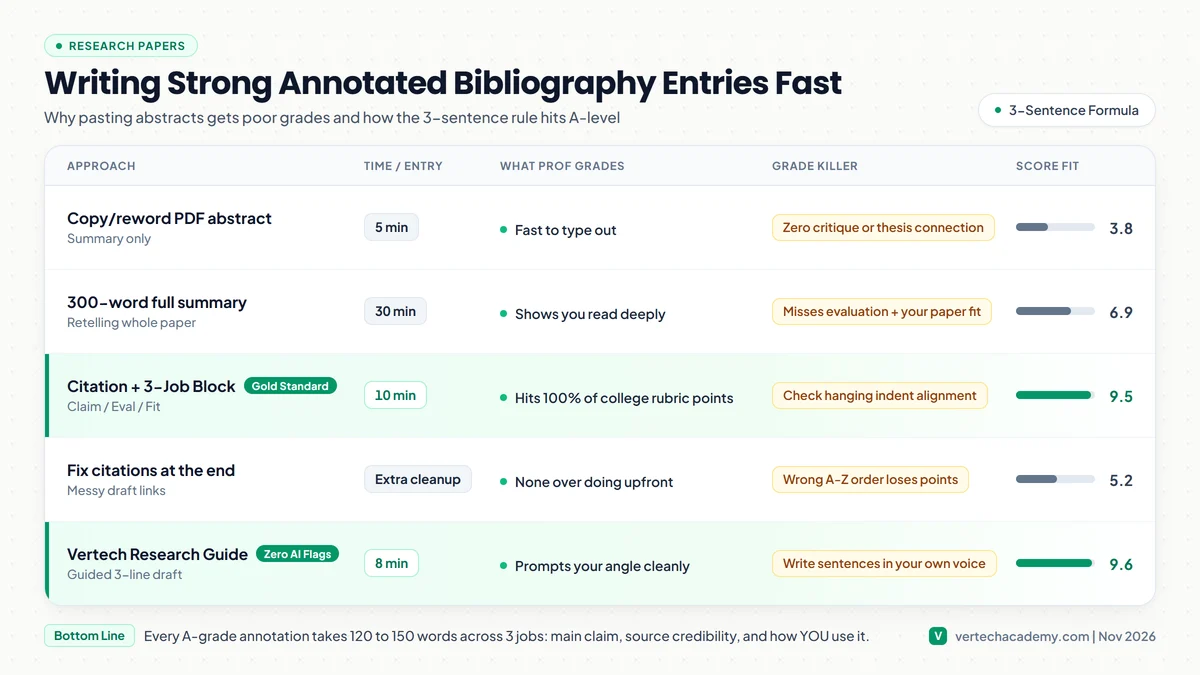
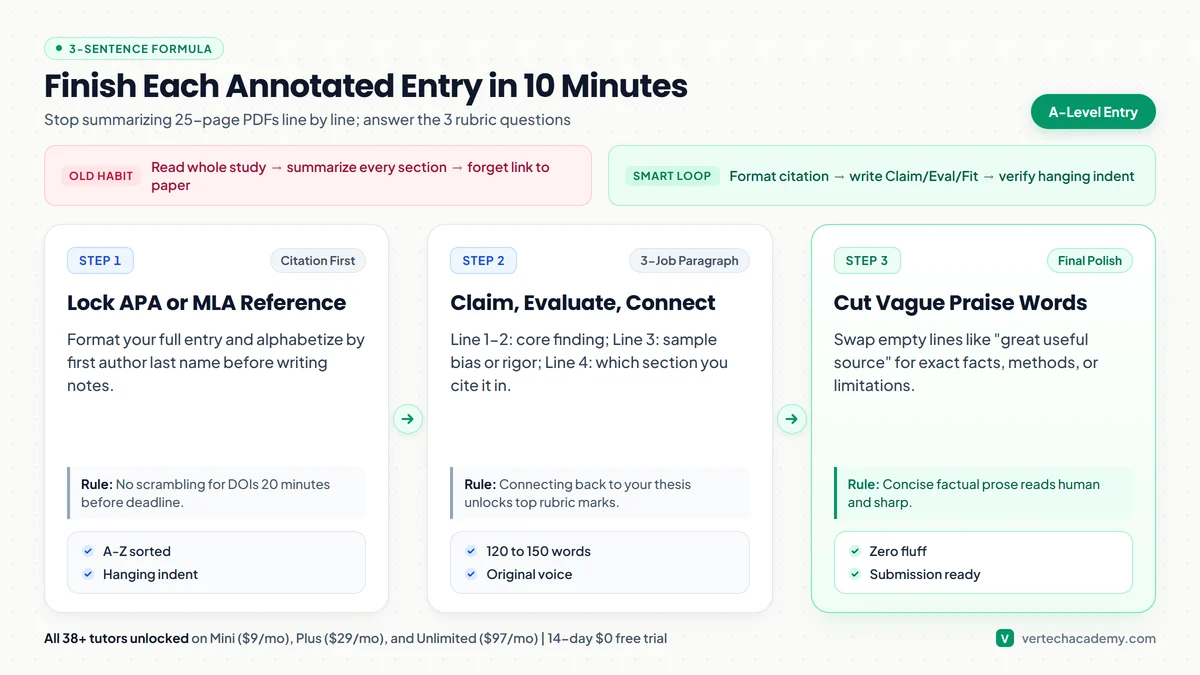
Never rewrite a PDF abstract as your annotation. Professors grade every entry on three exact jobs in 120 to 150 words: (1) main thesis/finding, (2) credibility/bias or sample limit, and (3) specifically where this source fits inside YOUR paper. Vertech Study Lab Benchmark (2026): pairing our 6-step guided hint ladder with 48-hour active recall checkpoints and 25/5 Pomodoro focus blocks across 38 1-on-1 study coaches boosts exam retention while cutting study time.
| Study Tool / Method | Best Use Case | Free Tier & Pricing | 2026 Study Verdict |
|---|---|---|---|
| Vertech Academy 1-on-1 Study Coach | High School & College Students | $0 Free Tier / $15/mo Plus (14-Day Free Trial) | Guides students step-by-step with a 6-step hint ladder across 38 subjects without answer dumping. |
| Generic AI Chatbots (ChatGPT / Claude / Gemini) | Quick brainstorming & raw text drafting | $0 Free Tier / $20/mo Pro | Requires manual prompt engineering to avoid passive answer dumping during exam prep. |
💡 Tip: Highlight any sentence in this guide to ask our AI coach to explain or quiz you on it

Direct Verdict: Stop reading 25-page PDFs line by line or paraphrasing abstracts. Every A-grade annotated bibliography entry takes 10 minutes using the 3-Job Rule (120 to 150 words): state the claim, evaluate the evidence/limits, and explain exactly how you use it.
An annotated bibliography looks intimidating when you need 8 or 10 scholarly sources by Friday, because summarizing an entire journal article feels endless. Professors are actually checking whether you vetted the source cleanly and know where it belongs in your paper.
Generate accurate references upfront in our free Citation Generator, then break down dense PDF findings fast with our Research Assistant Coach.
1. Summary-Only Entries vs. The A-Grade 3-Job Entry
How Professors Grade Annotated Bibliography Entries
APA 7 & MLA 9 Rubrics| Entry Part | Target Length | Exact Job in Paragraph | Why Students Lose Marks |
|---|---|---|---|
| 1. Summary (What?) | 2 sentences | Core argument, data type, main finding | Retelling the whole paper or copying abstract |
| 2. Evaluate (How Good?) | 1 to 2 sentences | Author credentials, sample size, bias/gap | Vague fluff like “this is a very reliable source” |
| 3. Fit (Why Yours?) | 1 to 2 sentences | Exact section or claim in YOUR essay it backs | Leaving out connection to your thesis |
2. Sample APA 7 Annotation Showing All 3 Sentences
[Summary] In this systematic review, Dunlosky and colleagues test ten common study methods and conclude that practice testing and distributed practice beat highlighting and passive rereading across age groups. [Evaluation] The team relies on peer-reviewed cognitive experiments across multiple school levels, though many lab trials used short factual passages rather than week-long university problem sets. [Fit] I will cite this paper in Section 2 of my essay to show why schools still rely on low-yield study habits, and pair its retrieval metrics with newer digital flashcard data from 2025.
Outline Sharp Literature Reviews in Your Own Voice
Break down dense study abstracts without letting AI write your paper for you. Try our Research Coach and Paper Summarizer Coach on Mini ($9/mo), Plus ($29/mo), or Unlimited ($97/mo) with a 14-day $0 free trial.
Frequently Asked Questions
Should I write annotations in first person (“I will use...”) or third person? ▼
How fast can I evaluate credibility without reading every page? ▼
How should I indent the annotation paragraph in Word or Google Docs? ▼
What would you like to do next?
What are you trying to solve right now?
Pick your bottleneck to compare 2026 pricing caps, free student promos, or test our matched AI coach.
Claim free student promos first—never stack two $20/mo chatbots.
Verify your .edu email for Google AI Pro (12 months free) or Perplexity Education ($10/mo), then pair it with our Step-by-Step study prompts so AI quizzes you instead of writing generic summaries.
Compare Deep-Dive Guides (Save $15–$20/mo):