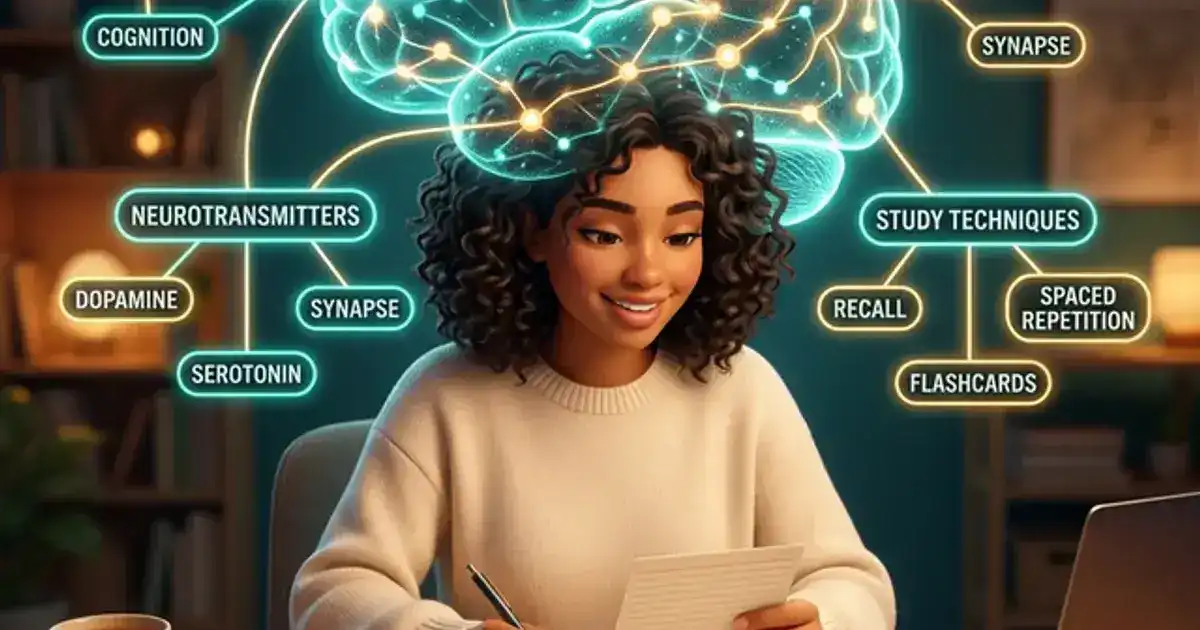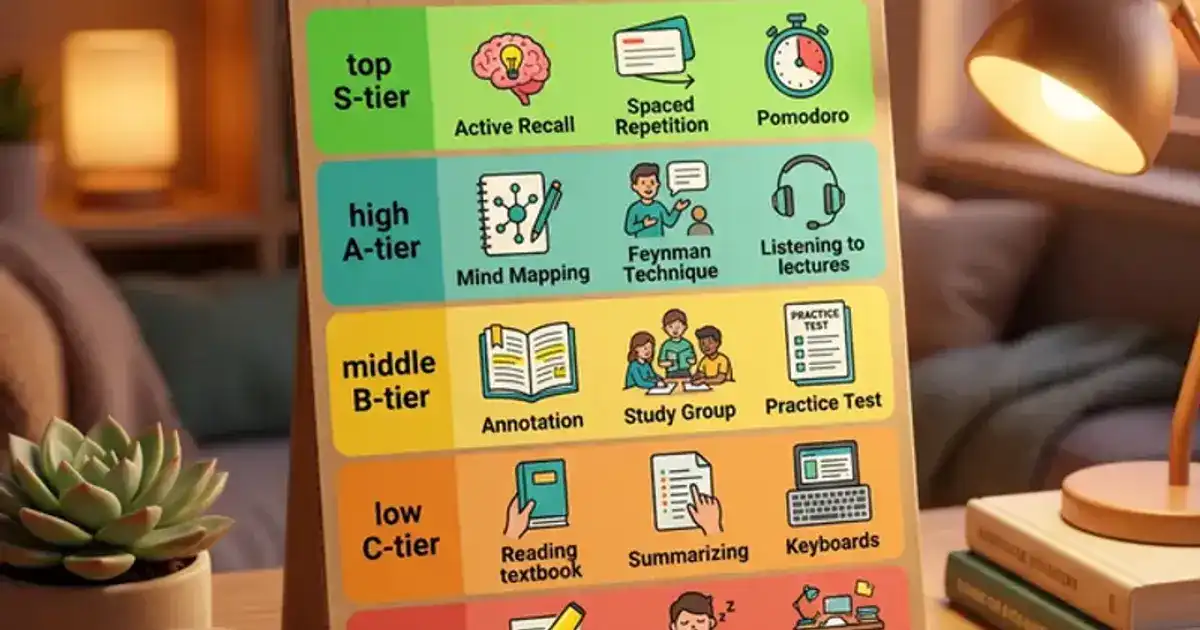
The students who learn fastest are not the ones who study the most hours. They are the ones who use the right techniques at the right time. Decades of cognitive science research have identified 5 methods that dramatically accelerate learning: active recall, spaced repetition, interleaving, the Feynman technique, and elaborative interrogation. Each of these methods is scientifically proven to outperform passive studying like rereading and highlighting. The problem is that most of these techniques are time-consuming to implement manually. AI changes that equation completely.
AI tools can now automate the tedious parts of evidence-based learning: generating practice questions for active recall, scheduling reviews for spaced repetition, creating varied problem sets for interleaving, and testing your explanations with the Feynman technique. This guide shows you how to combine each science-backed learning method with specific AI workflows that cut your study time while doubling retention. These are not productivity hacks or shortcuts. They are the same methods used by medical students, memory champions, and top performers who need to learn massive amounts of information reliably.
Every workflow in this guide uses free AI tools. No subscriptions required. No proprietary software. Just ChatGPT, Google Gemini, NotebookLM, and Perplexity.
Method 1: Active Recall + AI Question Generation
Active recall is the single most effective learning technique ever studied. Instead of rereading your notes, you close them and try to retrieve information from memory. The retrieval process itself strengthens the neural pathways. Students who practice active recall score 50% higher on exams than students who reread the same material for the same amount of time.
The AI workflow: After each lecture or study session, paste your notes into ChatGPT and ask it to generate practice questions at different difficulty levels.
Active recall prompt:
"Based on these notes, create 15 practice
questions: 5 factual recall questions, 5 conceptual understanding questions, and 5 application questions where I
need to use the concept in a new scenario. Do not include the answers yet. I want to test myself first."
After answering the questions yourself, paste your answers back and ask AI to grade them: "Here are my answers. For each one, tell me if I was correct, partially correct, or wrong. For any incorrect or partially correct answers, explain what I missed and why it matters." This creates a complete active recall cycle in 15 minutes that would take an hour to do manually.
Method 2: Spaced Repetition + AI Flashcards
You forget roughly 70% of new information within 24 hours unless you review it. Spaced repetition solves this by scheduling reviews at increasing intervals: 1 day, 3 days, 7 days, 14 days, 30 days. Each review strengthens the memory trace until the information is permanently stored.
The AI workflow: Use AI to generate flashcards from your course materials and import them into Anki or Quizlet for automated spaced repetition scheduling.
Flashcard generation prompt:
"Create 20 spaced repetition flashcards
from this material. Format: Front: [question] | Back: [answer]. Include a mix of: cloze deletions (fill in the
blank), scenario-based questions, and compare/contrast cards. Make each card test one specific concept."
The key insight is consistency, not intensity. 10 minutes of flashcard review every morning is dramatically more effective than a 2-hour cramming session before the exam. The spaced repetition algorithm handles the scheduling. You just show up and do the reviews.
Method 3: Interleaving + AI Problem Sets
Interleaving means mixing different topics or problem types during practice instead of studying one topic at a time (blocked practice). It feels harder in the moment but produces 43% better long-term retention. The challenge is that creating interleaved practice sets manually is extremely tedious.
The AI workflow: Ask AI to create mixed problem sets that force you to identify which concept applies before solving.
Interleaving prompt:
"I am studying chapters 4, 5, and 6 for my [class]
exam. Create a practice set of 12 problems that randomly mixes concepts from all three chapters. Do not label which
chapter each problem comes from. Part of the exercise is identifying which concept to apply. Include the answer key
separately at the end."
This is particularly powerful for math and science courses where the exam mixes problem types. Students who only practice one type at a time often struggle when problems are mixed on the exam because they never practiced the critical skill of identifying which method to use.
Method 4: The Feynman Technique + AI Testing
Richard Feynman, the Nobel Prize-winning physicist, believed that if you cannot explain something simply, you do not understand it well enough. The Feynman Technique has 4 steps: study a concept, explain it as if teaching a child, identify gaps in your explanation, and go back to fill those gaps. AI makes step 3 dramatically more effective.
The AI workflow: Explain a concept to ChatGPT or Claude as if you are teaching it. Then ask the AI to find holes in your explanation.
Feynman technique prompt:
"I am going to explain [concept] to you.
Pretend you are a curious student who has never studied this topic. After my explanation, ask me 5 follow-up
questions that expose any gaps, oversimplifications, or inaccuracies in what I said. Be specific about what I got
wrong or left out."
This is one of the most powerful uses of AI for learning. Instead of explaining to a wall or a study partner who might not catch your mistakes, you have an AI that can identify exactly where your understanding breaks down. The questions AI asks pinpoint the gaps you need to fill before the exam.
Method 5: Elaborative Interrogation + AI Depth
Elaborative interrogation is asking "why" and "how" about everything you learn. Instead of memorizing that "the mitochondria is the powerhouse of the cell," you ask "Why does the cell need a separate structure for energy? How does ATP synthesis actually work? What happens when mitochondria malfunction?" This creates deeper cognitive processing that makes information stick.
The AI workflow: After studying a topic, use AI to generate "why" and "how" questions that push you deeper than surface-level understanding.
Elaborative interrogation prompt:
"I just learned about [topic].
Generate 10 'why' and 'how' questions that go deeper than the surface level. Focus on: why this works the way it
does, how it connects to other concepts I might know, what would happen if this process failed, and what assumptions
are built into this concept."
Answer these questions yourself before checking with AI. The struggle to answer "why" is the learning process. If you can answer these questions, you understand the material at a level that most exam questions cannot stump you on.
Build a complete AI study system around these methods
Our 60-day plan combines all 5 methods into a structured study system with daily AI workflows.
Read the 60-Day Study Plan →A Daily Study Schedule That Uses All 5 Methods
Morning: Spaced repetition review (10 min)
Open Anki or Quizlet and review all due cards. This is pure retrieval practice. Do this first thing, before checking your phone or email.
After class: Active recall + card creation (15 min)
Close your notes. Write down everything you remember from the lecture. Then use AI to generate flashcards from your notes and add them to your spaced repetition deck.
Evening study: Interleaving + Feynman (30 min)
Use AI-generated interleaved problem sets for practice. Then pick the hardest concept from today and explain it to AI using the Feynman technique. Fill gaps based on AI feedback.
Weekend: Elaborative interrogation deep dive (45 min)
Pick the week's most challenging topic. Use elaborative interrogation prompts to go deeper. Connect it to other concepts you have learned. This is the session that builds real understanding.
Common Mistakes That Kill Your Learning Speed
Rereading instead of retrieving. Rereading feels productive because the material feels familiar. But familiarity is not the same as knowledge. You can reread a chapter 5 times and still fail the exam because recognition is not retrieval. Always test yourself before reviewing.
Studying one topic for too long. Blocked practice (studying one topic until you "get it" before moving on) feels efficient but produces worse long-term retention. Interleave topics even when it feels harder. The difficulty is the learning.
Using AI as a crutch instead of a coach. If you read AI's answer without trying to answer first, you are rereading, not recalling. Always attempt the problem, explanation, or question yourself before checking. The struggle is not a sign of failure. It is the actual mechanism of learning.
Cramming before exams instead of spacing throughout. A student who reviews for 15 minutes daily for 30 days will outperform a student who crams for 8 hours the night before. This is not a motivational claim. It is a repeatedly verified finding in cognitive science research. Spacing works. Cramming does not.
Need help preparing for finals specifically?
See our complete guide to using AI for finals prep, including a 3-week countdown plan.
Read: AI Finals Prep Guide →Designing Your Learning Environment for Speed
Science-backed learning methods work best in the right environment. Research shows that where and how you study affects retention as much as which techniques you use. Here are the environmental factors that accelerate learning.
Eliminate multitasking completely. Every time you switch between studying and checking your phone, it takes your brain 23 minutes to fully re-engage. Put your phone in another room during study sessions. Use website blockers like Focus or Freedom during study blocks. This single change can double your effective study time.
Use AI to create study session plans. Before each session, ask ChatGPT: "I have 45 minutes to study [subject]. Based on the Pomodoro technique, create a plan that includes: what to review first, when to take a break, and what to focus on after the break. Prioritize the material I am weakest in." Having a plan eliminates the 10-15 minutes most students waste deciding what to study.
Change locations for different subjects. Studying the same subject in different locations creates multiple memory cues that improve recall during exams. Review your biology flashcards in the library, practice your math problems in a coffee shop, and do your essay writing at your desk. The variation in context strengthens memory encoding.
Study in 25-minute focused blocks. The Pomodoro technique (25 minutes of focused work followed by a 5-minute break) is ideal for learning with AI. Use the 25-minute block for active study (questions, flashcards, practice problems). Use the 5-minute break to check your phone, stretch, or get water. After 4 blocks, take a longer 15-30 minute break.
Tracking Your Learning Progress with AI
You cannot improve what you do not measure. Most students have no idea which topics they understand well and which ones have gaps. AI can create a tracking system that pinpoints exactly where to focus your study time.
Weekly knowledge audit. Once a week, ask ChatGPT: "Quiz me on everything we have covered in [class] so far this semester. Ask 20 questions spanning all topics. After I answer, tell me which topics I am strong in and which ones I need to review more." This takes 15 minutes and gives you a clear picture of your knowledge landscape.
Confidence calibration. Before answering each practice question, rate your confidence: high, medium, or low. After checking your answers, look for two patterns: (1) topics where you were confident but wrong (overconfidence, dangerous for exams), and (2) topics where you were uncertain but right (underconfidence, less studying needed). Ask AI: "Based on these practice results and my confidence ratings, which topics should I prioritize this week?"
Spaced repetition analytics. If you use Anki, check your statistics regularly. The "retention rate" metric tells you if your reviews are too easy (above 95%, increase intervals) or too hard (below 85%, decrease intervals). The goal is an 85-90% retention rate, which maximizes learning speed. Ask AI to interpret your Anki stats: "My retention rate is [X]% with [Y] cards due daily. Is my deck configured optimally, or should I adjust my settings?"
Adapting These Methods for Different Subjects
Each subject responds best to different combinations of these 5 methods. Here is how to weight your approach based on what you are studying.
STEM and math courses: Prioritize interleaving and active recall. Math skills require recognizing which method to apply (interleaving) and then executing it correctly (practice through active recall). Use AI to generate problem sets that mix topics: "Create 15 calculus problems mixing integration techniques from chapters 6, 7, and 8. Do not label which technique each problem requires."
Humanities and social sciences: Prioritize elaborative interrogation and the Feynman technique. These courses test deep understanding and the ability to connect ideas. Ask AI "why" questions about every major concept: "Why did Keynesian economics emerge when it did? How did it differ from classical approaches and why did those approaches fail during the Great Depression?"
Language learning: Prioritize spaced repetition above everything else. Vocabulary, grammar rules, and verb conjugations are ideal for flashcard-based spaced repetition. Create AI-generated flashcards with audio pronunciation guides and use them daily. Even 10 minutes of daily flashcard review produces better results than weekly multi-hour study sessions.
Pre-med and nursing: Use all 5 methods heavily. Medical education requires memorizing massive volumes (spaced repetition), understanding mechanisms (Feynman technique), applying knowledge to patient scenarios (interleaving), and connecting symptoms to diagnoses (elaborative interrogation). Use AI flashcard generators for the memorization component and ChatGPT for clinical scenario practice.
Computer science: Prioritize active recall and interleaving. Programming skills are built through practice, not reading. Use AI to generate coding challenges that mix concepts: "Create 5 Python exercises that each require using at least 2 of these concepts: recursion, list comprehension, dictionary manipulation, and file I/O. Do not tell me which concepts each exercise requires."