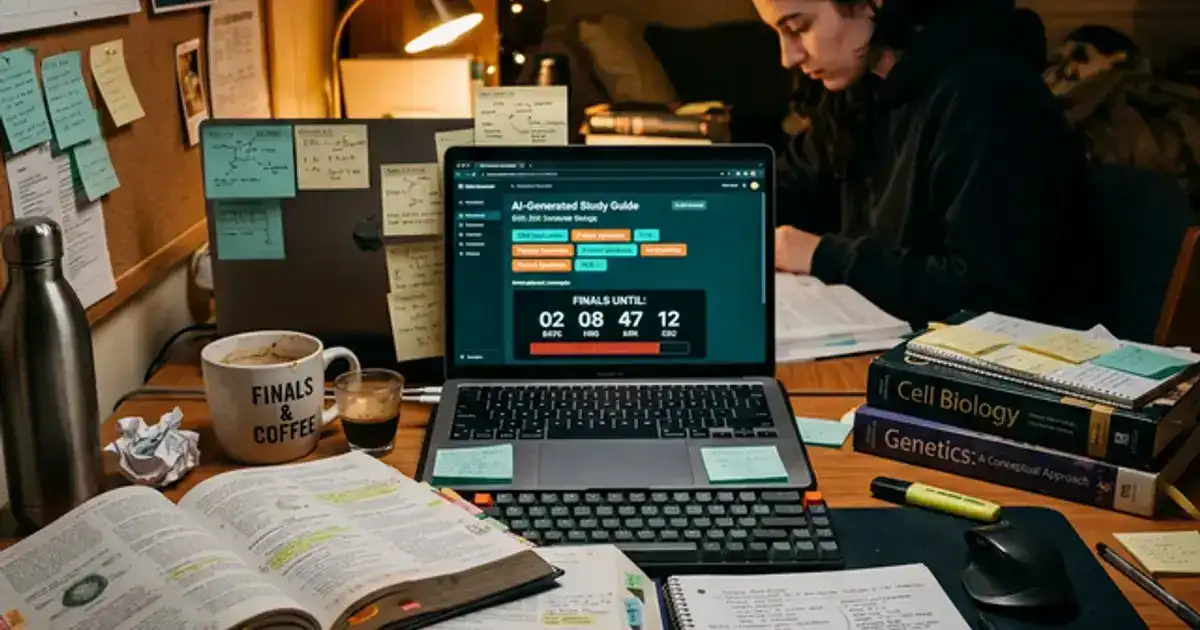
Finals week separates students who have a system from students who panic. AI tools make the difference by turning vague "I should study more" anxiety into a structured, data-driven preparation plan that covers every subject and adapts as you identify weak spots.
This guide covers a complete finals preparation strategy from 3 weeks out through exam day. Every tool is free. Every technique is backed by learning science.
Whether you are well-prepared or behind, there is a strategy here that matches your situation.
The 3-Week Finals Strategy
Week 1: Audit and Organize (3 weeks before)
Gather all course materials into NotebookLM. Use AI to generate comprehensive study guides. Identify gaps by taking diagnostic practice tests. Create a countdown schedule that distributes study time across all exams.
Week 2: Targeted Practice (2 weeks before)
Focus on weak areas identified in Week 1. Use AI-generated practice problems. Create flashcards for remaining memorization. Study with AI as a Socratic tutor for difficult concepts. Take a full-length practice exam for each course.
Week 3: Refine and Rest (finals week)
Review summary sheets and key flashcards. Take final practice exams. Light review only on the day before each exam. Prioritize sleep, nutrition, and mental health. You are consolidating, not learning new material.
Creating Your Finals Study Schedule with AI
Finals schedule prompt:
"I have finals in these courses on these dates: [list courses with dates and times]. For each course, rate my current readiness 1-10: [ratings]. I have [X] study hours available per day. Create a day-by-day study schedule from today until my last final that: (1) prioritizes courses where I am least prepared but have the nearest exam, (2) uses interleaving (studies 2-3 subjects per day rather than one), (3) includes breaks and buffer time for unexpected events, (4) schedules lighter review for the day before each exam."
The readiness rating matters. Being honest about your current preparation level (1 = have not attended class, 10 = could take the exam tomorrow) lets AI allocate time proportionally. A course rated 3 needs four times more study time than a course rated 8. Without this input, AI creates equal schedules for unequal needs.
Daily adjustments. At the end of each study day, update AI: "Today I completed [tasks]. I feel [confident/uncertain] about [topics]. Adjust tomorrow's schedule based on my progress." This adaptive approach prevents the common problem where a study plan becomes irrelevant by day 3 because reality did not match the original estimate.
AI-Generated Practice Exams
Practice exams are the single most effective study technique for finals. They simulate the testing environment, reveal knowledge gaps, and trigger the retrieval practice that strengthens memory.
Practice exam prompt:
"Create a practice final exam for [course] covering chapters [X-Y]. Include: [X] multiple choice questions, [X] short answer questions, and [X] essay questions. Match the difficulty and style of a college-level [introductory/advanced] course. For multiple choice, make the wrong answers plausible (common misconceptions). For essay questions, include a rubric showing what a full-credit answer includes."
The rubric request. Asking AI to provide rubrics for essay questions is the hidden power move. Most students lose points on essays not because they do not know the material, but because they miss required components. Seeing what a full-credit answer includes teaches you how to structure your exam responses for maximum points.
Grade yourself honestly. After completing a practice exam, ask AI: "Here are my answers: [paste]. Grade each answer against the rubric. For incorrect answers, explain what I got wrong and what the correct reasoning is. Calculate my overall score." This brutal honesty about your current level prevents the dangerous "I think I know this" overconfidence that leads to poor exam performance.
AI-Coordinated Study Groups
Study groups are more effective than solo study for many subjects, but poorly organized groups waste time. AI can structure group sessions for maximum efficiency.
Study group coordination prompt:
"We have a study group of [X] people preparing for [course] final on [date]. Each person's weak areas: [list]. Create a 2-hour study session plan that: (1) starts with a 10-question quiz to identify shared weak spots, (2) assigns each person to teach one topic to the group (teaching is the best way to learn), (3) includes a collaborative practice exam in the last 30 minutes."
The teaching method. Research shows that teaching a concept to others produces deeper understanding than any other study method. Assign each group member a topic to teach. The act of organizing the information, anticipating questions, and explaining clearly forces a level of processing that passive review cannot match.
Group practice exams. Use AI to generate a practice exam, then take it together under timed conditions. After completing it, grade each other's answers as a group and discuss the reasoning behind correct answers. This collaborative review reveals misunderstandings you would not catch studying alone because other students explain concepts from different perspectives than your textbook or professor.
Managing Stress and Mental Health During Finals
Finals week is the highest-stress period of the academic year. Your cognitive performance depends directly on how well you manage stress, sleep, and physical health.
Exercise maintains cognitive function. Even 20 minutes of moderate exercise (a brisk walk, a gym session, yoga) improves focus, reduces anxiety, and enhances memory consolidation for up to 2 hours afterward. Schedule a short exercise session before your most challenging study block each day. Students who maintain exercise during finals consistently outperform students who sacrifice exercise for extra study time.
Nutrition affects performance. Your brain consumes 20% of your daily calories. During intensive study periods, eating regular balanced meals (not just coffee and energy drinks) directly affects your ability to concentrate and retain information. Complex carbohydrates, proteins, and healthy fats sustain focus. Sugar and caffeine create spikes and crashes that disrupt sustained study sessions.
Breaks are productive. The Pomodoro technique (25 minutes of study, 5 minutes of break) maintains high-quality focus across long study days. During breaks, step away from your desk completely. Look at something distant to rest your eyes. Move your body. These microbreaks prevent the diminishing returns that make the sixth hour of studying far less productive than the first.
NotebookLM for Comprehensive Review
NotebookLM is the ideal finals companion because it processes all of your course materials in one place: lecture slides, textbook chapters, notes, assignments, and past exams.
Upload everything. At the start of your finals prep, upload all course materials into a NotebookLM notebook for each course. Ask AI to: "Create a comprehensive study guide covering all major topics, key terms, and important concepts from these materials. Organize by topic and indicate which materials cover each topic." This produces a master study guide that synthesizes an entire semester into a reviewable document.
Audio Overviews for passive review. NotebookLM generates podcast-style audio summaries of your materials. Listen to these during commutes, workouts, or meals. This passive review supplements your active study sessions without requiring additional dedicated study time. By finals week, you have heard the material discussed from multiple angles.
Targeted Q&A. When studying a specific topic, ask NotebookLM questions that reference your actual course materials: "Based on the lecture from Week 8 and Chapter 14, what are the key differences between [concept A] and [concept B]?" The answers are grounded in your course materials, not generic AI knowledge, so they match what your professor taught and emphasized.
Want AI flashcards for finals review?
Our flashcard guide covers Quizlet, Anki, and ChatGPT-generated cards with spaced repetition.
Read the Flashcard Guide →Identifying and Fixing Weak Spots
The biggest finals prep mistake is studying what you already know because it feels productive. AI helps you find and focus on what you do not know.
Gap analysis prompt:
"I just took a practice exam for [course] and scored [X]%. Here are the questions I got wrong: [list them]. Analyze what these wrong answers have in common. Is there a specific concept, chapter, or skill I am weak on? Create a focused 2-hour study plan targeting only these weak areas."
This analysis often reveals surprising patterns. You might think you need to review Chapter 5, but the gap analysis shows your mistakes all relate to one specific concept that spans multiple chapters. Targeted study is more efficient than comprehensive re-review because it focuses energy exactly where it is needed.
The 80/20 rule for finals. Roughly 80% of exam questions come from 20% of the material: the concepts your professor emphasized repeatedly, the topics covered in multiple lectures, the ideas that appeared on assignments and midterms. Ask AI: "Based on these lecture slides and assignments, what were the most frequently discussed concepts? These are likely to appear on the final." Study those concepts first, then use remaining time for the long tail of less-emphasized material.
The Day Before and Day Of
Day before: light review only. Your brain needs time to consolidate what you have studied. Intensive studying the night before actually interferes with this consolidation process. Do a 30-60 minute review of your summary sheet and key flashcards, then stop. Spend the rest of the evening doing something relaxing.
Summary sheet prompt:
"Create a one-page summary sheet for [course] covering: (1) the 10 most important concepts, (2) key formulas or frameworks, (3) the most likely essay topics based on course emphasis. Format it as a cheat sheet I can review in 10 minutes."
Sleep is non-negotiable. Research consistently shows that 7-8 hours of sleep the night before an exam improves performance more than the extra hours of studying you would get from an all-nighter. Sleep consolidates memories, improves focus, and reduces anxiety. An all-nighter trades long-term memory consolidation for short-term cramming that fades during the exam itself.
Day of: morning routine. Wake up early enough to eat breakfast, review your summary sheet once, and arrive at the exam room early. Being rushed increases anxiety and impairs performance. Use a simple breathing exercise (4 seconds in, 4 seconds hold, 4 seconds out) if you feel anxious before the exam starts. Avoid discussing material with anxious classmates right before the exam, as this often creates unnecessary doubt about things you already know.
During the exam. Start with the questions you know best. This builds confidence and ensures you do not lose easy points by running out of time. For essay questions, spend 2-3 minutes outlining before writing. For multiple choice, eliminate obviously wrong answers first. If you are stuck, move on and return later with fresh eyes. Watch your time allocation: divide the total time by the number of questions to set a per-question pace, and check your progress at the halfway mark.
Post-exam reflection. After each final, spend 10 minutes noting what went well and what surprised you. This data improves your preparation strategy for future exams. Ask ChatGPT: "Here is what I studied and how I studied for my [course] final. Here is what actually appeared on the exam. What should I adjust for next semester's exams based on this gap between preparation and reality?" This meta-learning compounds over your college career, making each semester's finals prep more efficient than the last.
If You Are Already Behind
Not everyone starts finals prep 3 weeks early. If you are reading this with days until your exam, here is the crisis strategy:
Last-minute study prompt:
"I have [X] hours before my [course] final. I have not studied much. Give me: (1) the 10 most important concepts that are most likely to be tested, (2) a focused study plan that maximizes my score in the time I have, (3) the most common exam question formats for this type of course. Prioritize the material with the highest expected value: concepts worth the most points with the least study time required."
Triage ruthlessly. You cannot learn everything. Focus on the highest-value topics: concepts your professor repeated multiple times, topics from the midterm that will reappear, and material covered in recent lectures (professors often emphasize final-exam material in the last weeks of class).
Even in crisis mode, sleep. If you have 12 hours before the exam, study for 8 and sleep for 4. This produces better performance than studying for 12 straight hours. Your brain needs sleep to move information from short-term to accessible memory. Without sleep, you forget half of what you crammed by the time the exam starts.
Start your finals plan today
Paste the finals schedule prompt into ChatGPT with your actual exam dates and readiness ratings. In 5 minutes, you will have a daily study plan from now until your last final. Knowing exactly what to study and when eliminates the anxiety that makes finals week so stressful.