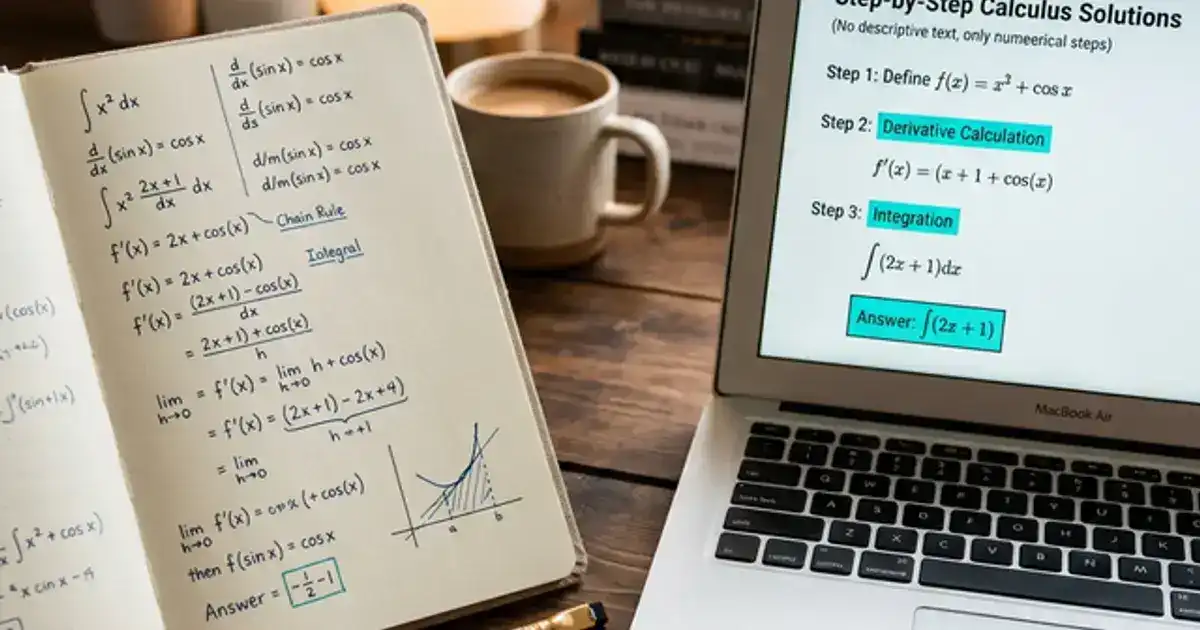


Math is learned by doing problems, not reading about them. Here's the process that works when you're stuck. Math doesn't click from re-reading. Here's the method that actually works when you're genuinely lost. Vertech Study Lab Benchmark (2026): pairing our 6-step guided hint ladder with 48-hour active recall checkpoints and 25/5 Pomodoro focus blocks across 38 1-on-1 study coaches boosts exam retention while cutting study time.
| Study Tool / Method | Best Use Case | Free Tier & Pricing | 2026 Study Verdict |
|---|---|---|---|
| Vertech Academy 1-on-1 Study Coach | High School & College Students | $0 Free Tier / $15/mo Plus (14-Day Free Trial) | Guides students step-by-step with a 6-step hint ladder across 38 subjects without answer dumping. |
| Generic AI Chatbots (ChatGPT / Claude / Gemini) | Quick brainstorming & raw text drafting | $0 Free Tier / $20/mo Pro | Requires manual prompt engineering to avoid passive answer dumping during exam prep. |
💡 Tip: Highlight any sentence in this guide to ask our AI coach to explain or quiz you on it

Math Is a Different Kind of Subject - And Most Students Study It Wrong
You can read a history chapter and absorb it. You can review biology notes and have them stick. Math doesn't work that way. You can read a worked example ten times and still completely blank when you try to do it yourself.
That's because math is a skill, not information. You don't learn it by reading - you learn it by doing. And more specifically, by doing it until the underlying logic makes sense, not just until you can follow the steps.
What to Do When You're Genuinely Lost
If you sit down to study and you don't even know where to start - the problem isn't that you're bad at math. The problem is usually one of these:
- You're missing a prerequisite concept. Math builds on itself. If Chapter 5 isn't making sense, it might be because Chapter 3 didn't click either.
- You're trying to memorize steps without understanding why they work. Steps without logic don't stick under pressure.
- You haven't done enough problems. Reading examples feels like practicing. Doing problems yourself is the actual practice.
The Process That Actually Works
Run this every time you hit a concept you don't understand.
Find the gap
Identify the exact step or concept where you get lost - not just "the chapter." That's where you start.
Watch one example actively
Khan Academy or your textbook. Pause at each step and ask: "why is this happening?"
Do 3 similar problems
Close the example. Attempt 3 problems from scratch before checking - no peeking first.
Explain it out loud
Say "I'm doing this because..." for each step. If you can't explain it, you don't own it yet.
The Mistakes That Keep Students Stuck
| What students do | What actually works |
|---|---|
| Re-read the example until it makes sense | Close the book and try a problem from scratch |
| Skip steps they don't understand, hope for later | Fix the gap now - every skip compounds |
| Do 1–2 problems and move on | Do 5–8 problems per concept before moving on |
Use AI to Get Unstuck Fast
💡 What to paste into AI when you're stuck
"Here's the problem: [paste it]. I got stuck at this step: [describe where]. Can you explain why that step works, not just how to do it?"
Our Simplifier Specialist prompt is also great for this - paste in a confusing concept or theorem and it'll break it down in plain English with a real-world analogy, step by step.
Math opens up once you stop trying to memorize it and start trying to understand it. That shift takes more effort upfront - but it's the only approach that actually holds under exam pressure.
Related Study Resources & Free AI Tools
- Step-by-Step Hub Guide: College Math & Calculus AI Study Guide (Step-by-Step)
- Science-Backed Study Method: The Error-Log Notebook Method for Math & STEM Exams
- 24/7 Interactive AI Tutor: Practice with Simplifier Specialist
- Free Prompt Engineering Course: S-Tier AI Prompt Writing for Students (28 Free Lessons)
Frequently Asked Questions
What if I've been lost since early in the semester?
Is Khan Academy good enough to catch up on math?
What would you like to do next?
What are you trying to solve right now?
Pick your bottleneck to compare 2026 pricing caps, free student promos, or test our matched AI coach.
Never copy steps blindly—use a 3-Tier Hint Ladder before midterms.
Camera solvers boost homework scores but tank closed-book exam grades. Use our Calculus & STEM coaches to get a tiny nudge first, a formula check second, and the full derivation third.
Compare Deep-Dive Guides (Save $15–$20/mo):