Introduction
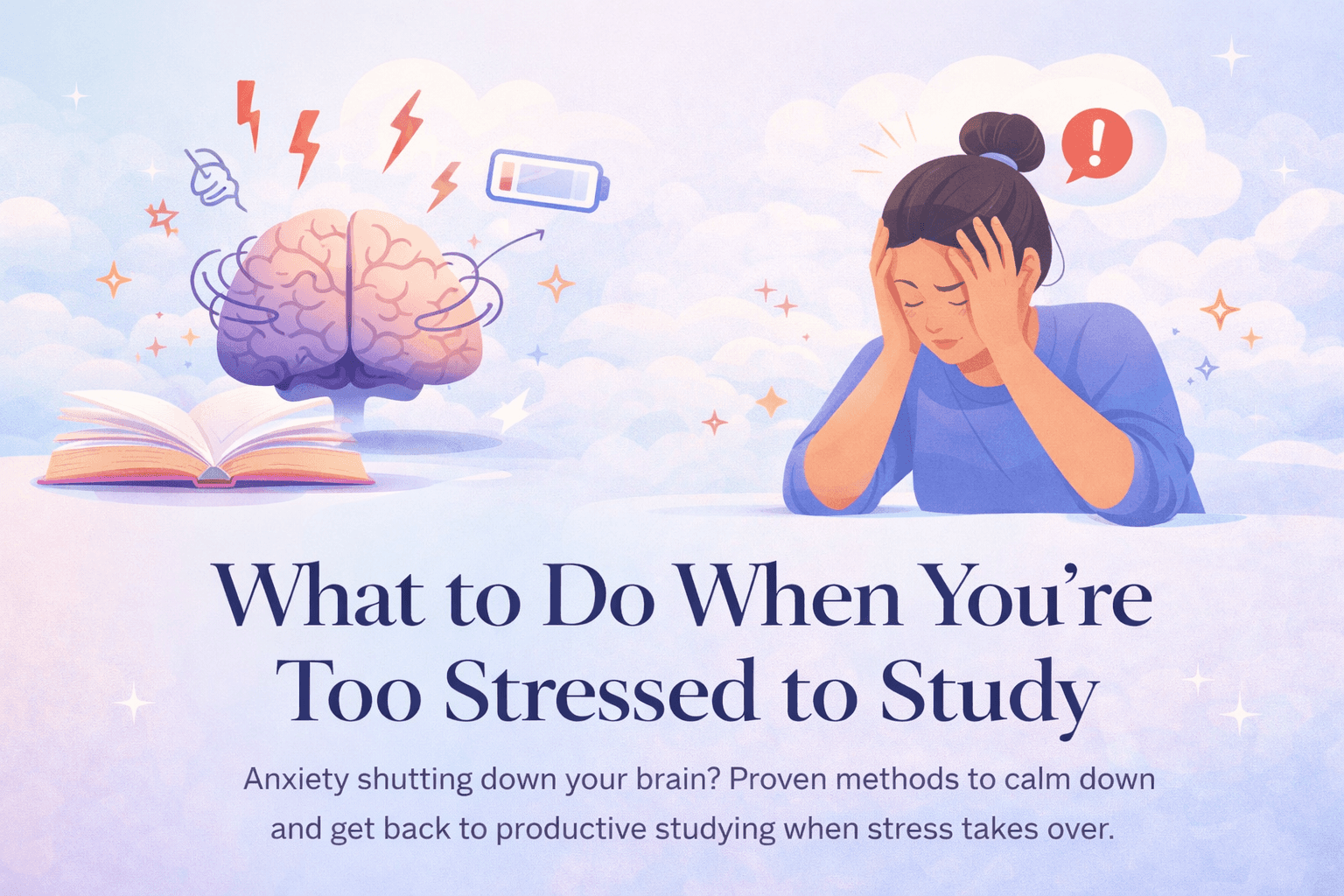
We have all been there. You sit down to study with good intentions. You have your books open, your laptop charged, and a coffee on the desk. But as soon as you look at the material, your chest tightens. The words on the page start to blur together. You read the same sentence three times, but it just won't stick.
This is the "stress freeze." It is a terrible feeling because it creates a vicious cycle. You are stressed because you have work to do, but you cannot do the work because you are stressed. Suddenly, you find yourself scrolling through your phone or cleaning your room just to escape the pressure.
Here is the most important thing you need to know right now: You are not lazy, and you are not broken.
This reaction is a biological survival mechanism. Your brain has mistaken your chemistry exam for a tiger in the bushes. It is prioritizing survival over calculus. The good news is that you can hack this system. You can signal to your body that you are safe, calm down your nervous system, and get your brain back online.
In this guide, we will cover:
Why stress physically blocks your ability to learn (and why it is not your fault).
Immediate physical techniques to lower your heart rate in under 5 minutes.
Psychological tricks to break through the "paralysis" of starting.
How to use smart tools to reduce the mental load when you feel overwhelmed.
Let's get you back in control.
Why Stress Makes Your Brain Go Blank
To solve the problem, we first have to understand what is happening under the hood. When you feel overwhelmed, your body releases a hormone called cortisol. This is often called the "stress hormone."
In small doses, cortisol is helpful. It wakes you up and helps you focus. But when you are panicking about a deadline, your cortisol levels spike too high. According to research from the National Institutes of Health (NIH), high levels of acute stress can actually impair memory retrieval.
Think of your brain like a computer. Your working memory is the RAM (Random Access Memory). It handles the information you are using right now. When you are stressed, your brain opens a massive program called "SURVIVAL." This program uses up 90% of your RAM. That leaves very little processing power for studying history or solving math equations.
That is why you can stare at a textbook for an hour and learn nothing. Your hardware is fine, but your system is overheated. To fix this, we do not need to study harder. We need to close the "SURVIVAL" program so your brain can run smoothly again.
Immediate Triage: Calming Down in 5 Minutes
If you are currently in a state of panic, do not try to study. It is a waste of time. You need to physically reset your nervous system first. You cannot "think" your way out of a panic response because the thinking part of your brain is offline. You have to use your body to send a signal to your brain.
The Box Breathing Technique
This is a method used by athletes and high-pressure professionals to regain control immediately. It works by regulating your breathing, which forces your heart rate to slow down.
How to do it:
Inhale slowly through your nose for 4 seconds.
Hold that breath for 4 seconds.
Exhale slowly through your mouth for 4 seconds.
Hold your lungs empty for 4 seconds.
Repeat this cycle four times.
According to Healthline, this technique helps regulate the autonomic nervous system. It creates a physical shift from "fight or flight" to "rest and digest."
The "Grounding" Exercise
If your mind is racing with "what if" thoughts (e.g., What if I fail? What if I never get into college?), you need to pull your focus back to the present moment.
Try the 5-4-3-2-1 Technique:
Identify 5 things you can see (the lamp, your pen, a crack in the wall).
Identify 4 things you can touch (the texture of your jeans, the cool desk surface).
Identify 3 things you can hear (traffic outside, the hum of your computer).
Identify 2 things you can smell (coffee, fresh air).
Identify 1 thing you can taste (gum, water).
This forces your brain to process sensory data from the "now," which breaks the loop of worrying about the future.
Resetting Your Environment
Once your body is calmer, look at your surroundings. A chaotic environment often leads to a chaotic mind. If your desk is covered in old wrappers, loose papers, and three different textbooks, your brain sees that as a threat. It is too much visual information to process.
Clear the Decks: Take two minutes to clear everything off your desk except the one thing you are working on. Put your phone in another room. Close all the tabs on your browser that aren't related to your current task.
Lighting and Sound: Harsh, fluorescent lighting can sometimes increase anxiety. If you can, switch to a warmer lamp light. For sound, avoid lyrical music, as words can distract your brain's language center. Instead, try "brown noise" or "pink noise." These are deeper and softer than white noise and are excellent for drowning out distractions without being annoying.
We talk more about how your environment affects your anxiety in our guide on what to do the night before a big test. The key takeaway is that your physical space sets the tone for your mental space.
Breaking the Paralysis: The "Just Five Minutes" Rule
Now that you are calm and your space is ready, you face the biggest hurdle: starting.
This is where "task paralysis" kicks in. You look at your to-do list, see "Study for Final Exam," and it feels like climbing a mountain. Your brain assumes it will be painful and boring, so it refuses to take the first step.
The trick is to lower the bar. Do not commit to studying for three hours. Do not even commit to finishing one chapter.
Commit to working for just five minutes.
Tell yourself: "I am going to open my book and read for five minutes. If I want to stop after that, I can."
This works because five minutes is not scary. Your brain knows it can handle five minutes of anything. But a magical thing usually happens once you start. The anxiety of anticipating the work is almost always worse than the work itself. Once you break that initial friction, you will likely find that it is not as bad as you feared, and you will keep going.
We explore this psychological trick deeply in our post on why you keep putting off homework. The goal is to prove to your brain that the task is safe and manageable.
The "Stupid Small" Step
If five minutes still feels like too much, make the step "stupid small."
Instead of "Write the essay," make the goal "Open a blank document."
Instead of "Do the math problem," make the goal "Write down the numbers."
Action kills anxiety. Any action, no matter how small, begins to chip away at the wall of stress.
Using Tools to Reduce Cognitive Load
Sometimes, the stress comes from the material itself. You might be staring at a complex physics problem or a dense literature passage, and you just don't understand it. This confusion fuels your panic.
This is a concept called Cognitive Load. Every brain has a limit on how much new, complex information it can hold at once. When you exceed that limit, you get frustrated and shut down.
In these moments, it is smart to use tools to "offload" some of that mental weight. You don't have to struggle in silence.
Leverage AI for clarity
If a concept is confusing you, use an AI tool to simplify it. Ask for an analogy. Ask for a breakdown.
For example, our Thinking Hat prompt is designed specifically for this moment. It doesn't just give you the answer (which doesn't help you learn). Instead, it acts like a patient tutor sitting next to you. It asks you guided questions to help you break the big, scary problem into small, solvable pieces.
Using a tool like this reduces the overwhelm. It turns a wall of text into a conversation. When you feel like you have a partner in the process, the stress levels drop significantly.
Remember, the goal of studying is understanding, not suffering. If you are stuck, get help.
Physical Habits That Fight Brain Fog
We often treat our brains like machines that exist separately from our bodies. But your brain is an organ. It needs fuel, water, and rest to function. If you are stressed and "foggy," check your biology.
Hydration is Focus Fuel
Your brain is about 75% water. Even mild dehydration can lead to lower attention spans and increased feelings of anxiety. If you have been drinking nothing but energy drinks and coffee, you are likely dehydrated. Drink a large glass of water. It is the cheapest cognitive enhancer available.
Move to Remove Cortisol
Stress hormones accumulate in your body. One of the fastest ways to process them is through movement. You do not need to run a marathon.
Do 10 jumping jacks.
Stretch your arms up to the ceiling.
Walk around the block.
This increases blood flow to the brain and physically releases tension.
The Sleep Connection
This is the one nobody wants to hear, but it is the most critical. If you are pulling an all-nighter, your stress levels will naturally be higher. Lack of sleep increases anxiety and decreases emotional regulation. According to the Sleep Foundation, sleep-deprived students are significantly more likely to perceive tasks as more difficult than they actually are.
If it is 2:00 AM and you are crying over your chemistry notes, the most productive thing you can do is sleep. You will learn more in 30 minutes with a rested brain than in 4 hours with an exhausted one. You can read more about the biology of memory and rest in our article on how to remember what you study.
When to Call It Quits
There is a difference between "giving up" and a "strategic retreat."
Sometimes, pushing through the stress is the wrong move. If you have tried the breathing exercises, cleared your desk, and stared at the page for 30 minutes without reading a single word, you have hit the Law of Diminishing Returns.
This means that for every extra hour you put in, you are getting less and less value out. In fact, you might be doing negative work by confusing yourself further or associating studying with pain.
The Reset Break
If you are at this point, you need a full reset.
Step away completely. Do not sit at your desk on your phone. Leave the room.
Change your state. Take a shower. Eat a snack. Call a friend (but don't talk about the test).
Set a return time. Tell yourself, "I am taking a 30-minute break. I will return at 4:00 PM."
This permission to stop relieves the pressure. Often, when you come back after a real break, the mental block has dissolved.
Conclusion
Stress is not a sign that you are not smart enough. It is just a sign that your brain cares about the outcome, but it has gone into overdrive.
You cannot force your brain to learn when it is in panic mode. You have to treat the anxiety first.
Here are your key takeaways to beat the stress:
Validate the feeling: It is biology, not laziness.
Breathe first: Use the Box Breathing technique (4-4-4-4) to physically lower your heart rate.
Start small: Use the 5-Minute Rule to break the paralysis.
Offload the pressure: Use tools like the Thinking Hat to break complex problems into small steps.
Respect your body: Drink water and recognize when you need a strategic break.
Next time you feel that chest-tightening panic, don't try to fight it with willpower. Stop. Breathe. Reset. You have handled difficult things before, and you can handle this too. Just take it one breath, and one problem, at a time.