Introduction
We have all been there. You are sitting at your desk with a textbook open. You read the same sentence three times, but you have no idea what it said. Your phone looks incredibly interesting. Even cleaning your room seems like a better option than turning the page.
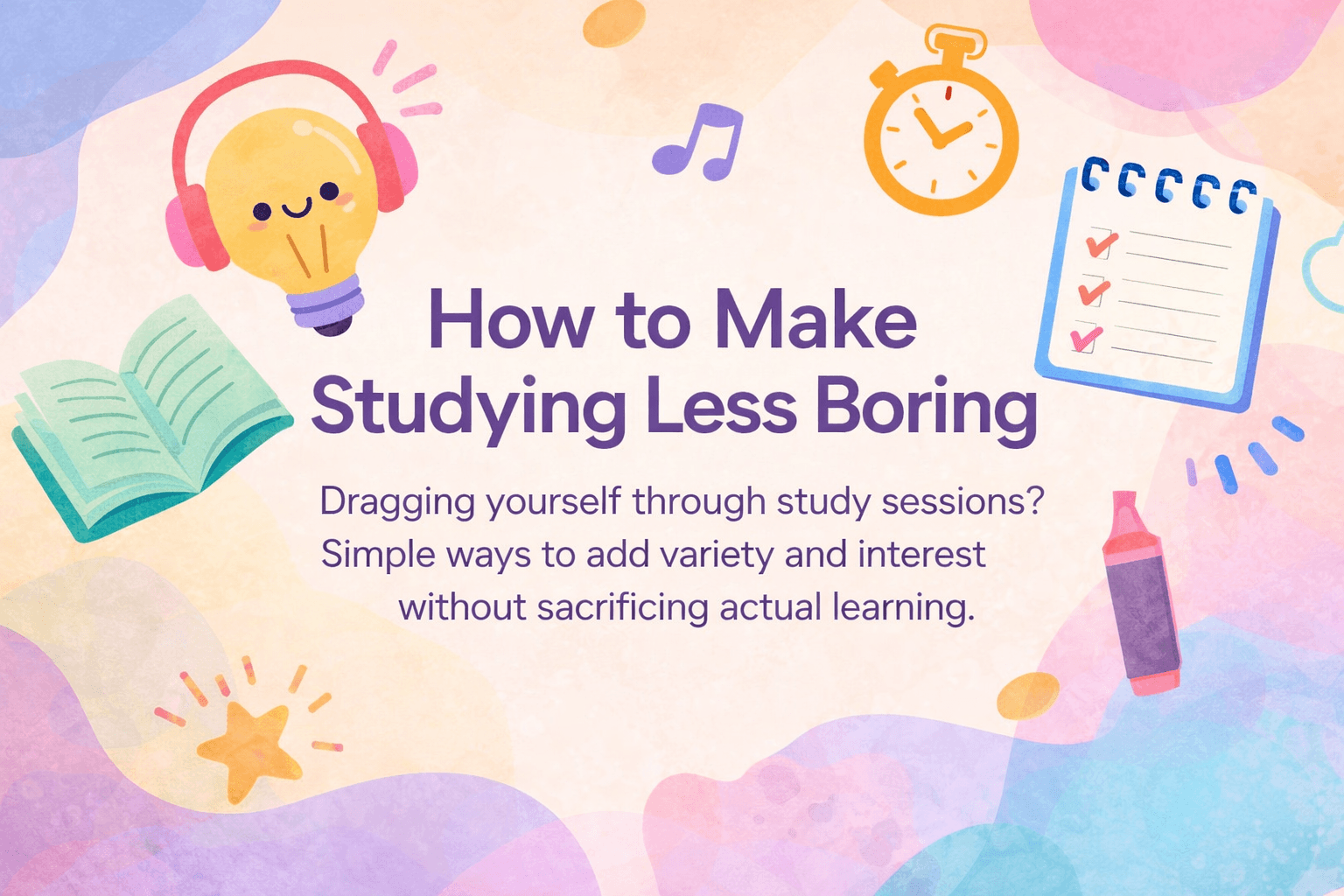
Boredom is the biggest enemy of productivity. When you are bored, your brain actually stops absorbing information. It treats the material like background noise. This makes studying take twice as long and feel twice as hard.
The good news is that you do not have to suffer through dry, dull study sessions. You can trick your brain into enjoying the process by changing how you interact with information.
In this post, we will cover:
Why your brain tunes out during passive studying
How to turn boring notes into active games
Simple changes to your environment that wake up your brain
Tools and apps that do the heavy lifting for you
Let’s get started and turn that boredom into better grades.
Why Studying Feels So Boring (And How to Fix It)
To solve the problem, we first need to understand it. Why is scrolling through social media for two hours easy, but reading one chapter of history feels painful?
The answer lies in passive vs. active engagement.
Most students study passively. This involves activities like:
Re-reading textbook chapters
Highlighting notes
Listening to recorded lectures without pausing
When you do these things, you are not challenging your brain. Your mind recognizes the pattern and goes into "power-saving mode." It assumes you already know the material because you recognize the words, even if you do not understand the concepts. This lack of challenge creates boredom.
The Solution: Active Learning To kill boredom, you must switch to active learning. This means you are doing something with the information rather than just looking at it. When you have a task to solve, your brain releases dopamine. This is a chemical that keeps you focused and interested.
We are going to look at specific ways to make this switch below.
Switch to Active Learning Methods
If reading is boring, stop reading. Instead, start creating. Active learning forces your brain to make connections. It turns studying into a puzzle rather than a chore.
The Feynman Technique
This is a fancy name for a simple trick. Pretend you are teaching the material to a 10-year-old.
Albert Einstein is often credited with saying that if you cannot explain it simply, you do not understand it well enough. When you study complex topics, jargon makes things boring. It feels like you are memorizing a foreign language.
Try this method:
Write the concept name at the top of a blank sheet of paper.
Write down an explanation in your own words.
Use simple language. Do not use the textbook definitions.
If you get stuck, go back to the source material to fill the gaps.
This works because it forces you to translate the information. That translation process keeps your brain awake.
The "Blurting" Method
This method is messy, fast, and very effective. It turns reviewing notes into a challenge.
How to do it:
Read a section of your notes or textbook.
Close the book and hide your notes.
Take a piece of paper and write down everything you remember. "Blurt" it all out on the page.
Open your notes and check what you missed.
The gaps in your memory will be obvious. This gives you a clear goal for the next round of studying. Having a clear goal is much less boring than aimless reading.
For more on effective retrieval practice, you can read about the science of learning from the Learning Scientists. They offer great resources on why retrieval works better than re-reading.
Gamify Your Study Sessions
Video games are addictive because they offer immediate feedback and rewards. Studying usually offers delayed rewards (like a grade you get three weeks from now). You can fix this by adding game elements to your study routine.
Turn Tasks into Quests
In a video game, you do not just "walk around." You have a quest. You need to find an item or defeat a boss. Treat your study session the same way.
Instead of writing "Study Biology" on your to-do list, write "Complete Chapter 4 Quiz with 90% accuracy." This is a clear win condition. When you define exactly what "winning" looks like, you feel a rush of satisfaction when you achieve it.
Use a Reward System
You need to bribe your brain. Set up a system where effort equals a prize.
Small wins: Read for 25 minutes = 5 minutes of phone time.
Medium wins: Finish a math assignment = A favorite snack.
Big wins: Complete a research paper = A movie night with friends.
This is basic psychology. If your brain knows there is a treat waiting at the finish line, it is more willing to run the race.
RPG Your Life
There are apps designed specifically to turn your life into a Role-Playing Game (RPG). One of the most popular is Habitica.
In Habitica, you create a character. When you finish your real-life tasks (like studying Spanish), your character gains experience points and gold. If you skip your tasks, your character loses health. This adds stakes to your studying. It sounds silly, but watching your character level up can be surprisingly motivating.
Leverage Technology for Engagement
Technology can be a distraction, but it can also be your best study buddy. The key is using tools that require you to interact, rather than just scroll.
Generate Interactive Exercises
One of the fastest ways to get bored is running out of practice problems. Once you have done the questions in the back of the book, you are stuck just re-reading.
This is where AI can save the day. You can use AI tools to generate unlimited practice questions, fill-in-the-blank exercises, or case studies based on your notes.
This is exactly what the Exercise Generator in our prompt library is designed for.
Instead of staring at your notes, you paste them into the prompt. The AI will then create a variety of active exercises for you to solve. It changes passive review into an interactive workout for your brain. You can create true/false questions, matching games, or short-answer quizzes instantly.
Check out the Exercise Generator here to start creating your own practice tests.
Use Digital Flashcards
Paper flashcards are great, but they can be slow to make. Digital apps use "Spaced Repetition." This is an algorithm that shows you the cards you are struggling with more often than the cards you already know.
This keeps studying interesting because you are always challenged. You are not wasting time on easy cards.
Change Your Environment
Your brain attaches memories to locations. If you always study at the same messy desk in your bedroom, your brain associates that spot with boredom and stress.
The "Novelty Effect"
A change of scenery can wake up your brain. When you enter a new environment, your senses perk up. You are more alert.
Try rotating your study spots:
The Public Library: The silence creates peer pressure to focus.
A Coffee Shop: The background noise and smell of coffee can boost creativity.
A Park: Fresh air and natural light are great for energy, though you might lack Wi-Fi (which can be a good thing).
Control the Sound
Silence is not always golden. For some people, total silence allows their mind to wander.
Background noise can occupy the "distracted" part of your brain so the rest of it can focus.
Lo-Fi Beats: Music without lyrics is best. Lyrics distract the language centers of your brain.
White Noise: Sounds like rain, waves, or static.
Websites like Noisli allow you to mix your own background sounds. You can combine a crackling fire with rain to create the perfect cozy study vibe.
Mix Up Your Input Formats
If you eat the same meal every day, you get sick of it. If you study using only textbooks, you get bored. You need a varied "information diet."
Watch Documentaries and Videos
Sometimes reading is just too taxing. That is okay. Switch to a visual format.
Sites like Khan Academy offer short, digestible videos on math, science, and history. They use visuals to explain concepts that might be dry in a textbook.
For history or science, high-quality YouTube channels can be educational. Channels like Crash Course break down complex topics with humor and animation. Watching a 10-minute video can give you the big picture before you dive into the details of your book.
Listen to Podcasts
Turn your study time into a walk or a chore session. If you have to read a book for English class, see if there is an audiobook version. If you are studying economics, find a podcast discussing current market trends.
This engages a different part of your brain (auditory processing) and gives your eyes a break.
The Power of Social Studying
Studying alone can feel isolating. Humans are social creatures. We often work better when we feel like we are part of a group.
The "Body Double" Technique
This is a strategy often used by people with ADHD, but it works for everyone. A "body double" is just someone who sits with you while you work.
They do not help you with the work. They do not even have to talk to you. Their presence just anchors you to the task. You are less likely to open Instagram if you know someone is sitting right there working hard.
If you do not have a roommate or sibling to sit with you, you can use a virtual coworking space. Focusmate pairs you with a random partner for a 25-minute or 50-minute video session. You greet each other, say what you are working on, and then work in silence. It sounds strange, but it is incredibly effective for beating procrastination.
Teach Your Friends
We mentioned the Feynman technique earlier. It is even better if you have a real audience.
Form a study group with a clear rule: No complaining, only teaching.
Split the chapters up. Each person is responsible for becoming the "expert" on one chapter. Then, meet up and teach your chapters to each other. This saves everyone time. You only have to read one chapter deeply, but you get the benefit of learning five chapters. plus, explaining it to your friends proves you actually know it.
If your friends are busy, look for resources at your school. For example, many universities have learning centers. The Cornell University Learning Strategies Center has excellent guides on how to form effective study groups.
Conclusion
Studying does not have to be a battle against boredom. The feeling of boredom is usually just a signal from your brain that it needs a new challenge or a different format.
By switching from passive reading to active doing, gamifying your tasks, and changing your environment, you can make study time fly by.
Here are your key takeaways to start today:
Stop just reading. Use the "Blurting" method or flashcards to test yourself actively.
Use tech to your advantage. Tools like the Exercise Generator or Anki can create practice problems for you instantly.
Change your location. If you are stuck, move to a library or coffee shop.
Find a body double. Use Focusmate or a friend to keep you accountable.
Gamify it. Give yourself rewards for finishing tasks, not just for "spending time" at your desk.
Pick just one of these strategies to try during your next session. You might be surprised at how much more you get done, and how much less painful it feels.
You have the tools. Now go make studying interesting.