Introduction
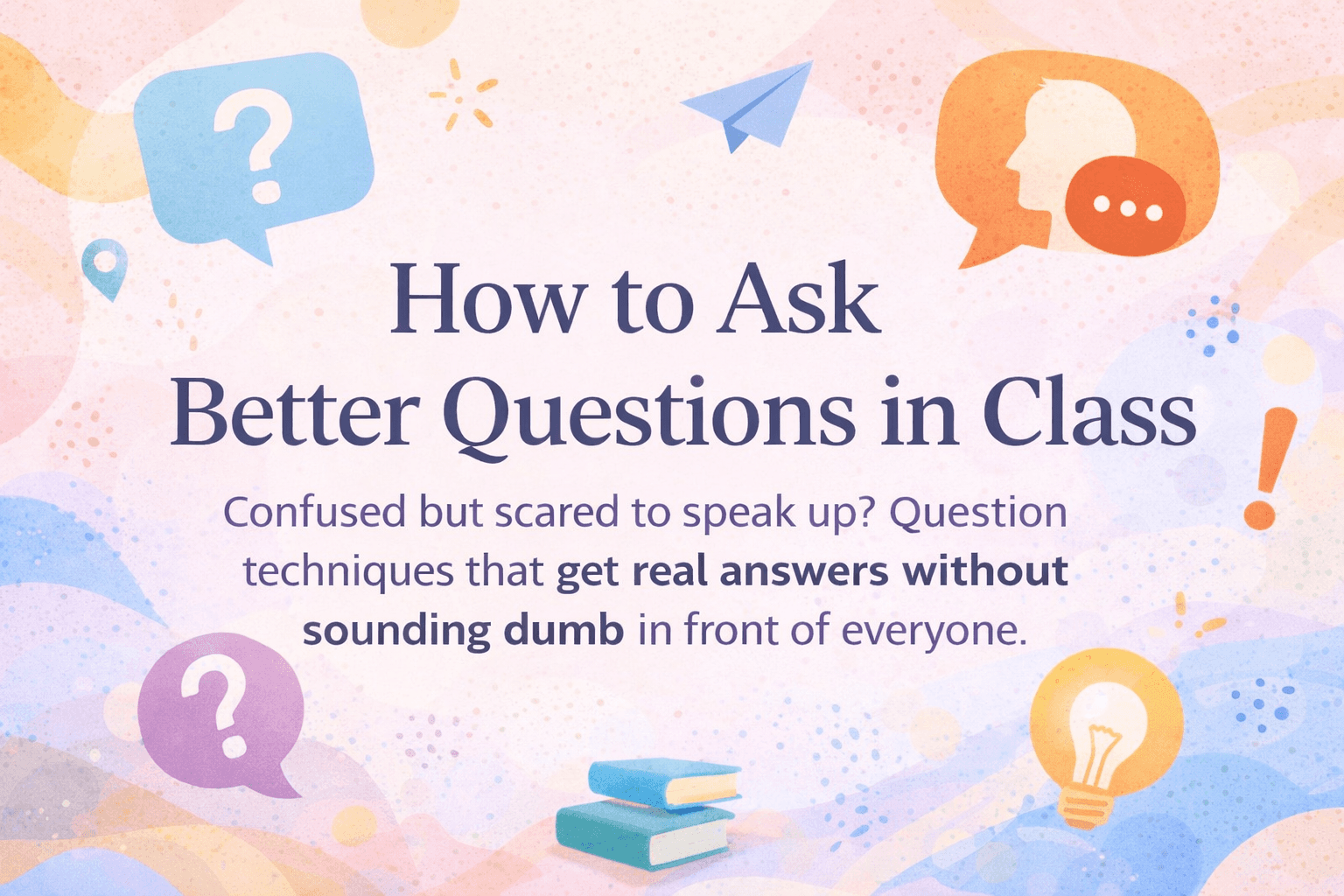
We have all been there. The professor pauses and asks, "Does anyone have any questions?" The room goes silent. You look around. Everyone else seems calm, nodding along as if they perfectly understand the complex lecture on quantum mechanics or macroeconomics. Meanwhile, your brain is spinning. You are confused, but you are glued to your chair.
You have a question, but a voice in your head stops you. What if I sound stupid? What if everyone else already knows this? What if the teacher gets annoyed? So, you stay silent. You leave the class with a gap in your notes and a knot in your stomach, hoping you can figure it out later on your own.
This fear is not a sign that you are a bad student. It is a biological reaction to social pressure. The good news is that asking questions is a skill, not a personality trait. You can learn how to do it effectively without feeling like a burden to the class.
Here is what we will cover:
The Psychology: Why your brain tricks you into silence (and why you are wrong).
The Traffic Light System: A simple method to know what kind of question to ask.
The Formula: How to turn "I don't get it" into a smart, targeted inquiry.
The Scripts: Exact phrases you can use today.
The Tech: How to use AI tools to practice asking deeper questions.
Why We Freeze Up in Class (The Psychology)
Before we fix the problem, we need to understand it. Why is raising your hand so terrifying? It usually comes down to a psychological concept called Pluralistic Ignorance.
What is Pluralistic Ignorance? Pluralistic Ignorance occurs when a majority of group members privately reject a norm, but incorrectly assume that most others accept it, and therefore go along with it.
In a classroom, it looks like this: You are confused. You look around, and nobody else is raising their hand. You assume, "Everyone else understands this except me." The reality? They are looking at you thinking the exact same thing. According to research on classroom dynamics, if you are confused, statistically, at least 30% of the room is confused about the same point. When you ask a question, you are often the hero who breaks the tension for everyone else.
The Fear of Negative Evaluation This is the anxiety that others will judge you poorly. You worry that asking a basic question signals low intelligence. However, teachers often view questions differently. To a teacher, a question signals engagement. It shows you are listening closely enough to find a gap. Silence often looks like boredom or disinterest.
The Traffic Light System for Asking
Not all questions are created equal. When you feel the urge to speak up, take three seconds to categorize your confusion using the Traffic Light System. This helps you decide how to phrase your question.
Red Light: Total Confusion
The Feeling: You have no idea what is going on. You have lost the thread completely.
The Mistake: Asking, "Can you repeat the last 30 minutes?"
The Strategy: Do not ask for a full replay. Ask for a landmark. You need to know where you are on the map so you can catch up.
What to Ask: "I got lost after we discussed [Concept A]. What is the main connection between [Concept A] and what we are discussing now?"
Yellow Light: The Fuzzy Spot
The Feeling: You follow the general idea, but one specific detail doesn't make sense.
The Mistake: Letting it slide and hoping it won't be on the test.
The Strategy: Ask for clarification. These are often the most helpful questions for the whole class.
What to Ask: "You mentioned that [X] affects [Y]. Does that mean [X] always causes [Y], or are there exceptions?"
Green Light: Curiosity
The Feeling: You understand perfectly, but you are interested in how this applies to other things.
The Mistake: Going on a long, personal tangent that wastes class time.
The Strategy: Ask for implications or connections.
What to Ask: "How would this theory apply if we changed the variables to [Z]?"
How to Formulate a Smart Question (The Formula)
The difference between a "bad" question and a "good" question is usually context. A bad question puts 100% of the work on the teacher to guess what you need. A good question shows what you know and highlights exactly what you don't know.
Use this simple formula: Context + The Gap + The Ask.
1. Context: State what you do understand. 2. The Gap: State where you got stuck. 3. The Ask: Ask for the specific bridge to cross that gap.
Example: Biology Class
Bad Question: "I don't understand photosynthesis."
Why it fails: It is too broad. The teacher has to re-teach the whole lesson. It makes you look like you weren't listening.
Good Question (Using the Formula):
(Context): "I understand that plants use sunlight to turn water and CO2 into glucose..."
(The Gap): "...but I am confused about the role of the Calvin Cycle in the dark."
(The Ask): "Does that part happen at night, or does it just not need light?"
Example: History Class
Bad Question: "Why did the war start?"
Why it fails: It sounds like you didn't do the reading.
Good Question (Using the Formula):
(Context): "The textbook mentioned that the assassination was the spark for the war..."
(The Gap): "...but it also talked about secret alliances."
(The Ask): "Which one was the primary driver? Would the war have happened without the assassination?"
By using this formula, you prove you are paying attention. You earn respect before you even finish the sentence.
Scripts You Can Use (The Cheat Sheet)
Sometimes, you just need the words. Memorize these simple scripts to help you speak up even when you are nervous.
The "Can You Give an Example?" Script
Abstract concepts are hard. If a professor is talking in theory, ask for reality.
"Could you provide a real-world example of how this concept is used in [Industry/Daily Life]?"
"I think I understand the theory. What would this look like in a practical scenario?"
The "Did I Hear That Right?" Script
This is the safest way to ask a question. You are just "checking your notes," but it forces the teacher to explain it again simply.
"I want to make sure I wrote this down correctly. Did you say that [Fact A] leads to [Fact B]?"
"Could you repeat that last definition? I want to ensure I have the exact wording."
The "Connection" Script
This shows high-level thinking. You are connecting dots.
"Is this concept similar to [Concept from last week]? Or are they different?"
"How does this relate to [Earlier Topic]? It seems like they contradict each other."
What to Do When You Are Completely Lost
Sometimes, you are so lost that you cannot even formulate a question. You are in the Red Light zone, and the lecture is moving too fast.
Do not panic. And do not interrupt the class to say, "I am totally lost."
Instead, use the Bookmark Method.
Mark the exact time in your notes (e.g., "10:15 AM - LOST").
Write down the last word or phrase you understood.
Listen for a keyword that sounds like a new topic (a "Landmark").
Start taking notes again from that new landmark, leaving a blank space on your page.
After class, you can approach the teacher or a classmate and say: "I lost track when we moved from Topic A to Topic B. Can you recommend a specific chapter or resource I should read to fill that gap?"
This strategy keeps you from spiraling. You acknowledge the gap, skip it for now, and keep learning the rest of the lecture. You can also use techniques like the Feynman Technique later to identify exactly where your logic broke down. You can read more about how to do that in our guide on how to make hard topics easier to understand.
Using AI to Practice Your Questions
If you are still too nervous to raise your hand, you can practice with AI. Large Language Models are excellent tools for refining your thoughts. You can "rehearse" your question with an AI to see if it makes sense, or you can use AI to help you find the deep questions you should be asking.
The Critical Thinking Expert We have a specific tool for this in our Prompt Library called the Critical Thinking Expert.
How to use it:
Paste your messy, confused notes into the AI.
Tell it: "I am confused about this topic. Help me formulate three smart questions I could ask my professor to clarify this."
The AI will analyze the logic gaps in your notes and give you precise, intelligent questions.
Why this helps: It acts like a simulator. You get to see what a "good question" looks like before you have to say it in front of 30 people. It builds confidence because you know your question is valid.
For example, if you are reading a dense textbook chapter and don't know what matters, you can use the technique we discuss in how to actually understand what you're reading combined with this prompt to generate discussion points for your next seminar.
Conclusion
Asking questions is not about showing off, and it is not about admitting defeat. It is a tool for learning. The smartest people in the room are usually the ones asking the most questions, not the ones sitting in silence.
Key Takeaways:
You are not alone: If you are confused, others are too (Pluralistic Ignorance).
Check your Traffic Light: Know if you need a landmark (Red), clarification (Yellow), or connection (Green).
Use the Formula: Context + Gap + Ask.
Use AI to prep: Tools like the Critical Thinking Expert can help you draft questions before class.
Your Challenge: In your next class, ask one question. It can be a simple "Yellow Light" question like, "Could you give an example?" Watch what happens. The room won't laugh. The teacher will likely nod and explain. And you will walk out with better notes than everyone else.
Start small. Speak up. Your grade (and your brain) will thank you.