Introduction
It is 8:00 PM. The big test is tomorrow morning. Your textbooks are spread out on your bed, your notes are a mess, and you have that tight feeling in your stomach. You might be thinking, "If I stay up until 3 AM reading everything one more time, I'll be fine."
Stop right there.
Most students think the night before a test is for learning everything they missed during the semester. But science tells us that is the worst thing you can do. The night before is not for learning; it is for priming. Think of it like a sports game. Athletes don't run a marathon the night before the big match; they stretch, eat well, and rest.
In this guide, we are going to walk you through exactly what to do, hour by hour, to make sure you wake up feeling ready. We will cover:
Why cramming actually erases your memory
The specific foods that help your brain focus
How to pack your bag so you don't panic in the morning
Simple tricks to fall asleep when you are nervous
Let’s turn that panic into a plan.
Why Cramming Does Not Work
We have all been there. You try to shove facts, dates, and formulas into your brain like you are stuffing clothes into a full suitcase. It feels productive, but it usually backfires.
The Science of "Brain Drain"
Your brain needs time to move information from "short-term memory" to "long-term memory." This process happens mostly when you sleep. If you stay up late studying, you are cutting off the exact process that saves what you learned.
According to the Sleep Foundation, losing sleep the night before a test can lower your performance as much as if you were tipsy. You might read a page three times and still not remember a word of it.
The Anxiety Cycle
Cramming also creates stress. When you realize you don't know a topic perfectly at 11 PM, you panic. This releases cortisol, a stress hormone that actually blocks your memory. It becomes a vicious cycle: you stress, you forget, so you stress more.
Instead of trying to learn new things, your goal tonight is to keep your brain calm and confident.
Organize Your Materials First
Before you do any studying, clear your space. A messy desk leads to a messy mind. If you spend 20 minutes looking for your calculator tomorrow morning, you will start your test day in a state of panic.
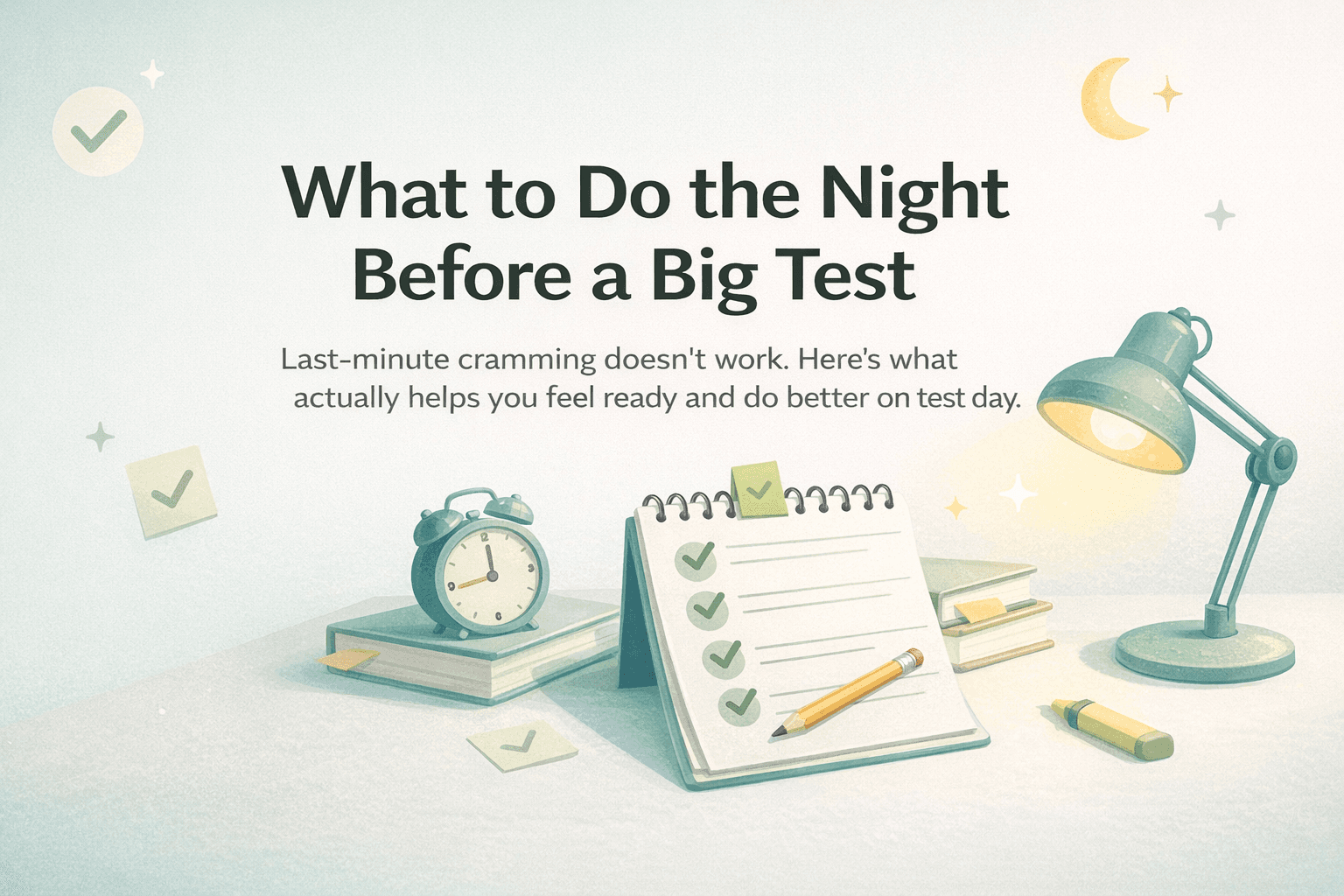
The "Ready-to-Go" Checklist
Do this right now. Don't wait until morning.
Pencils and Pens: Sharpen two pencils. Have a backup pen.
Calculator: Check the batteries. If it’s a graphing calculator, make sure it’s in the right mode.
ID Card: Put it in your bag. You don't want to be barred from the exam hall because you left your wallet at home.
Water Bottle: Hydration helps focus.
Watch: Exam rooms sometimes have broken clocks. Bring a simple wristwatch (not a smartwatch, as those are often banned) to track your time.
By packing your bag tonight, you are telling your brain, "I am prepared." This simple action can lower your anxiety levels significantly.
Review, Don't Re-Learn
If you must study tonight, do it the right way. Do not try to read a whole textbook chapter. It is too late for that. Instead, focus on Light Active Recall.
What is Light Active Recall?
Passive reviewing is when you just read your notes. Active recall is when you cover your notes and try to remember the main points. Tonight, keep it light.
Flashcards: Go through a small stack of key terms. If you get one wrong, don't stress. Just look at the answer and move on.
Summary Sheets: Read over the one-page summaries you made earlier in the week.
If you need a quick way to test yourself without the stress of organizing a study group, you can use AI to help. Our Memory Coach prompt is designed exactly for this. You just paste in your list of terms, and it gently quizzes you until you remember them. It’s perfect for a low-stress review session before bed.
The "Brain Dump" Technique
If you are worried you will forget specific formulas or dates, take a blank piece of paper. Write down everything you are afraid of forgetting.
Formulas
Key dates
Acronyms
Keep this paper. Tomorrow, when the test starts, you can do this again on your scratch paper immediately. Knowing you have a plan to "dump" this info out of your brain can help you relax tonight.
For more on how to study effectively without burning out, check out our guide on how top students study. It explains why short bursts of focus work better than long marathons.
Eat the Right Dinner
Your brain is an organ, and it needs fuel. Imagine trying to drive a car on empty, that is what taking a test on a bad diet feels like.
Foods to Avoid
Heavy Carbs: A giant bowl of pasta might make you sleepy (the "food coma"), which is bad if you plan to do a light review.
Sugary Snacks: Candy gives you a burst of energy, but then you crash. You don't want to crash while you are trying to fall asleep.
Caffeine: No coffee, soda, or energy drinks after 2 PM. Even if you can fall asleep, caffeine ruins the quality of your deep sleep.
The Brain-Power Menu
Aim for a balanced meal that keeps you full but not stuffed.
Omega-3s: Fish like salmon or tuna are great for brain function.
Proteins: Chicken, eggs, or beans.
Vegetables: Leafy greens like spinach or broccoli.
A good example meal: Grilled chicken with a side of broccoli and some brown rice. It’s boring, but it works.
The Sleep Strategy
This is the most important part of your night. You cannot trade sleep for study time. It is a bad trade.
Understanding Sleep Cycles
Your brain consolidates memory during REM sleep, which happens mostly in the second half of the night. If you cut your sleep from 8 hours to 5 hours, you aren't just losing 3 hours of rest; you are losing the exact time your brain needs to store facts.
According to the National Institutes of Health, sleep deficiency affects your ability to solve problems and react quickly. On a test, you need to be sharp, not just knowledgeable.
How to Fall Asleep When Nervous
It is normal to toss and turn before a big event. Here is a routine to help:
Screens Off: Turn off your phone 1 hour before bed. The blue light tricks your brain into thinking it is daytime.
Cool Room: Your body sleeps better in a cooler environment (around 65°F or 18°C).
White Noise: If your house is noisy, use a fan or a white noise app to block out distractions.
If you are lying in bed and cannot stop thinking about the test, try the "4-7-8" breathing trick:
Inhale through your nose for 4 seconds.
Hold your breath for 7 seconds.
Exhale slowly through your mouth for 8 seconds.
Repeat this four times. It physically forces your heart rate to slow down.
Dealing with Anxiety
"What if I fail?" "What if I forget everything?"
These thoughts are common. The problem is that your brain cannot tell the difference between a math test and a tiger attacking you. It reacts with the same "fight or flight" response.
Visualization
Instead of imagining yourself failing, imagine yourself succeeding.
Close your eyes.
Picture yourself walking into the exam room.
Picture yourself sitting down and feeling calm.
Picture yourself flipping over the paper and knowing the first answer.
Athletes use this technique all the time. By visualizing success, you prime your brain to be confident.
The "Worst Case" Game
Sometimes, facing your fear helps. Ask yourself: "What is the absolute worst thing that happens if I fail?"
You might get a bad grade.
You might have to retake the class.
Your parents might be disappointed.
But you will not die. You will not lose your friends. The sun will still rise. Realizing that the "worst case" is survivable can take the pressure off.
If you are feeling stuck on a specific hard topic and it is causing you panic, don't spin your wheels. Use a tool like our Generalist Teacher prompt. You can ask it to "Explain this concept like I'm 5 years old." Sometimes, hearing a simple explanation is all you need to click the puzzle piece into place so you can sleep.
The Morning Routine
The night before is also about setting up your morning for success. You want your morning to be on autopilot.
The Alarm
Set two alarms. One on your phone, and one on a different device across the room. This forces you to get out of bed to turn it off. Do not hit snooze. Snoozing makes you groggy.
The Outfit
Pick your clothes tonight. Choose layers. Exam rooms can be freezing cold or boiling hot. Wear a T-shirt with a hoodie or sweater over it so you can adjust.
Breakfast Plan
Decide what you are going to eat now.
Good: Oatmeal with fruit, eggs on toast, yogurt with granola.
Bad: Sugary cereal (crash later), nothing (brain fog).
For more tips on how to prepare efficiently, read our article on how to actually use AI to prepare for tests. It covers smart ways to use your morning time effectively without cramming.
Final Checklist for Tonight
Here is your summary. If you do these things, you have done enough.
Pack your bag: ID, pencils, calculator, water.
Eat a healthy dinner: Protein and veggies, no sugar.
Light review only: 30 minutes max. No new topics.
Set your alarms: Double check the time (AM vs PM!).
Screens off: 1 hour before bed.
Sleep: Aim for 8 hours.
Conclusion
The night before a test feels high-stakes, but the battle is won by keeping calm. You have done the work. You have attended the classes. Now, your job is to protect that information by resting your brain.
Remember, a tired genius will lose to a well-rested student every time. Trust your preparation. Follow this routine, get some sleep, and walk into that exam room knowing you gave yourself the best possible chance to succeed.
Don't cram.
Don't panic.
Do sleep.
You've got this. Good luck!