Introduction
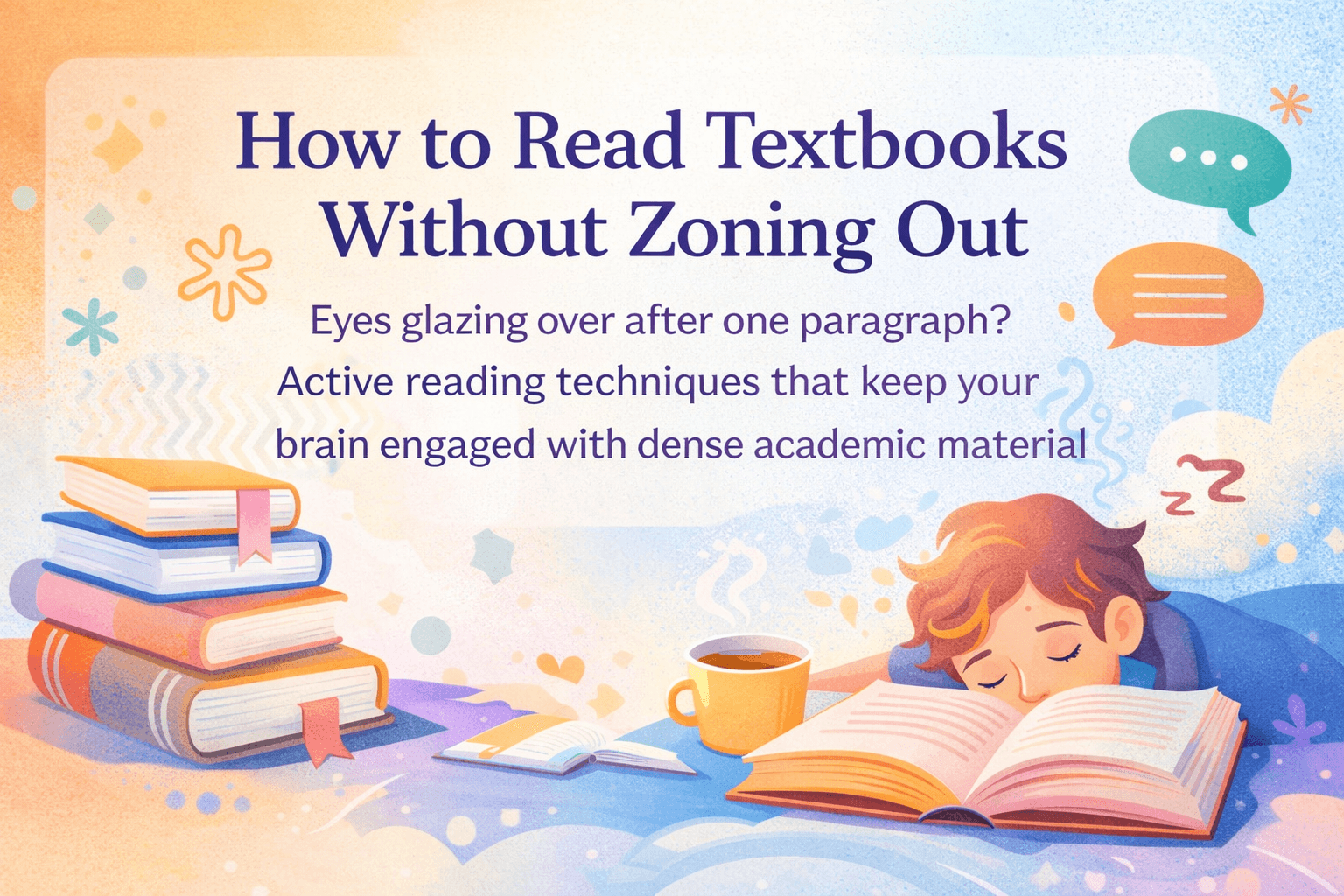
We have all been there. You are sitting at your desk, the room is quiet, and you have been staring at page 42 of your history textbook for twenty minutes. You read the words, your eyes move left to right, but nothing is sticking. It feels like the information is bouncing right off your brain. You re-read the paragraph again. Still nothing.
This is not a sign that you aren't smart enough. It is a sign that the "brute force" method of reading—starting at the top and hoping for the best—is failing you. Academic writing is often dense, dry, and packed with complex jargon that creates a mental roadblock. The good news is that you don't need to read harder; you need to read differently.
In this guide, we are going to walk through a step-by-step system to dismantle even the most difficult chapters. We will cover:
Why your brain shuts down when facing dense text (and how to fix it).
The "Pre-Read" strategy that works like a GPS for your study session.
How to use AI tools to translate "academic speak" into plain English.
Active reading techniques that stop you from zoning out.
Let’s turn that wall of text into something you can actually master.
Why Textbooks Are So Hard to Read
Before we fix the problem, we need to understand it. Textbooks are not written like novels. A novel is designed to pull you along with a narrative flow. A textbook is designed to archive information. Authors of academic texts often suffer from what psychologists call the "Curse of Knowledge." They know the material so well that they forget what it’s like not to know it. Consequently, they use heavy terminology and complex sentence structures that overload your working memory.
When you try to read a dense chapter linearly (from start to finish) without preparation, you are asking your brain to do three things simultaneously:
Decode new vocabulary.
Connect new ideas to things you already know.
Store the information for later.
That is too much cognitive load for one pass. It leads to mental fatigue, wandering attention, and eventually, the urge to give up. If you find yourself cleaning your room instead of reading, check out our guide on how to stop procrastinating on homework right now to get your focus back on track. The strategies below are designed to lighten that load by breaking the reading process into manageable steps.
The Pre-Read Strategy (Scan Before You Dive)
Imagine you are driving to a new city for the first time. You wouldn't just hop in the car and hope the road signs explain everything as you speed past them at 60 mph. You would look at a map first. You would get an idea of the big picture: "I'm heading North, then I take the second exit."
Reading a complex chapter requires the same "mapping" process. Before you read a single sentence of the actual content, you must perform a "Pre-Read." This technique, often part of the SQ3R method recommended by the UNC Learning Center, primes your brain for what is coming.
Here is how to map your chapter in 5 minutes:
Read the Title and Intro: What is the main argument or theme?
Read every Heading and Subheading: These are your road signs. They tell you how the author has organized the information.
Look at the Visuals: Charts, graphs, and maps are often more valuable than the text itself. They summarize pages of data in one image.
Read the Chapter Summary: Yes, read the end first. Knowing the conclusion helps you understand the steps the author takes to get there.
Scan for Bold Words: These are the vocabulary terms you will need to define later.
By doing this, you create a mental "skeleton" of the chapter. When you finally do the deep reading, you aren't discovering the structure; you are simply hanging the details on the skeleton you already built. This dramatically reduces the feeling of being overwhelmed.
Chunking: Divide and Conquer
One of the biggest mistakes students make is trying to read a 30-page chapter in one sitting. That is a recipe for burnout. Your brain can only maintain high-level focus for about 20 to 25 minutes before returns diminish. To combat this, you need to use "chunking."
Chunking involves breaking the chapter down into small, digestible sections based on the headings you identified during your Pre-Read. Instead of saying, "I need to read Chapter 4," say, "I am going to read the section on 'Cellular Respiration' for the next 15 minutes."
The Protocol:
Select one subheading.
Read only that section.
Stop.
Summarize it in your head or on paper.
Take a short break or move to the next chunk.
This method leverages the psychological principle that we remember the beginning and end of a session better than the middle. By creating more "beginnings" and "ends" through chunking, you actually retain more information overall.
Turn Headings into Questions
Passive reading is the enemy of retention. Passive reading is when you run your eyes over the text, highlighting random sentences, hoping they stick. To learn difficult material, you must be an active reader. The simplest way to switch from passive to active is to turn every heading into a question.
If the subheading is "The Causes of the French Revolution," your brain sees a statement. It’s boring. It’s a fact. Change it to: "What were the primary causes of the French Revolution?"
Now, your brain has a job to do. It is no longer just "looking at words"; it is on a scavenger hunt for an answer. This simple shift engages your critical thinking skills. As you read the section, you are filtering out the fluff and searching specifically for the evidence that answers your question.
According to the Harvard Academic Resource Center, reading with a specific goal helps you focus on relevant information and know exactly when you are done. Once you can answer the question you posed, you have mastered that chunk and can move on.
Using Tools to Translate Academic Speak
Sometimes, no matter how much you chunk or active-read, the sentence structure is just too dense. Academics love using five-syllable words when a one-syllable word would do. They love passive voice and abstract concepts that feel impossible to pin down.
In the past, you would have to reread that sentence ten times or dig through a dictionary. Today, you can use AI to bridge the gap. We built the Simplifier Specialist prompt specifically for this moment.
How to use it:
Copy the confusing paragraph from your digital textbook (or type out the key sentence).
Paste it into the Simplifier Specialist prompt.
The tool rewrites the content in plain, everyday English, using analogies that make sense to a layperson.
Example:
Textbook: "The mitigation of risk factors is contingent upon the efficacy of the implemented prophylactic measures."
Simplifier Specialist: "To lower the danger, we need to make sure our safety plans actually work."
Using a tool like this doesn't mean you are cheating or skipping the learning. It means you are removing the language barrier so you can actually engage with the concepts underneath. Once you understand the plain English version, go back and read the textbook version. You will find it suddenly makes sense because you now know what it is trying to say.
The Feynman Technique
Once you think you understand a section, how do you prove it? You teach it. This is the core of the Feynman Technique, named after the Nobel Prize-winning physicist Richard Feynman. He believed that if you couldn't explain something simply, you didn't understand it well enough.
The 4 Steps of the Feynman Technique:
Choose the concept you just read (e.g., "The Water Cycle").
Explain it out loud (or in writing) as if you were teaching it to a 6th grader. Use simple words. Avoid jargon.
Identify your gaps. Did you get stuck explaining evaporation? Did you forget why it rains? That is your blind spot.
Review the source material. Go back to the textbook and re-read only the part you got stuck on.
This technique is ruthless at exposing what you don't know. It prevents the "Illusion of Competence", that feeling where you read a page and think "I got it," but fail the test later because you only recognized the words rather than understanding the logic. If you struggle with this, read our article on how to know what you don't know yet for more self-testing strategies.
Taking Notes That Actually Help
Most students take notes by transcribing the textbook. They copy sentences word-for-word. This is a waste of time. Your textbook already has the words in it; you don't need to write them again.
Effective notes are a record of your thinking, not just the author's writing. When you break down a confusing chapter, your notes should look like a translation.
Try the "Split Page" Method:
Draw a line down the middle of your page.
Left Side: Write the technical terms or the "Question" you generated from the heading.
Right Side: Write the answer or definition in your own words.
If you can't write it in your own words, you don't know it yet (see the Feynman Technique above). Writing things down by hand is powerful because it forces you to slow down and process the information. For a deeper dive into why handwriting beats typing for retention, check out our post: Does Writing Things Down Help You Remember Better?.
Conclusion
Breaking down a confusing textbook chapter is not about being a genius; it is about having a system. When you stare at a dense wall of text, remember that you don't have to conquer it all at once.
Key Takeaways:
Scan first: Build a mental map using titles, headings, and summaries before you read line-by-line.
Chunk it: Break the reading into 15-minute segments based on subheadings.
Question it: Turn headings into questions to force your brain into "hunter" mode.
Simplify it: Use tools like the Simplifier Specialist to translate jargon into plain English.
Teach it: Use the Feynman Technique to find and fix your knowledge gaps.
Next time you open that intimidating biology or economics book, take a deep breath. You have the tools to decode it. Start with the Pre-Read, find your headings, and take it one chunk at a time. You’ve got this.