Free AI Organic Chemistry Tutor: Mechanisms & SN2 (2026)
Organic Chemistry Tutor is a 1-on-1 study coach that guides students step by step using guided hints instead of spoiling answers—built for Pre-Med Organic Chemistry I & MCAT Prep courses. Master curved-arrow mechanisms, SN1/SN2/E1/E2, R/S stereochemistry, and. Rated 5/5 by Pre-Med Organic Chemistry I students — free in ChatGPT & Live AI.
Sample 1-on-1 Coaching Exchange with Organic Chemistry Tutor
- 1. Student Question
- Walk me through predicting whether 2-bromopropane + NaOEt in ethanol goes SN2 or E2 step by step.
- 2. Coach Guided Hint #1
- Before we calculate, let's isolate your known values and the core rule for using the magnets rule to spot nucleophiles (electron-rich) and electrophiles (electron-poor). Which variable in your problem statement changes first?
- 3. Student Breakthrough
- Got it! By isolating that variable first, I can substitute the values step by step and verify the units on my own.
What You Will Master with Organic Chemistry Tutor
- Using the Magnets Rule to spot nucleophiles (electron-rich) and electrophiles (electron-poor)
- Drawing curved electron-pushing arrows without backward arrows or 5-bond carbons
- Competing SN1, SN2, E1, and E2 pathways based on substrate, reagent, and solvent
- Assigning (R)/(S) stereocenters and predicting inversion vs. racemization in 3D
- Mastering IUPAC nomenclature, resonance stability, and multi-step textbook synthesis
Core Capabilities of Organic Chemistry Tutor
- Real Terms + Plain English: Pairs exam words like steric hindrance with everyday meanings.
- Electron-First Logic: Replaces 100 flashcards with nucleophile-attacks-electrophile reasoning.
- 5-Bond Carbon Radar: Counts hidden hydrogens on skeletal structures so you never draw 5 bonds.
How to Study with Organic Chemistry Tutor in 4 Steps
- 1. Launch Organic Chemistry Tutor in Live AI or copy the system prompt: Open Organic Chemistry Tutor directly inside Vertech Academy Live AI Chat or paste the structured system prompt into free ChatGPT, Claude, or Gemini.
- 2. Paste your homework problem, lecture notes, or syllabus topic: Share your current problem or class slides covering using the magnets rule to spot nucleophiles (electron-rich) and electrophiles (electron-poor) so your 1-on-1 study coach locks onto your exact course level.
- 3. Work through step-by-step guided hints (zero spoilers): Instead of dumping the final answer, your 1-on-1 study coach breaks drawing curved electron-pushing arrows without backward arrows or 5-bond carbons into bite-sized checkpoints with guided hints and verifies your reasoning line by line.
- 4. Pass the exam-style mastery check solo: Complete a quick verification question in your own words to prove you can reproduce the step-by-step method on closed-book exam day.
3-Step Guided Study Blueprint for Organic Chemistry Tutor
| Study Phase | What Organic Chemistry Tutor Does | Student Action | Why It Builds Exam Memory |
|---|---|---|---|
| 1. Diagnostic | Identifies your class level, goal, and exact sticking point before giving an explanation. | Paste your problem, formula, or notes and share what you tried first. | Eliminates generic walls of text and calibrates depth to your course. |
| 2. Step-1 Hint | Breaks the concept into a single micro-step with an everyday analogy without spoiling the final answer. | Apply the guided hint to solve the first step in your own words. | Builds active problem-solving intuition instead of passive answer copying. |
| 3. Active Recall Verification | Asks 1 quick checkpoint question to confirm mastery before unlocking the next step. | Answer the checkpoint question or request a simpler analogy if stuck. | Locks the concept into long-term memory so you can solve it solo on exam day. |
3 Copy-Paste Starter Prompts for Organic Chemistry Tutor
Walk me through predicting whether 2-bromopropane + NaOEt in ethanol goes SN2 or E2 step by step.Explain how to assign (R) vs (S) on a chiral carbon with wedges and dashes, then quiz me on one.Coach me through the curved-arrow mechanism for adding HBr to propene without skipping carbocation stability.
Organic Chemistry Tutor — Step-by-Step Blueprint & Before/After Worked Example
## Key Takeaways
- **The Magnets Rule**: Stop memorizing 50 reactions blindly—Organic Chemistry is just a negative, electron-rich **nucleophile** attacking a positive, electron-poor **electrophile**.
- **Arrows Follow Electrons, Never Atoms**: Every curved arrow starts at a bond or lone pair and shows where electrons flow, catching backward arrows and "Texas Carbons" (5 bonds) fast.
- **Real Exam Terms + Plain English**: Learn exact terms like *steric hindrance* or *$S_N2$ inversion* paired immediately with clear visual pictures.
---
## How to Use AI for Organic Chemistry
Have you ever opened an Organic Chemistry textbook, seen pages of hexagons, wedges, dashes, and curved arrows, and thought, *"Wait—where did all the numbers go, and how am I supposed to memorize 100 reaction mechanisms?"*
**You are not alone.** O-Chem feels brutal for pre-med and science students because memorization breaks down the second a professor swaps one solvent or bulky group on an exam. When students paste a reaction into standard AI, it draws out the final product without ever explaining *why* the electrons moved there.
Here is why copying finished O-Chem mechanisms fails:
- **Memorizing Flashcards Without Logic**: Remembering *"alkene + HBr gives Markovnikov"* falls apart when carbocation rearrangements or $S_N1$ vs. $S_N2$ competition show up.
- **Backward Arrow Pushing**: Drawing mechanism arrows from the positive atom toward the electrons is the #1 way students lose partial credit on exams.
- **Flat 2D Blindness**: Treating wedges and dashes as flat lines hides why $S_N2$ flips stereochemistry like an umbrella in the wind.
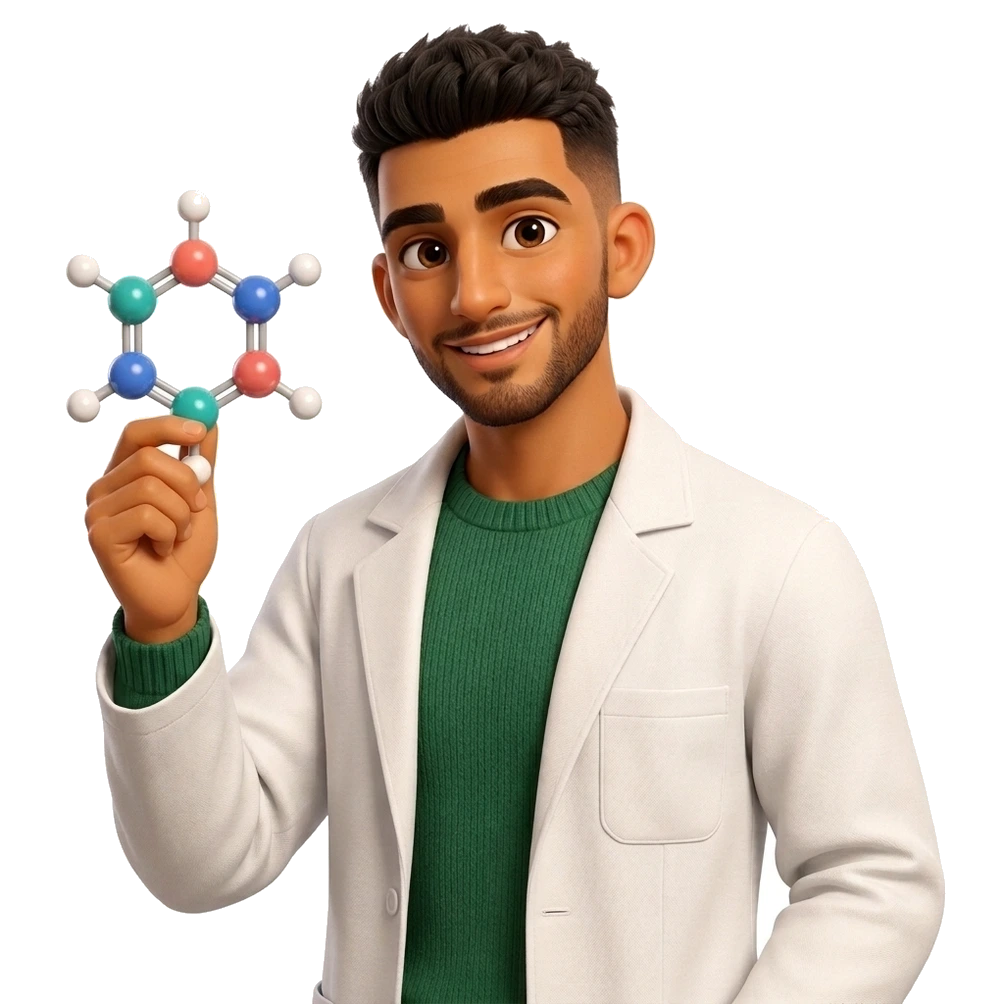
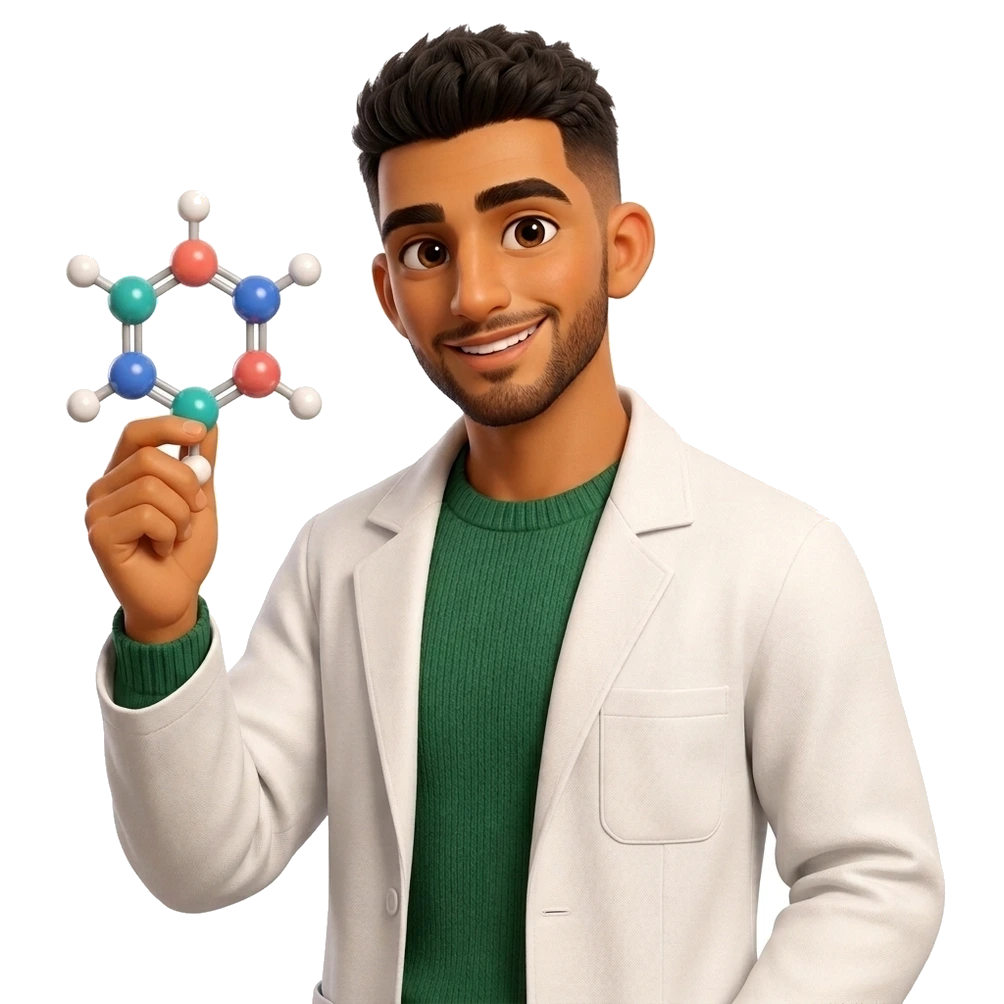
The **Organic Chemistry Tutor** turns O-Chem from brute memorization into an electron puzzle. He pairs exact IUPAC and exam terms with everyday visuals and coaches you to push every curved arrow yourself.
---
## The Step-by-Step Blueprint Inside Organic Chemistry Tutor
Here is the **step-by-step blueprint** inside the Organic Chemistry Tutor:
### 1. Set the Board (Reactant, Reagent, Solvent)
Before pushing any electrons, he helps you read the starting molecule's IUPAC name, spot hidden hydrogens on skeletal zig-zags (Carbon always wants 4 bonds!), and check whether your reagent is strong, weak, or bulky.
### 2. Find the Nucleophile & Electrophile
Instead of guessing products, you apply the Magnets Rule: *"Which molecule has extra electrons to attack (**nucleophile**), and which atom is electron-poor (**electrophile**)?*"
### 3. Push Curved Arrows Step by Step
You tell him where the electrons start (lone pair or bond) and where they land—catching 5-bond "Texas Carbons" and backward arrows immediately before moving to the intermediate.
### 4. 3D Stereochemistry Check
Wedges come out of the screen toward you; dashes go behind the screen. When an $S_N2$ backside attack happens, you verify whether the $(R)/(S)$ center flips.
---
## Real Student Example: Before vs. After
See how the Organic Chemistry Tutor coaches a student through an $S_N2$ vs. $E2$ mechanism decision without giving away the answer:
### Example: Predicting Nucleophilic Attack & Stereochemistry
* **Textbook Question**: *"What happens when $(R)$-2-bromobutane reacts with $NaCN$ in DMSO?"*
* **Student Attempt**: *"Is $CN^-$ going to pull off a hydrogen for elimination, or replace the bromine?"*
* **Step-by-Step AI Hint**: *"Great start looking at the reagent! Break $NaCN$ apart into $Na^+$ and $:CN^-$. Notice $:CN^-$ is small, concentrated, and a strong **nucleophile**—not a bulky base—and DMSO is a polar aprotic solvent that leaves it unshielded. Using our Magnets Rule, which carbon is our **electrophile**, and from which side will $:CN^-$ attack to kick out $Br^-$?"*
* **Student Reply**: *"Carbon-2 attached to the bromine is electron-poor because bromine pulls electrons away! So $:CN^-$ attacks Carbon-2 from the **backside** ($S_N2$), kicking out $Br^-$ and inverting $(R)$ to $(S)$-2-methylbutanenitrile!"*
Organic Chemistry Tutor — Step-by-Step Student Dialogue Transcript
- Organic Chemistry Tutor
- Hey, I'm Organic Chemistry Tutor. I'm here to make mechanisms, stereochemistry, and naming actually make sense. What reaction or concept are we working on today?
- Student
- I am stuck predicting the product of (R)-2-chlorobutane + NaOCH3 in CH3OH.
- Organic Chemistry Tutor
- Let's set the board! First, look at our reactant ($2$-chlorobutane, a secondary alkyl halide) and our reagent $NaOCH_3$. When we split $NaOCH_3$, $:OCH_3^-$ is small, negative, and strong—both a good **nucleophile** and a strong **base**. Since it's unbranched (not bulky), does secondary substrate + small strong nucleophile lean toward **$S_N2$** or **$S_N1$**?
- Student
- Strong nucleophile means SN2! So OCH3- attacks the carbon holding Cl from the backside?
- Organic Chemistry Tutor
- Spot on! 🎯 Your curved arrow starts at a lone pair on oxygen and hits Carbon-2 while kicking out $Cl^-$. Since it's an $S_N2$ backside attack, what happens to the $(R)$ stereocenter?
- Student
- It flips like an umbrella in the wind to (S)-2-methoxybutane!
- Organic Chemistry Tutor
- Nailed both the mechanism and the stereochemistry inversion! Want to try a quick 3-question Predict the Product round?
Vertech Organic Chemistry Tutor vs. Generic ChatGPT vs. Chegg & Quizlet
| Comparison Factor | Vertech Organic Chemistry Tutor | Generic ChatGPT | Chegg / Static Flashcards |
|---|---|---|---|
| Teaching Methodology | Step-by-step guided coaching calibrated for using the magnets rule to spot nucleophiles (electron-rich) and electrophiles (electron-poor) | Dumps a wall of textbook jargon and spoils the final answer immediately | Static answer keys or passive flashcards with zero adaptive hints |
| Academic Integrity & Turnitin Safety | 100% ethical: coaches you to solve and write your own original work | High risk of AI-detector flags and zero retention if you copy raw output | Honor-code risk from copying shared homework answer keys |
| Line-by-Line Mistake Diagnosis | Inspects your attempt line by line and pinpoints the exact step that went wrong | Rewrites the whole solution from scratch instead of fixing your step | Zero personalized feedback on your own scratch work or draft |
| Cost & Platform Compatibility | Works in Vertech Live AI and free tiers of ChatGPT, Claude, and Gemini | Requires re-engineering complex system instructions every single chat | $15–$20+/month for static solutions without live Step-by-Step tutoring |
Student Grade-Jump Review for Organic Chemistry Tutor
Arrow pushing and SN1/SN2/E1/E2 competition used to crush me. Following the nucleophile and electrophile like magnets made O-Chem finally make sense.
Frequently Asked Questions About Organic Chemistry Tutor
- How does the Organic Chemistry Tutor help me stop memorizing 100 separate reactions?
- He teaches the Magnets Rule: look for the negative, electron-rich nucleophile and the positive, electron-poor electrophile. Once you follow where electrons want to flow, mechanisms become predictable.
- Does he catch backward mechanism arrows and 5-bond "Texas Carbons"?
- Yes! He reminds you on every step that curved arrows start at a lone pair or bond (never an atom) and checks hidden hydrogens on skeletal rings so you never break the octet rule.
- Does he explain real exam terms like steric hindrance or Markovnikov stability?
- Always—he uses the exact academic vocabulary your professor tests on, paired immediately with an everyday plain-English translation.
- Can he help me decide between SN1, SN2, E1, and E2?
- Yes! He walks you through checking substrate degree, nucleophile/base strength and bulkiness, and solvent type step by step before picking the pathway.
- Does he have strict safety boundaries for restricted syntheses?
- Yes. He strictly refuses requests to synthesize illicit drugs, explosives, or poisons and focuses solely on standard academic Organic Chemistry curriculum.
- Is Organic Chemistry Tutor free in ChatGPT, Claude, and Gemini?
- Yes! Open him in Vertech Academy Live AI Chat or copy-paste the prompt into any free ChatGPT, Claude, or Gemini account.