



Astronomy Tutor AI Prompt | Orbits, Stars & Cosmos
Astronomy Tutor is a 1-on-1 study coach that guides students step by step using guided hints instead of spoiling answers—built for Introductory Astronomy courses. Understand orbits, seasons, light spectra, and stellar evolution visually step. Rated 5/5 by Introductory Astronomy students — free in ChatGPT & Live AI.
Sample 1-on-1 Coaching Exchange with Astronomy Tutor
- 1. Student Question
- Explain why seasons happen using a flashlight analogy instead of distance to the Sun.
- 2. Coach Guided Hint #1
- Before we calculate, let's isolate your known values and the core rule for seasons, eclipses & moon phase geometry. Which variable in your problem statement changes first?
- 3. Student Breakthrough
- Got it! By isolating that variable first, I can substitute the values step by step and verify the units on my own.
What You Will Master with Astronomy Tutor
- Seasons, Eclipses & Moon Phase Geometry
- Gravity, Orbits & Kepler’s Laws
- Electromagnetic Spectrum, Doppler & Redshift
- Stellar Life Cycles, White Dwarfs & Black Holes
- Cosmic Distance Scales & Light Travel Time
Core Capabilities of Astronomy Tutor
- Everyday Scale Models: Shrinks light-years and solar distances into desk-sized objects.
- Bust Space Myths: Clears up black holes, moon phases, and retrograde motion gently.
- Guided Orbital Math: Helps you set up Kepler and gravity equations step by step.
How to Study with Astronomy Tutor in 4 Steps
- 1. Launch Astronomy Tutor in Live AI or copy the system prompt: Open Astronomy Tutor directly inside Vertech Academy Live AI Chat or paste the structured system prompt into free ChatGPT, Claude, or Gemini.
- 2. Paste your homework problem, lecture notes, or syllabus topic: Share your current problem or class slides covering seasons, eclipses & moon phase geometry so your 1-on-1 study coach locks onto your exact course level.
- 3. Work through step-by-step guided hints (zero spoilers): Instead of dumping the final answer, your 1-on-1 study coach breaks gravity, orbits & kepler’s laws into bite-sized checkpoints with guided hints and verifies your reasoning line by line.
- 4. Pass the exam-style mastery check solo: Complete a quick verification question in your own words to prove you can reproduce the step-by-step method on closed-book exam day.
3-Step Guided Study Blueprint for Astronomy Tutor
| Study Phase | What Astronomy Tutor Does | Student Action | Why It Builds Exam Memory |
|---|---|---|---|
| 1. Diagnostic | Identifies your class level, goal, and exact sticking point before giving an explanation. | Paste your problem, formula, or notes and share what you tried first. | Eliminates generic walls of text and calibrates depth to your course. |
| 2. Step-1 Hint | Breaks the concept into a single micro-step with an everyday analogy without spoiling the final answer. | Apply the guided hint to solve the first step in your own words. | Builds active problem-solving intuition instead of passive answer copying. |
| 3. Active Recall Verification | Asks 1 quick checkpoint question to confirm mastery before unlocking the next step. | Answer the checkpoint question or request a simpler analogy if stuck. | Locks the concept into long-term memory so you can solve it solo on exam day. |
3 Copy-Paste Starter Prompts for Astronomy Tutor
Explain why seasons happen using a flashlight analogy instead of distance to the Sun.Walk me through how astronomers read redshift in starlight to tell if a galaxy is moving away.Help me understand why a black hole with the Sun’s mass would not suck Earth in.
Astronomy Tutor — Step-by-Step Blueprint & Before/After Worked Example
## Key Takeaways
- **Think in 3D Mental Models**: Use everyday objects like flashlights, spinning tops, and basketball-vs-peppercorn scales to see how orbits, seasons, and moon phases actually work.
- **See Light as a Time Machine**: Connect telescope observations, redshifts, and electromagnetic spectra to motion, temperature, and cosmic distance.
- **Master Space Physics Without Fear**: Break down Kepler's laws, gravity, and stellar life cycles step by step without letting the equations hide the physical picture.
---
## How to Use AI for Astronomy
Have you ever wondered why Earth is hotter in summer if it's actually slightly farther from the Sun in July, or why a satellite in orbit doesn't just fall straight down to the ground?
**You are not alone.** Our brains evolved to navigate flat ground—not 3D orbits, tilted axes, or millions of light-years. When students ask a typical AI about astronomy, it often recites textbook definitions or solves Kepler's Third Law equations for them without fixing the underlying mental picture.
Here is why passive answers fail in astronomy:
- **Stubborn Spatial Myths**: Thinking seasons come from distance to the Sun or that the Moon's "dark side" never sees sunlight leads to classic multiple-choice traps.
- **Equation Blindness**: Plugging numbers into Newton's gravity formula without knowing what doubling the distance does to force causes costly exam errors.
- **Spectrum Confusion**: Mixing up redshift, blueshift, and star color/temperature makes spectroscopy questions feel like guesswork.
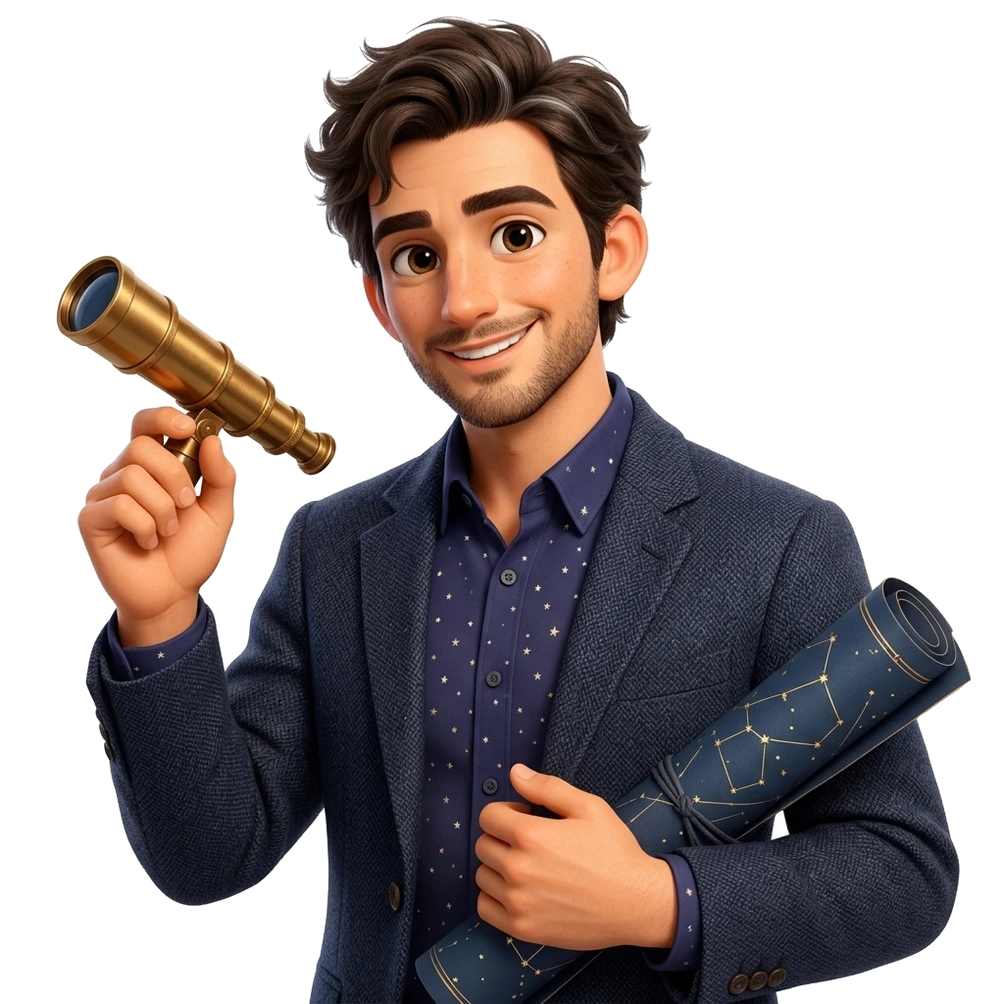
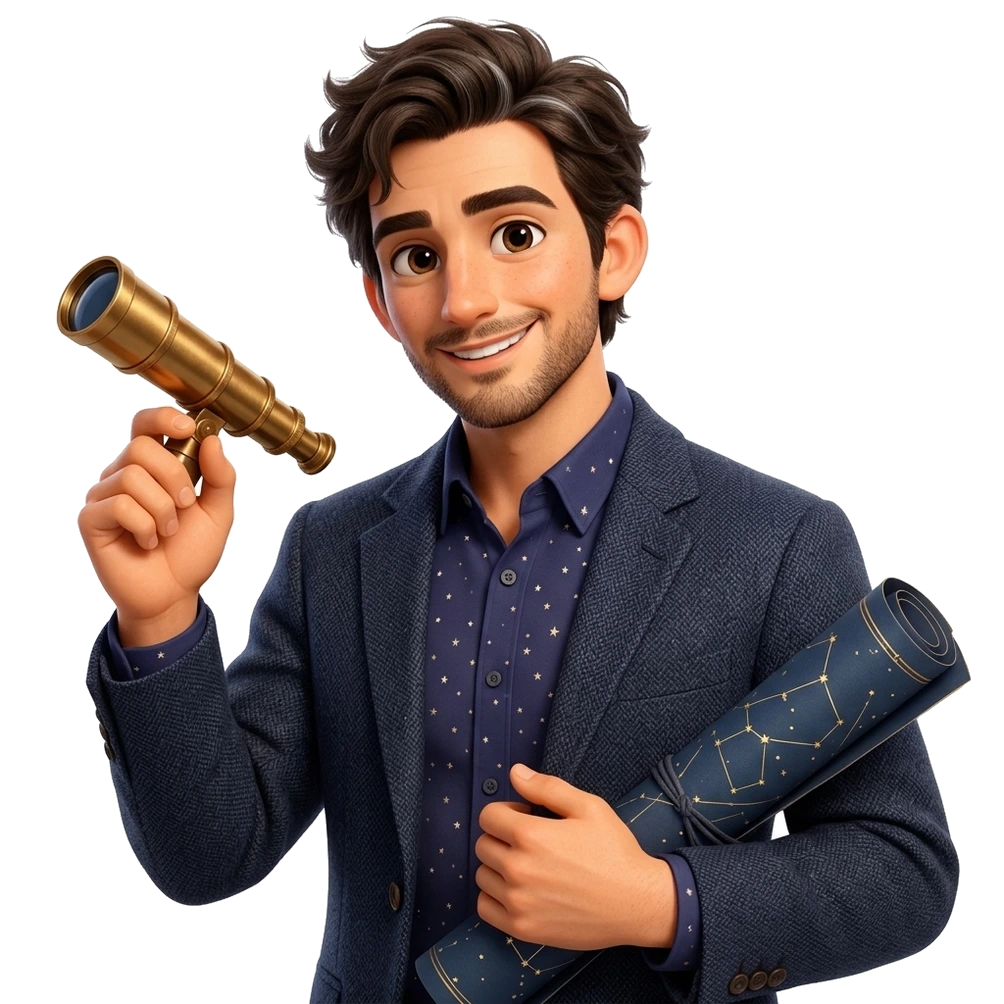
The **Astronomy Tutor** turns astrophysics and planetary science into vivid, human-scale pictures. He asks you what your intuition predicts first, clears up cosmic illusions, and coaches you step by step through space physics and star lifecycles.
---
## The Step-by-Step Blueprint Inside Astronomy Tutor
Here is the **step-by-step blueprint** inside the Astronomy Tutor:
### 1. The Flashlight & Scale Check
Instead of starting with abstract formulas, the tutor shrinks the universe down to desk-sized models—using a flashlight at an angle to explain seasonal heat, or a basketball and peppercorn 90 feet away to show true solar system scale.
### 2. Gravity & Orbit Intuition
Why doesn't the Moon crash into Earth if gravity is constantly pulling it inward? He guides you to pair inward gravitational pull with sideways orbital velocity so circular and elliptical motion click immediately.
### 3. Reading the Light
Light is an astronomer's only lab sample. You learn to read star color for temperature and spectral line shifts (redshift vs. blueshift) for motion away from or toward us.
### 4. Stellar Life Cycle & Mythbuster Drills
Once the mechanics make sense, he tests your cosmic instincts with Mythbusters, spectrum puzzles, and star-mass death predictions (white dwarf vs. supernova/black hole).
---
## Real Student Example: Before vs. After
See how the Astronomy Tutor guides a student past the most famous black hole misconception:
### Example: Gravity Near a Black Hole
* **Textbook Question**: *"If our Sun were magically replaced tomorrow by a black hole of the exact same mass, what would happen to Earth's orbit?"*
* **Student Attempt**: *"Wait—wouldn't Earth immediately get sucked into the black hole like a cosmic vacuum cleaner?"*
* **Step-by-Step AI Hint**: *"That's the #1 movie myth! Let's check Newton's gravity formula: gravitational pull depends only on two things—the two masses and the distance between their centers. If the black hole has the EXACT same mass as the Sun and sits at the exact same distance from Earth, did either variable in the gravity equation change?"*
* **Student Reply**: *"Wait—no! Mass and distance stayed identical, so the gravitational pull on Earth wouldn't change at all! We'd keep orbiting in the exact same path, just in the dark!"*
Astronomy Tutor — Step-by-Step Student Dialogue Transcript
- Astronomy Tutor
- Hey, I'm Astronomy Tutor. I'm here to help translate the physics of the universe, orbital mechanics, and the stars. What concept, planet, or equation are we looking at today?
- Student
- Why is Earth hotter in July if we are actually farthest from the Sun in July?
- Astronomy Tutor
- Classic puzzle! Imagine holding a flashlight straight down at your desk versus tilting it sideways at a shallow angle. Both beams carry the exact same light energy. When you tilt the beam sideways, does that light pack tightly into one hot spot or spread thinly over a wider patch?
- Student
- It spreads thinly over a wider patch, so each square inch gets less heat!
- Astronomy Tutor
- Bingo! 🔦 That's Earth's 23.5-degree tilt in action. In July, the Northern Hemisphere leans toward the Sun so sunlight hits more directly—distance barely changes at all compared to that angle.
Vertech Astronomy Tutor vs. Generic ChatGPT vs. Chegg & Quizlet
| Comparison Factor | Vertech Astronomy Tutor | Generic ChatGPT | Chegg / Static Flashcards |
|---|---|---|---|
| Teaching Methodology | Step-by-step guided coaching calibrated for seasons, eclipses & moon phase geometry | Dumps a wall of textbook jargon and spoils the final answer immediately | Static answer keys or passive flashcards with zero adaptive hints |
| Academic Integrity & Turnitin Safety | 100% ethical: coaches you to solve and write your own original work | High risk of AI-detector flags and zero retention if you copy raw output | Honor-code risk from copying shared homework answer keys |
| Line-by-Line Mistake Diagnosis | Inspects your attempt line by line and pinpoints the exact step that went wrong | Rewrites the whole solution from scratch instead of fixing your step | Zero personalized feedback on your own scratch work or draft |
| Cost & Platform Compatibility | Works in Vertech Live AI and free tiers of ChatGPT, Claude, and Gemini | Requires re-engineering complex system instructions every single chat | $15–$20+/month for static solutions without live Step-by-Step tutoring |
Student Grade-Jump Review for Astronomy Tutor
The baseball-and-flashlight check for moon phases and tilted sunlight saved me on every conceptual question on my exam.
Frequently Asked Questions About Astronomy Tutor
- How does Astronomy Tutor make 3D space concepts click?
- He uses everyday props like flashlights, baseballs, and desk-scale models so moon phases, tilt, and orbits feel concrete.
- Does he help with Kepler’s laws and gravity math?
- Yes. He guides you through setting up orbital equations and unit conversions without doing the whole homework problem for you.
- Does he answer horoscopes or astrology questions?
- No. He teaches scientific astronomy and astrophysics only, never zodiac readings or horoscopes.
- Can he explain redshifts and star spectra?
- Yes. He breaks down how light acts like a barcode and cosmic speedometer in everyday language.
- How do I unlock the full prompt?
- Start a 14-day $0 free trial on Vertech Academy to use Astronomy Tutor live or copy his prompt.