

Ir a la sección (7)
- 1.All 10 Study Methods Ranked from S-Tier to F-Tier (2026)
- 2.Workflow #1: Turn Any Lecture PDF Into an S-Tier Active Recall Drill
- 3.Workflow #2: The 10-Minute "Blank-Page Blurting" + AI Gap Audit
- 4.Workflow #3: The "Interleaved Problem Mixer" for STEM Midterms
- 5.Automate S-Tier Study Methods Inside Vertech Academy
- 6.Final Verdict: Trade Cozy Hours for High-Retention Sprints
- 7.Frequently Asked Questions
El recuerdo activo y la repetición espaciada son los únicos métodos de nivel S respaldados por décadas de ciencia. Subrayar y releer se sienten productivos pero apenas funcionan.
Here is the most painful paradox in higher education: when researchers survey college students on how they prepare for midterms, 78% say their primary strategy is re-reading lecture slides and highlighting textbooks. Yet when cognitive psychologists test those exact two habits in controlled lab studies, re-reading and highlighting score near zero for long-term exam retention.
Based on Professor John Dunlosky's landmark meta-analysis of 700+ memory studies and UCLA's research on "Desirable Difficulties," one scientific law governs all human learning: memory is forged when you struggle to pull information OUT of your head, never when you passively try to pour it IN. Below is the definitive 2026 Science-Ranked Study Tier List (from S-Tier to F-Tier), plus how to automate the S-Tier habits in 30 seconds using Vertech's Pocket Quiz, Simplifier Specialist, and Learning Planner.
The 6 Highest-Yield Study Habits Ranked by Retention ROI
-
 S-Tier #1: Active Recall Testing1-question-at-a-time retrieval via Vertech Pocket Quiz
-
S+S-Tier #2: Spaced Repetition (2-3-5-7)Reviewing right before Ebbinghaus's forgetting curve drops
-
 A-Tier #3: Feynman Teach-BackExplaining concepts out loud in plain English & fixing gaps
-
 A-Tier #4: Interleaved Problem SetsShuffling Chapters 1-4 together so you practice choosing formulas
-
 A-Tier #5: Dual Coding (Visual + Text)Drawing blank-page concept maps from memory after reading
-
FF-Tier Trap: Re-Reading & HighlightingCreates false familiarity with near-zero closed-book recall

All 10 Study Methods Ranked from S-Tier to F-Tier (2026)
Here is how the 10 most common study techniques rank according to peer-reviewed cognitive science (Dunlosky et al.; Roediger & Karpicke; Bjork), along with the exact 2026 AI tool that supercharges each one:
10 Study Methods Ranked by Empirical Exam Retention & Time Efficiency
| Study Method | Science Tier | 7-Day Exam Retention | Why It Works (or Fails) | 2026 AI Acceleration Workflow |
|---|---|---|---|---|
| 1. Practice Testing (Active Recall) | S-Tier (High Utility) | 85% to 92% | Retrieval effort strengthens neural pathways | 1-at-a-time quizzes in Vertech Pocket Quiz |
| 2. Spaced Repetition (Distributed) | S-Tier (High Utility) | 82% to 90% | Interrupts forgetting curve right before decay | 2-3-5-7 calendar via Learning Planner + Anki/Knowt |
| 3. Feynman Technique (Teach-Back) | A-Tier (High-Moderate) | 75% to 84% | Exposes hidden blind spots in your mental model | Grade your explanation via Simplifier Specialist |
| 4. Interleaved Practice (Shuffled) | A-Tier (Best for STEM) | 76% to 83% | Trains your brain to diagnose WHICH formula fits | Shuffled problem sets in Calculus Tutor |
| 5. Elaborative Interrogation ("Why?") | A-Tier (Moderate-High) | 70% to 78% | Connects new facts to existing causal schemas | Socratic "Why/How" drills in Critical Thinking Expert |
| 6. Blank-Page Blurting / Mind Maps | B-Tier (When Closed-Book) | 62% to 72% | Free-recall dump before checking missing links | Audit your blurted sheet with Notes Organizer |
| 7. Pomodoro Technique (25/5 Timer) | B-Tier (Focus Wrapper) | Depends on Active Task | Beats procrastination, but must pair with S-Tier | Run 25-min Pocket Quiz sprints |
| 8. Summarizing Open-Book Notes | C-Tier (Low-Moderate) | 35% to 45% | Often turns into mindless transcription | Convert summaries into Cornell cue questions |
| 9. Highlighting & Color-Coding | F-Tier (Low Utility) | 15% to 25% | Zero cognitive effort; aesthetic procrastination | Stop highlighting; turn bold terms into flashcards |
| 10. Passive Re-Reading of Slides | F-Tier (Worst ROI) | 10% to 20% | Creates false visual fluency ("I recognize that!") | Close the slides and take a 5-question pre-test first |
Quizzing is not just for measuring learning; it CREATES learning
In classic Washington University experiments, students who read a passage once and took 3 recall quizzes remembered 50% more a week later than students who studied the passage 4 times straight.
If studying feels easy and relaxing, it isn't working
Re-reading feels soothing because your brain expends zero effort. Taking a closed-book quiz in Pocket Quiz feels uncomfortable because your brain has to strain, and that strain is what wires long-term memory.
Four 30-minute sessions beat one 2-hour cram session
Reviewing a lecture 24 hours later, 3 days later, 5 days later, and 7 days later flattens the forgetting curve permanently (see our 14-day AI finals game plan).
Guessing wrong BEFORE reading a chapter boosts retention
Even if you score 20% on a 5-question pre-quiz before reading a new chapter, trying to answer primes your brain's "search radar" to lock onto the answers as soon as you read them.
Workflow #1: Turn Any Lecture PDF Into an S-Tier Active Recall Drill
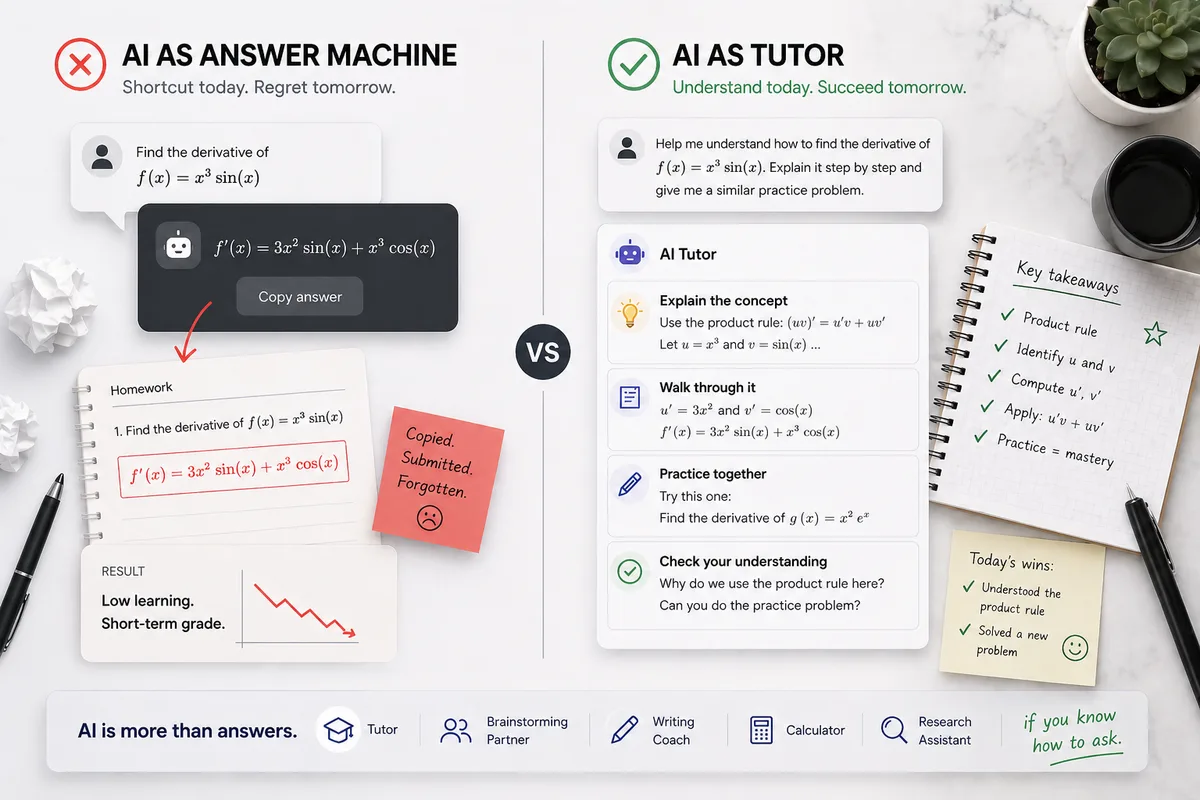
Instead of reading your lecture slides for the third time tonight, upload the slides into our Pocket Quiz or Generalist Teacher with Prompt #1. It combines S-Tier Practice Testing with A-Tier Elaborative Interrogation ("Why does X cause Y?"):
Workflow #2: The 10-Minute "Blank-Page Blurting" + AI Gap Audit
"Blurting" is one of the fastest ways to diagnose what you actually know: take a blank sheet of paper (or a blank document), set a timer for 8 minutes, and write down everything you remember about today's lecture from memory. Then, paste both your messy "blurt" and your real lecture notes into our Simplifier Specialist or Notes Organizer with Prompt #2 so it highlights the exact 20% you forgot:
Workflow #3: The "Interleaved Problem Mixer" for STEM Midterms
Why do students ace homework sets on Section 4.1, 4.2, and 4.3, and then bomb the Chapter 4 exam? Because textbook homework uses Blocked Practice: when you are doing Section 4.2 homework, you already know every single problem uses the Section 4.2 formula! On the exam, the questions are shuffled without section labels. Use Prompt #3 with our Calculus Tutor or Pocket Quiz to create an Interleaved Practice Set (see also our step-by-step STEM math guide):
F-Tier "Cozy Studying" vs. S-Tier High-Retention Studying
The F-Tier "Illusion of Competence"
- • Re-reading lecture slides 3 times in a row until the words look familiar (mistaking visual recognition for memory).
- • Highlighting 60% of a textbook page in four pastel colors without ever closing the book to test yourself.
- • Rewriting neat, calligraphic iPad notes while listening to music (pure motor transcription with zero retrieval).
- • Cramming all 5 hours of studying into the night before the test instead of spacing it across 4 days.
The S-Tier Science-Backed System
- • Closing your notes after 15 minutes of reading and running a 6-question Socratic drill in Vertech Pocket Quiz.
- • Doing an 8-minute Blank-Page Blurt and letting Simplifier Specialist expose the exact 20% you forgot.
- • Shuffling problem types via Interleaving so you practice diagnosing which theorem fits unlabeled exam questions.
- • Following a 2-3-5-7 Spaced Repetition calendar built by Learning Planner and AI flashcards.
Automate S-Tier Study Methods Inside Vertech Academy
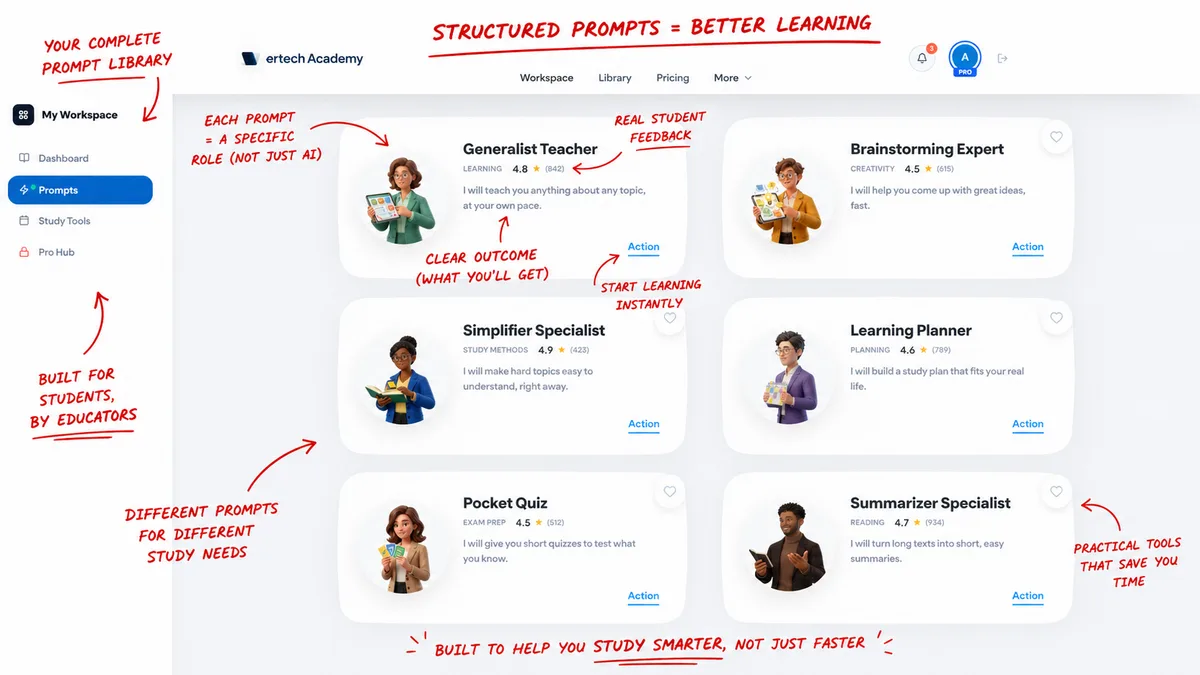
Every prompt inside the Vertech Academy Library was engineered around Dunlosky and Bjork's cognitive science research (see also our ADHD active-focus study guide).
Built for Active Recall, Feynman & Spaced Repetition
Launch Pocket Quiz, Simplifier Specialist, Learning Planner, or Brainstorming Expert to upgrade your study routine to S-Tier in 1 click.
How to Run a Science-Backed 45-Minute Study Session Tonight
Minutes 0 to 10: Closed-Book "Blank-Page Blurt" + AI Gap Check
Write down everything you remember from class on a blank page, then use Prompt #2 to spot the 20% you missed.
Minutes 10 to 30: S-Tier Active Recall Drill in Vertech Pocket Quiz
Answer 8 to 10 "Why/How" application questions one at a time inside Pocket Quiz.
Minutes 30 to 45: Feynman Teach-Back + Schedule Next Spaced Review
Explain the hardest concept out loud to Simplifier Specialist and log your next review date in 48 hours.
Final Verdict: Trade Cozy Hours for High-Retention Sprints
Why 45 Minutes of Active Recall Beats 4 Hours of Highlighting.
The first time you switch from re-reading your slides to taking a closed-book quiz in Pocket Quiz, it is going to feel harder. Your brain will complain because pulling answers out of thin air takes real effort. Embrace that feeling: in cognitive science, that friction is the exact signal that your neurons are wiring the memory in place for exam day, and it lets you close your laptop two hours earlier every night.