Introduction
Imagine your brain is like a messy desk covered in papers. Throughout the day, you pile on more and more information, conversations, facts, TikToks, and math formulas. If you never stop to organize it, you eventually run out of space, and things start falling off the edge.
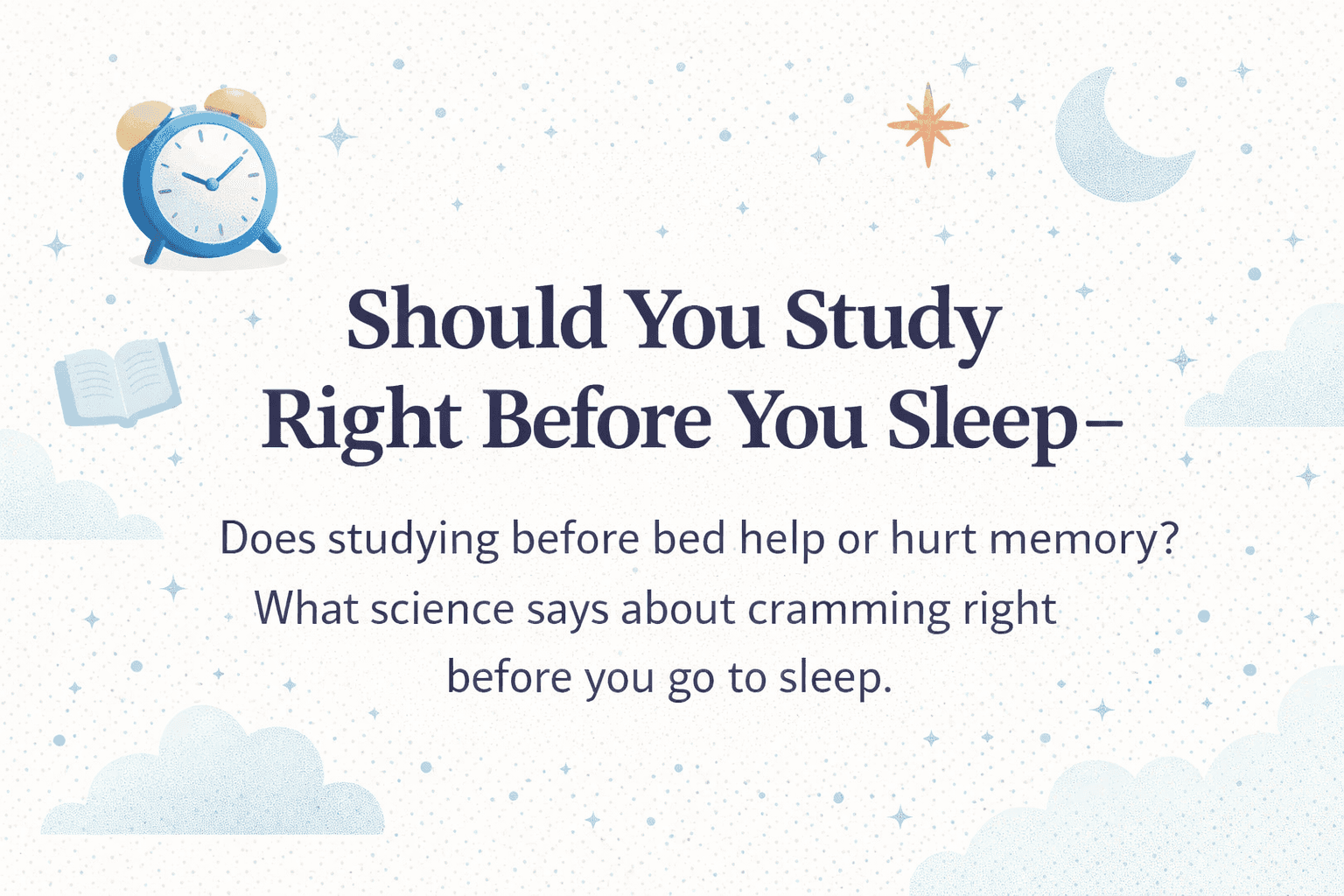
This is where sleep comes in. Many students wonder, should you study right before you sleep? Is it a magic hack to remember everything, or does it just make you tired for no reason? The answer isn't a simple "yes" or "no." It depends on how you do it.
In this post, we will explore the science of sleep and study habits without using confusing medical words. Here is what you will learn:
How your brain files away memories while you dream.
Why looking at your phone to study might backfire.
The specific subjects that are best to review at night.
A simple routine to help you learn without losing sleep.
How Sleep Helps Your Brain Learn
You might think that when you fall asleep, your brain shuts off like a computer. But actually, your brain is incredibly busy while you are dozing. This is when it does its most important filing work.
Scientists call this process "consolidation." Think of consolidation as the "Save" button on a document. When you are awake, you are typing out the information (learning). But if the power goes out before you hit save, you lose that work. Sleep is the moment your brain hits "Save."
According to the National Institutes of Health (NIH), sleep stabilizes memories. It takes the fragile new things you learned and moves them into long-term storage. If you skip sleep to study more, you are essentially typing for hours but forgetting to save your file.
The Science of "Sleep-Learning"
There is a fascinating concept called "replay." Research from MIT News shows that when animals (and humans) learn a maze or a new task, their brains replay that same activity while they sleep. It happens fast, like a movie on fast-forward.
If you study a list of vocabulary words right before bed, your brain is more likely to replay those words during your deep sleep cycles. This is why you sometimes dream about the things you were doing just before bed.
However, this only works if you actually fall asleep. If you stay up all night cramming, you miss the replay window. Your brain never gets the chance to practice what you learned.
The Dangers of Late-Night Cramming
There is a big difference between "reviewing" before bed and "cramming" before bed. Cramming is when you try to shove weeks of information into your brain in one night, usually sacrificing sleep to do it.
This is dangerous for your grades. When you are sleep-deprived, your focus drops. You might feel like you are reading, but nothing is sticking. It is like trying to fill a bucket that has a hole in the bottom.
If you have a lot of exams coming up, you need a strategy that doesn't rely on losing sleep. You can read more about balancing a heavy workload in our guide on the Best Way to Study for Multiple Tests Same Week.
Blue Light: The Hidden Enemy
Here is the biggest trap for modern students: Screens.
If your method of studying before bed involves a laptop, a tablet, or a phone, you might be hurting your memory. These devices emit "blue light," which tricks your brain into thinking it is still daytime. This stops your body from making melatonin, the hormone that helps you sleep.
If you study on a screen right before bed, you might find it hard to fall asleep. This cuts into that precious "consolidation" time we talked about earlier.
According to the Sleep Foundation, poor sleep quality directly affects your ability to recall facts. So, if you must study at night, try using physical flashcards, a textbook, or printouts.
Best Subjects to Review at Night
Not all school subjects are created equal when it comes to night study.
Good Night Subjects:
Vocabulary: Simple definitions are easy for the brain to replay.
History Dates: Factual lists work well.
Formulas: Looking at a math formula and memorizing it is great.
Bad Night Subjects:
Complex Problem Solving: Trying to solve a hard physics problem might wake your brain up too much.
Intense Essay Writing: This requires too much active energy and can make you stressed, which keeps you awake.
If you are struggling to keep facts in your head, check out our post on How to Remember What You Studied for a Test. It breaks down memory tricks that work day or night.
Techniques to Study Effectively Before Bed
f you want to try studying before sleep, keep it light and easy. You want to prime your brain, not exhaust it.
One of the most effective methods is Active Recall. Instead of just re-reading your notes, cover them up and try to remember what they say. Do this for 15 minutes before you brush your teeth.
If you have trouble organizing this, technology can actually help (if you use it correctly and turn down the brightness!). We have a tool in our library called the Memory Coach. It is an AI prompt designed to quiz you and help you practice recalling information so it sticks long-term.
You can find it in the Vertech Academy Prompts Library. It is specifically built to teach you techniques to remember what you study better without the stress of cramming.
Morning vs. Night: Finding Your Rhythm
Some people are morning larks; others are night owls.
Morning Learners: Their brains are fresh. They are great at tackling new, hard concepts right after breakfast.
Night Learners: They feel more creative or focused when the house is quiet.
If you are a night owl, studying before bed is natural. Just make sure you have a "cutoff time." You need a buffer zone between studying and sleeping to let your brain cool down.
Practical Routine for Night Owls
If you decide that studying before bed is for you, follow this simple routine to make sure it helps rather than hurts.
The 30-Minute Rule: Stop doing hard work 30 minutes before you plan to sleep.
Dim the Lights: Use a lamp, not the big overhead light.
Review, Don't Re-Learn: Use this time to go over things you already studied during the day. Don't try to learn a brand new chapter from scratch.
Brain Dump: If you are stressed about what you have to do tomorrow, write it down on a piece of paper. This clears your mind so you can sleep.
For more habits that help information stick, read our article on How to Stop Forgetting Everything After the Test.
Conclusion
So, should you study right before you sleep? The verdict is yes, but with a warning.
Reviewing information right before bed can boost your memory because your brain replays and files that data while you sleep. However, this only works if you actually get a good night's rest. If you stay up until 3:00 AM cramming, you are doing more harm than good.
Here is the summary:
Sleep is when you save your work. Don't skip it.
Avoid blue light. Use paper notes or flashcards if possible.
Keep it simple. Review facts and vocab, don't start major projects.
Use tools. Tools like the Memory Coach can make your review sessions faster and more effective.
For more research on how memory works, you can visit the Yale School of Medicine news page which covers how sleep preserves memory.
Treat your sleep like part of your study session, and you will find yourself remembering more with less effort.