Introduction
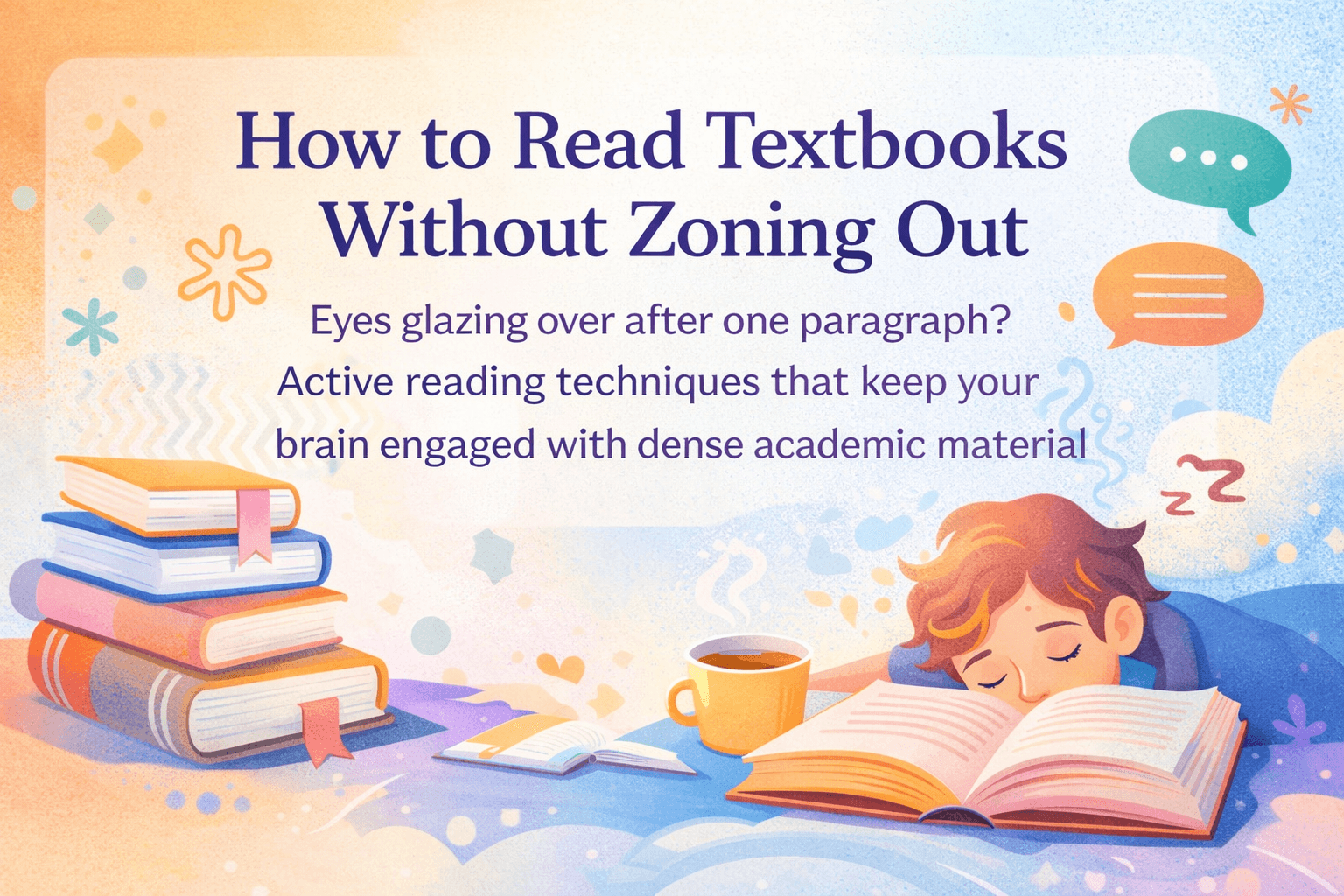
You sit down, open your textbook, and tell yourself you are going to crush this chapter. Five minutes later, your eyelids feel heavy. Ten minutes later, you are rereading the same sentence for the fourth time. Fifteen minutes later? You are fast asleep.
It happens to almost everyone. Textbooks are often written in a way that is dry, dense, and frankly, boring. But if you have a test coming up, you don't have a choice—you need to get that information into your brain. The good news is that falling asleep isn't something that just "happens" to you; it is a reaction you can stop with the right tricks.
In this guide, we are going to break down exactly how to stay awake and actually learn from your reading. We will cover:
Why your brain tries to shut down when you read specific books.
Simple changes to your room that keep you alert.
Active reading tricks so you aren't just staring at words.
How to use tools to do the heavy lifting for you.
Let’s turn that boring reading session into a win.
Why Textbooks Are So Sleep-Inducing
Before we fix the problem, it helps to know why it is happening. You aren't lazy, and you aren't "bad at reading." There is actually a bit of science behind why textbooks act like a sleeping pill.
When you read a novel or a comic book, your brain is excited. It wants to know what happens next. There is tension, emotion, and surprise. Textbooks are different. They are usually just facts, lists, and explanations. This requires what experts call "effortful processing." Your brain has to work hard to turn those words into meaning.
Because your brain is working hard without the reward of a fun story, it gets tired quickly. If you are also sitting in a comfortable chair or lying on your bed, your brain gets confused. It thinks, "I am tired, and I am in a comfy spot... it must be time to sleep!"
According to BBC Science Focus, reading relaxes you and lowers your heart rate. If the material is boring, that relaxation turns into drowsiness fast. To fight this, we need to stop your brain from relaxing too much.
Fix Your Environment to Stay Alert
The first step to staying awake has nothing to do with the book itself. It is all about where you are. If you try to read a boring history chapter while lying under a cozy blanket, you are going to lose that battle every time.
Get Out of Bed Your brain is trained to associate your bed with sleep. As soon as you lay down, your body starts prepping for a nap. The number one rule for reading boring stuff is: Never read in bed. Sit at a desk, a kitchen table, or even on the floor.
Check Your Lighting Dim light tells your body it is evening time. If you are reading with just a small lamp, you are signaling your brain to wind down. Try to use bright, cool-colored light (like a white LED bulb) or natural daylight near a window. Bright light wakes up your nervous system.
Temperature Matters Warm rooms are cozy, but "cozy" is the enemy of studying. If your room is too warm, you will get sleepy. Try keeping the room a little cooler than usual, or even open a window for fresh air. The slight chill will keep you on your toes.
Hydrate with Cold Water Keep a glass of ice water next to you. Taking a sip of cold water gives you a small jolt of alertness. Plus, dehydration can make you feel tired and sluggish, so drinking water helps your brain work better.
The Active Reading Method (Don’t Just Stare)
The biggest mistake students make is passive reading. Passive reading is when you just move your eyes across the page, hoping the information sticks. This is the fastest way to fall asleep because your brain isn't actually doing anything.
To stay awake, you need to switch to Active Reading. This means you are physically doing something while you look at the text.
The SQ3R Method One of the most famous techniques for this is called SQ3R. It sounds fancy, but it is really simple. It stands for:
Survey: Look at the chapter titles, bold words, and pictures first.
Question: Turn the headers into questions (e.g., change "The Causes of WWI" to "What were the causes of WWI?").
Read: Read the section to find the answer to your question.
Recite: Say the answer out loud in your own words.
Review: Look over what you learned.
By searching for answers instead of just reading words, you turn reading into a scavenger hunt. This keeps your brain engaged because it has a job to do. You can read more about this classic method from University of Toronto's guide on SQ3R.
The Power of Skimming First
Have you ever watched a movie trailer before seeing the film? It gets you interested and tells you what to expect. You should do the same thing with your textbook.
Before you read a single sentence of the actual text, spend 5 minutes skimming.
Read the Introduction paragraph.
Read the Conclusion or Summary at the end.
Look at every picture, chart, and graph.
Read the bold keywords.
This creates a "map" in your head. When you actually start reading, your brain will recognize things: "Oh, I saw this in the chart earlier!" It makes the reading feel faster and less overwhelming.
If you dive straight into the first sentence without skimming, it feels like walking through a forest without a map. You don't know how long the journey is or where you are going, which is exhausting. Skimming gives you a finish line.
Take Breaks (they are healthy)
You cannot read a boring textbook for two hours straight. It is biologically impossible for most people to maintain high focus on boring tasks for that long. You need to chop the time up.
The Pomodoro Technique This is a classic productivity timer method. You set a timer for 25 minutes of focus, followed by a 5-minute break.
25 Minutes: Read with zero distractions (phone away!).
5 Minutes: Do something physical.
What to do during the break: Do NOT scroll on TikTok or Instagram. That doesn't rest your brain; it just fills it with more noise. Instead:
Do 10 jumping jacks.
Walk to the kitchen and back.
Stretch your arms.
Look out a window at something far away.
This physical movement gets your blood flowing again, pumping oxygen to your brain so you are ready for the next 25 minutes. You can learn more about how this timing works from Todoist’s guide to the Pomodoro Technique.
If you are trying to plan a big study session with lots of breaks, you might want to check out our post on the Best Way to Study for Multiple Tests Same Week, which talks about how to organize your time so you don't burn out.
Turn Reading into a Game
If the book is boring, you have to make the process fun. Gamification is the idea of adding game-like rules to normal tasks.
The "Candy on the Page" Trick This is a classic for a reason. Take a small pieces of coloured Paper and place them at the end of every 3rd page, once you read the page you give yourself a treat. You are not allowed to have your reward it until you finish reading those pages. It sounds silly, but that little reward gives you a dopamine hit that keeps you moving forward.
The "Teacher" Game Pretend you have to teach this material to someone else in 10 minutes. Read a section, then look away and try to explain it out loud to an empty chair (or your dog). If you can't explain it simply, you didn't really read it. This pressure to "perform" wakes your brain up.
This technique helps a lot with memory, too. If you are worried about forgetting what you read the next day, take a look at our guide on How to Remember What You Studied for a Test.
Use Tools to Help You
Sometimes, no matter how much water you drink or how bright the lights are, the text is just too complicated or too long. This is where modern technology can save you. You don't have to suffer through 50 pages of dense academic jargon alone.
If you are stuck on a massive block of text and your eyes are glazing over, you can use AI to help break it down for you. We have a specific tool in our library designed exactly for this moment.
Try the Summarizer Specialist The Summarizer Specialist prompt takes long, complicated reading material and pulls out just the main points so you can understand what matters most without reading everything.
It looks for the key arguments.
It simplifies the difficult language.
It gives you a summary you can actually understand.
You can copy a section of your textbook, paste it into your AI with this prompt, and get a clear version in seconds. Then, you can read the textbook version with a much better idea of what is going on. You can find this prompt in our Prompts Library.
Using a tool like this isn't "cheating", it is making sure you actually understand the concepts instead of just sleeping through them, if you give its output to your teacher while pretending it was your own, that's cheating.
Taking Notes That Keep You Engaged
Reading with a pen in your hand is one of the best ways to stay awake. If your hand is moving, you are less likely to doze off.
Don't Just Highlight Highlighting is actually kind of lazy. You can highlight a whole page without reading a word of it. Instead, try annotation.
Write summaries in the margins.
Draw arrows connecting ideas.
Put a big question mark (?) next to things you don't get.
Draw little pictures that represent the concepts.
Handwriting vs. Typing Try to take notes on paper rather than a laptop. The bright screen of a laptop can be distracting, and it is too easy to open a new tab and check social media. Handwriting forces you to slow down and process the information.
For more ideas on how to interact with your text, check out these active reading strategies from Beanstack. They list great ways to make notes that actually help you learn.
Conclusion
Reading a dry textbook doesn't have to be a fight against gravity. By changing your environment, sitting up straight, and using active strategies like SQ3R or the Pomodoro technique, you can get through your reading list without a nap.
Remember, the goal isn't just to look at every word; the goal is to understand the ideas. If you are really stuck, don't be afraid to use tools like the Summarizer Specialist to get you unstuck.
Next time you feel your eyelids drooping:
Stand up.
Drink some cold water.
Set a timer for 20 minutes.
Attack the chapter with a plan.
You’ve got this. Now go crush that chapter.