Introduction
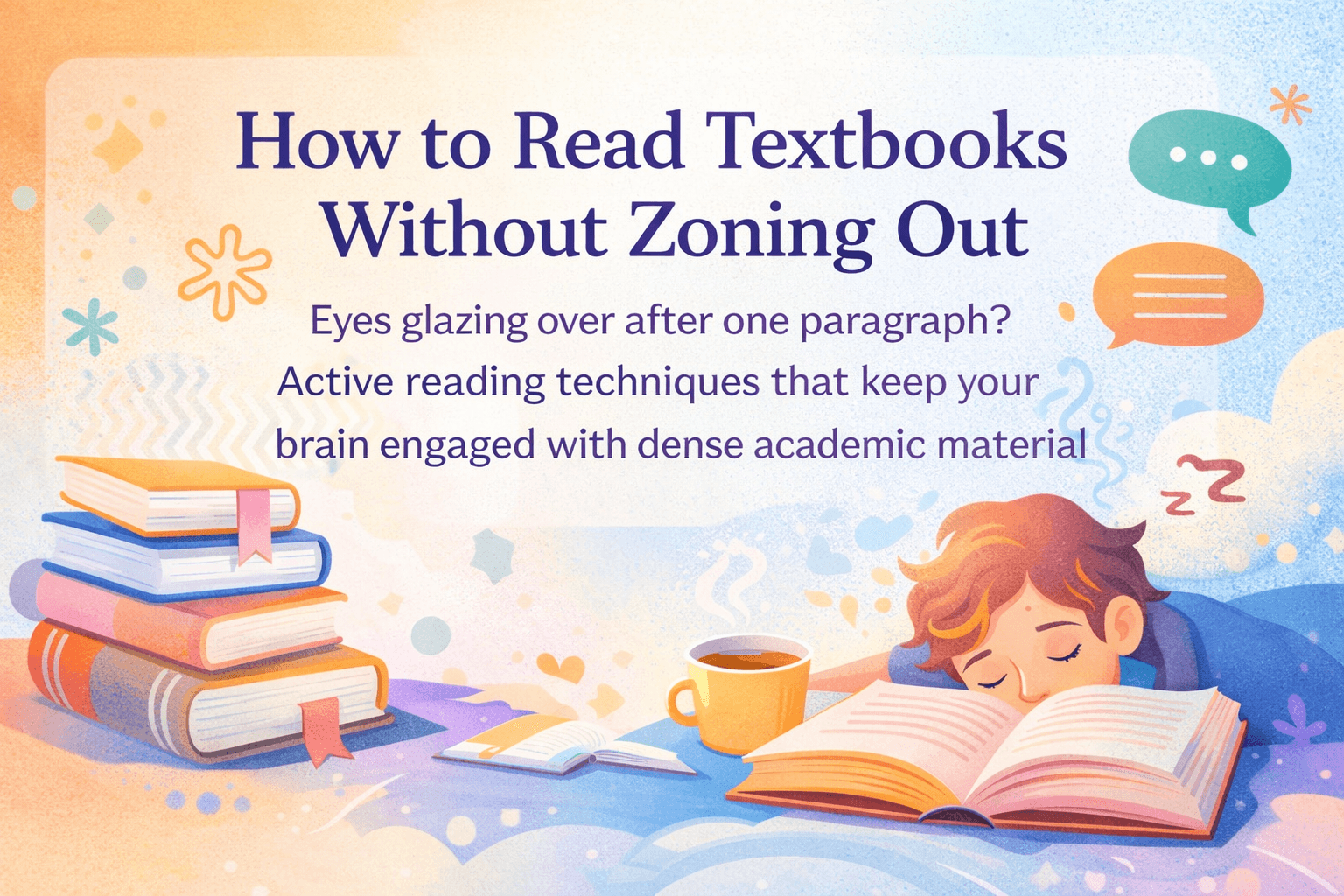
You know the feeling. You have been staring at page 42 of your history textbook for twenty minutes. You read the same paragraph three times. But if someone paid you a million dollars, you still could not tell them what it said.
Your eyes are moving across the page. You are pronouncing the words in your head. Yet, your brain has completely checked out. It is thinking about dinner, that awkward thing you said yesterday, or literally anything else.
This is the "Zombie Reader" effect. It is frustrating, and it makes studying take three times longer than it should.
But here is the good news: You are not broken.
Textbooks are dense. They are not written like novels or Instagram captions. They are packed with heavy information that requires a specific type of focus. If you try to read them like you read a story, you will zone out every time.
In this guide, we will cover:
Why your brain shuts down during dense reading
How to "warm up" your brain before you start
The SQ3R method (simplified for real life)
How to use AI to check if you actually learned anything
Quick fixes for your study environment
Ready to stop wasting hours staring at the same page? Let’s get started.
Why You Keep Zoning Out (It's Not Just Boredom)
First, we need to stop the self-blame. You are not lazy. The problem is usually your approach.
Most students read passively. Passive reading is like watching a movie. You sit back, let the words wash over you, and hope some of it sticks.
The problem? Learning is not a spectator sport.
When you watch a movie, the director does all the work for you. They control the pace, the music, and the focus. When you read a textbook, you have to be the director. You have to decide what is important.
Cognitive Load Think of your brain like a web browser. If you have 50 tabs open, the browser slows down and crashes.
Textbooks fill up your "browser tabs" very quickly because every sentence is new information. If you do not process that information immediately, your brain runs out of memory. When that happens, you zone out. It is your brain's way of going into "screensaver mode" to save energy.
To fix this, we need to switch from passive reading to active reading.
Active reading is like solving a puzzle. You are not just looking at the pieces; you are constantly moving them around, trying to fit them together, and looking for patterns. It takes more effort upfront, but it saves you hours of re-reading later.
According to research from the University of North Carolina Learning Center, treating reading as an active process is the single biggest change you can make to improve retention.
The Pre-Read Strategy: Warm Up Your Brain
You would not sprint 100 meters without stretching first. You would pull a muscle.
Yet, most students dive straight into Chapter 4, Sentence 1, without any warm-up. This is a recipe for instant boredom. Your brain has no context for what is coming, so it gets overwhelmed.
Before you read a single sentence of the actual text, you need to do a Pre-Read.
The Movie Trailer Method Think of the Pre-Read as watching the trailer before the movie. It tells you who the characters are and what the plot is. This creates a "mental shelf" in your brain where you can place the information later.
Here is how to do a 5-minute Pre-Read:
Read the Title and Intro: What is this chapter even about?
Read the Headings: Flip through the pages and just read the bold headlines. This gives you the structure.
Look at the Pictures: Yes, look at the charts, graphs, and photos. Read the captions. Visuals often explain the concept faster than the text.
Read the Summary at the End: Most textbooks have a "Conclusion" or "Key Takeaways" section. Read this first. It spoils the ending, which is exactly what you want.
Why this works When you finally start reading the dense paragraphs, your brain will go: "Oh, I remember seeing a heading about this."
It makes the information feel familiar instead of scary. This lowers the cognitive load (that "browser tab" usage we talked about) and keeps you focused.
The SQ3R Method Simplified
If you look up study tips, you will eventually find SQ3R. It stands for Survey, Question, Read, Recite, Review.
It was developed decades ago, but it is still the gold standard for academic reading. However, the official version can feel a bit stiff. Let’s break it down into a version you will actually use.
Step 1: Survey (The Pre-Read) We just did this. Scan the headings and images. Get the big picture.
Step 2: Question (The Game Changer) This is where you stop being a zombie. Before you read a section, look at the heading and turn it into a question.
Heading: "The Causes of the French Revolution"
Your Question: "What were the main causes of the French Revolution?"
Now, you are not just reading. You are on a treasure hunt. You are looking for the answer to your question. This gives your brain a specific goal, which makes it much harder to drift off.
Step 3: Read Read the section to find the answer to your question. Do not worry about the fluff. Just hunt for the answer.
Step 4: Recite Look away from the book. Can you answer your question in your own words? If you can’t, you didn’t learn it. Read it again.
Step 5: Review Once you finish the chapter, look at your list of questions. Can you still answer them?
This method forces you to engage with the text. You can find more deep dives on this structure from resources like Eastern Mennonite University, which breaks down the science behind why this structure helps memory.
Interrogating the Text (Active Reading)
To stay awake, you need to be a little aggressive with your textbook. Do not just let the author talk at you. Talk back.
We call this Interrogating the Text.
Imagine the author is sitting across from you. If they said something confusing, you would ask, "What do you mean by that?" or "Can you give me an example?"
Do the same thing while you read.
The "So What?" Test After every paragraph, ask yourself: "So what? Why does this matter?"
If you cannot answer, you probably just read "filler" text, or you missed the point.
Connect it to what you know Try to link the new information to something you already understand. this is called elaboration.
Textbook concept: "Mitochondria is the powerhouse of the cell."
Your brain: "Okay, so it is like the battery in my phone."
Using AI to check your work Sometimes, you think you understand a concept, but you are actually fooling yourself. This is called the "Illusion of Competence." You recognize the words, so you think you know the material.
A great way to test this is to explain it to someone else. But if you do not have a study buddy available at 2 AM, you can use AI.
You can use this prompt for checking your understanding. It acts like a tutor that listens to your explanation. You type in what you think the chapter was about, and the AI tells you what you missed.
This forces you to recall the information (which strengthens memory) and gives you instant feedback. It is safer than waiting for the exam to find out you didn't get it.
Managing Your Environment and Focus
Sometimes, the problem isn't the book. It's the room.
If you are trying to read a dense biology textbook while lying in bed, with Netflix on in the background, and your phone buzzing every 30 seconds, you are going to fail.
Your brain looks for distractions when it encounters something hard (like reading). You have to remove the exit ramps.
The "Phone in Another Room" Rule This is painful, but necessary. Research shows that just having your phone within sight reduces your cognitive capacity. Even if it is off.
Put it in another room. Or at least throw it under your bed.
Lighting and Posture Do not read in bed. Your brain associates bed with sleep. If you get comfortable, your body will prioritize napping over learning physics.
Sit at a desk or table.
Use bright, cool lighting. Warm, dim lights signal relaxation.
Sit up straight. It helps oxygen flow to your brain.
The Pomodoro Technique No one can read dense material for two hours straight. Your focus is a limited resource.
Try the Pomodoro Technique:
Set a timer for 25 minutes.
Read as focused as you can.
When the timer beeps, stop.
Take a 5-minute break (stretch, get water).
Knowing that there is a "finish line" coming in 25 minutes makes it easier to stay focused. You aren't reading "forever," you are just reading for 20 more minutes. You can learn more about how timing affects focus from productivity resources like Todoist's guide to Pomodoro.
Note-Taking That Actually Keeps You Awake
Many students highlight their textbooks until the page looks like a neon coloring book.
Stop highlighting.
Highlighting is a passive activity. You can move a yellow marker across a page without your brain actually turning on. Plus, when you look back later, you just see a sea of yellow and don't know what is important.
Instead, try Summarizing in the Margins.
After you read a paragraph, write a 3-word summary in the white space next to it.
Paragraph: Explains how plants turn sunlight into energy using chlorophyll.
Your Note: "Sunlight -> Energy process"
Why this works To write a summary, you have to understand what you just read. You cannot summarize something you didn't pay attention to. It forces your brain to process the information immediately.
Mind Mapping If you are a visual learner, ditch the lists. Draw a map.
Put the main concept in the middle of a blank sheet of paper. Draw branches out for the main headings. Draw smaller twigs for the details.
This helps you see how ideas connect. Textbooks are linear (one word after another), but knowledge is usually a web of connections. Drawing it out matches how your brain actually stores data.
What to Do When You Just Can't Focus
Sometimes, despite your best efforts, the words are just swimming on the page. You have tried the Pre-Read, you hid your phone, and you are still zoning out.
Here is a troubleshooting checklist for when your brain refuses to cooperate:
1. Check your physical state Are you hungry? Thirsty? Tired? Your brain consumes a huge amount of energy. If you haven't eaten or slept, it cannot process complex text. Drink a glass of cold water and eat a snack with protein.
2. Switch formats If the text is just too dry, try to find a video on the same topic first. Watch a 10-minute YouTube explanation of the concept. Once you understand the "gist," go back to the reading. The text will make much more sense because you already know the story.
3. Read out loud It feels silly, but it works. Reading out loud forces you to slow down. It also engages a different part of your brain (auditory processing). You are seeing the words and hearing them.
4. The "Just 5 Minutes" Trick Procrastination usually comes from fear. The task feels too big. Tell yourself, "I am just going to read for 5 minutes. If I still hate it, I can stop."
Usually, once you start, the friction disappears and you can keep going.
5. Change your scenery If your desk feels like a prison cell, move. Go to the kitchen table. Go to a coffee shop. A change in environment can reset your focus.
Conclusion
Reading textbooks does not have to be a fight against sleep.
The reason you zone out is not because the material is boring (though, let’s be honest, sometimes it is). It is because you are trying to absorb heavy information passively.
By switching to active strategies, you turn reading into a challenge rather than a chore.
Here is your quick recap:
Warm up: Always scan the headings and summary before you start reading.
Question everything: Turn headers into questions and hunt for the answers.
Check your work: Use tools like the Active Listener prompt to verify you actually understood what you read.
Environment matters: Get out of bed, hide your phone, and use a timer.
Stop highlighting: Write short summaries in the margins instead.
Next time you have a heavy reading assignment, do not just open the book and hope for the best. Take five minutes to pre-read. It will save you an hour of re-reading later.
You have the tools. Now go crush that chapter.