Introduction
Have you ever walked into a classroom only to see a "No Recording" sign on the syllabus? Many students find themselves in a panic when they realize they can't record lectures due to university policies or professor preferences. In a world where we rely on digital replays, being forced to rely on handwritten notes feels like a step backward. However, searching for lecture recording alternatives is about more than just finding a workaround. It is about learning how to process information effectively.
If you leave class with fragmented bullet points and messy handwriting, do not worry. You can use modern technology to implement a comprehensive poor notes fix that actually strengthens your memory. Instead of passively listening to an audio file, you can reconstruct lecture AI content using your own memory and course materials. This method forces your brain to engage with the subject matter. Consequently, you end up with a deeper understanding than if you had simply re-watched a video.
At Vertech Academy, we focus on helping you study with academic integrity while using the best tools available. This guide will show you how to turn your worst notes into your best study guides. By exploring these lecture recording alternatives, you will discover that you don't need a perfect recording to be a top student. Let’s look at how you can bridge the gap between a fast-talking professor and a high-quality study session.
Why Some Professors Say No to Recordings
It is important to understand why the option to record is often taken away. Many universities, such as the University of Pittsburgh, emphasize that classroom discussions are protected intellectual property. Professors often want to create a "safe space" where students can debate ideas without fear of being recorded. When you can't record lectures, it is usually an attempt to keep the conversation private and spontaneous.
Furthermore, academic institutions like Oxford University often believe that recording encourages "passive learning." If you know you can watch the video later, you might not pay as much attention in the moment. Therefore, looking for lecture recording alternatives is actually a response to an intentional pedagogical choice. The goal is to make you a more active participant in your own education.
In my experience, students who rely too heavily on recordings often procrastinate on their revision. They think, "I'll just listen to the audio before the exam." However, when finals arrive, they have forty hours of audio to get through. This is why a poor notes fix involving immediate AI reconstruction is so much more effective. It turns a "lack of data" into a "learning opportunity."
The Cognitive Science Behind the Poor Notes Fix
Why are messy notes actually a good thing? According to research published in Scientific American, the act of "generative note-taking" is vital for retention. When you summarize and paraphrase in real-time, you are already learning. A poor notes fix is effective because it forces you to use active recall to fill in the missing pieces later.
If you had a perfect recording, you might never think about the lecture again until it’s too late. But when you reconstruct lecture AI style, you have to remember what the professor said to prompt the AI correctly. This mental struggle is exactly what builds long-term memory. It is one of the most powerful lecture recording alternatives because it relies on your biological "hard drive" first.
Active retrieval: Trying to remember a missed point strengthens neural pathways.
Synthesis: Combining bad notes with textbook data creates a "Master Note."
Organization: AI helps categorize your messy thoughts into logical hierarchies.
Therefore, do not be discouraged by a few missed sentences. As long as you have a few keywords, you have enough to start the reconstruction process. This transition from "recording" to "reconstructing" is the hallmark of an expert student.
How to Reconstruct Lecture AI Content from Memory
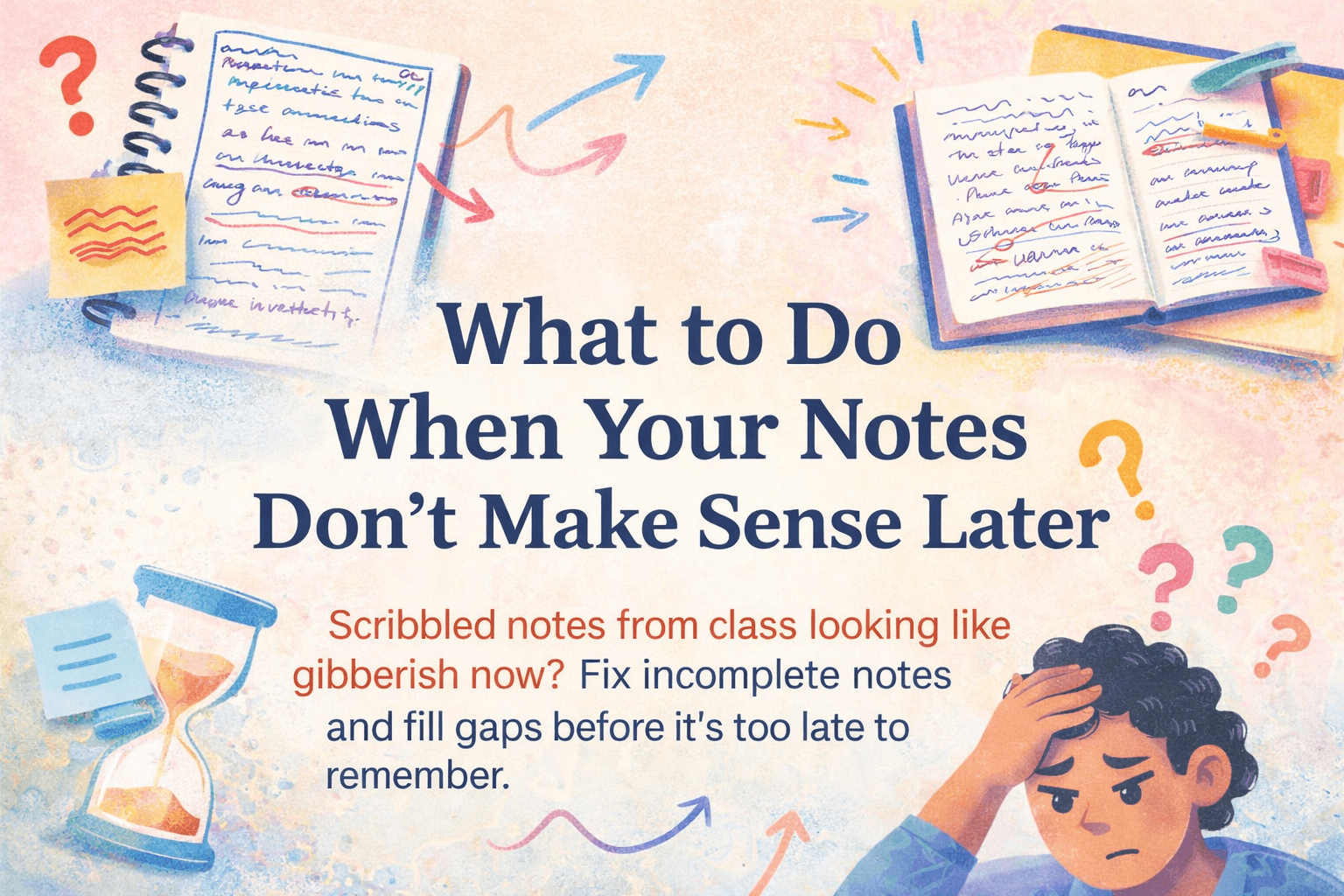
The most effective poor notes fix starts the moment class ends. Within 15 minutes of leaving the room, sit down and "brain dump" everything you remember. Do not worry about formatting yet. Just get the raw ideas out. This is the first step when you can't record lectures and need to build a study guide from scratch.
Once you have your messy notes and your brain dump, you can reconstruct lecture AI content using a conversational tool. Upload your text and say: "I just attended a lecture on [Topic]. Here are my fragmented notes. Can you help me organize these into a logical flow and identify where I might be missing a transition?" The AI acts as a collaborative partner, not just a search engine.
This is one of the best lecture recording alternatives because it turns a solo activity into a dialogue. The AI can suggest: "It looks like you moved from Point A to Point C. Did the professor mention anything about the relationship between them?" This prompt reminds you of that one thing the professor said that you forgot to write down. This is the ultimate way to reconstruct lecture AI data while it is still fresh in your mind.
Using Your Syllabus as an AI Anchor
If you have very little to work with, your syllabus is your best friend. Every syllabus contains a roadmap of the course. When you can't record lectures, the syllabus tells you what you were supposed to learn that day. You can use this as an "anchor" for your lecture recording alternatives.
To perform a high-level poor notes fix, provide your syllabus to an AI tool. Tell it: "Today's lecture topic was [Syllabus Heading]. Based on this curriculum, what are the five most likely concepts my professor covered?" Then, look at your messy notes. You will likely see keywords that match those five concepts. Now you can reconstruct lecture AI content that is aligned with your specific course goals.
Furthermore, you can cross-reference these findings with Google Scholar to find academic papers on those exact topics. This ensures that your reconstructed notes are accurate and scholarly. Even if you missed the specific anecdote your teacher told, you will still master the core academic material. This is why the syllabus trick is one of our favorite lecture recording alternatives.
Identify the weekly topic from your syllabus.
Input your messy notes and the syllabus topic into the AI.
Ask the AI to generate an outline based on the "standard" teaching of that topic.
Refine the outline with any specific "teacher-only" insights you remember.
Best Tools for Lecture Recording Alternatives
When you are looking for a poor notes fix, you need tools that help you organize and expand your thoughts. While we advocate for deep learning, several brands offer excellent platforms for managing your reconstructed materials. It is important to be fair: different tools serve different needs depending on your learning style.
Tool | Primary Function | Why it works as an alternative |
Vertech Academy | AI Prompt Engineering | Best for deep active recall and fact-check AI workflows. |
Notion | Database & Organization | Notion is great for storing your reconstructed "Master Notes." |
Otter.ai | Transcription | Best used only if you have permission to record audio. |
Obsidian | Personal Knowledge Map | Excellent for linking ideas from different lectures together. |
If you can't record lectures, you should focus on tools like Vertech Academy's Notes Organizer. This tool doesn't just store text; it helps you think. It asks questions that force you to reconstruct lecture AI material from your own brain. Meanwhile, a tool like Notion provides the "digital bookshelf" where you can keep those ideas for the rest of the semester.
Turning Fragmented Thoughts into Study Guides
The final goal of any poor notes fix is to have something you can study for the exam. Once you have used your lecture recording alternatives to build a structured outline, it is time to turn it into a guide. Use an AI to transform your new "Master Note" into a set of practice questions. This ensures that the reconstruction process leads directly to a boost in your grades.
When you reconstruct lecture AI content, ask for "higher-order" questions. Don't just ask for definitions. Ask the AI to: "Create a scenario where I have to apply the principles we just outlined." This tests if you actually understand the material you reconstructed. If you can answer the questions, then your lecture recording alternatives were successful.
At Vertech Academy, we recommend using the Active Listener during this phase. This prompt will talk back to you, challenging your reconstructed notes and ensuring there are no logical holes. It is the closest thing to having a personal tutor who attended the lecture with you. This makes it one of the most effective lecture recording alternatives available to students today.
Conclusion
Finding out that you can't record lectures is not the end of the world. In fact, it is an invitation to become a more disciplined and active student. By using the lecture recording alternatives we have discussed—like post-class reconstruction, syllabus mapping, and AI-powered dialogue, you can turn even the messiest notes into a professional study guide.
The key to a successful poor notes fix is speed and engagement. Don't wait three days to look at your notes. Sit down while the ideas are still fresh and reconstruct lecture AI content that bridges your memory with your textbooks. This process doesn't just help you "get through" class; it helps you master the material for a lifetime.
At Vertech Academy, we believe that education is about the work you do with your mind, not just the files you store on your phone. Whether you use our specific prompts or other high-quality tools, always prioritize understanding over simple collection. Use these lecture recording alternatives to build a learning system that works for you. Keep taking notes, keep questioning, and keep learning. Your brain is a better recorder than any phone could ever be.
FAQ
What should I do if I missed a whole chunk of a lecture?
If you can't record lectures and missed a section, start with your syllabus. Find the specific topic for that day and use an AI to summarize the most common concepts within that theme. Then, use a Notes Organizer to integrate that "generic" knowledge with the specific notes you did manage to take. This creates a bridge that helps you catch up without needing an audio file.
Is it ethical to use AI to reconstruct my notes?
Yes, as long as you are using it as a study aid to understand the material. Using lecture recording alternatives to help you organize your own thoughts is a form of self-tutoring. However, you should never claim that AI-generated summaries are your own original writing for a graded assignment. Always maintain high academic integrity by using these tools for learning, not for taking shortcuts.
How can I make sure my reconstructed notes are accurate?
Accuracy is the biggest concern when you reconstruct lecture AI content. To solve this, always provide the AI with "source documents" like your textbook or the official course syllabus. This prevents the AI from making up facts. After you finish your guide, you should always fact-check AI results against your professor's slides or official readings to be 100% sure.
Which is the best of all the lecture recording alternatives?
The best alternative is any method that involves "active recall." While AI tools like ChatGPT are great for organizing, the "Blurt and Bridge" method (blurting out your memory and bridging it with notes) is the gold standard. It is the most effective poor notes fix because it forces your brain to do the heavy lifting before the AI steps in to help with the formatting.
Can I use Vertech Academy if my professor bans all tech?
If your professor bans tech in the classroom, you should respect that and take notes by hand. However, once you leave the room, you are free to use our Prompts Library to process those handwritten notes. This is one of the most powerful lecture recording alternatives because it allows you to be fully present in class while still having the benefits of AI for your study sessions at home.
You might also like: