
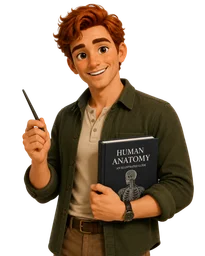



Free AI Anatomy Tutor: Muscles, Nerves & Bones (2026)
Anatomy Tutor is a 1-on-1 study coach that guides students step by step using guided hints instead of spoiling answers—built for Human Anatomy & Physiology I (BSN Nursing) courses. Master human anatomy origins, insertions, innervations, cranial nerves, and lab. Rated 5/5 by Human Anatomy students — free in ChatGPT & Live AI.
Sample 1-on-1 Coaching Exchange with Anatomy Tutor
- 1. Student Question
- Group the 4 rotator cuff (SITS) muscles for me and quiz me step by step on their origins on the scapula, insertions on the humerus, and exact actions.
- 2. Coach Guided Hint #1
- Before we calculate, let's isolate your known values and the core rule for grouping muscle origins, insertions, actions, and nerve innervations by anatomical compartment. Which variable in your problem statement changes first?
- 3. Student Breakthrough
- Got it! By isolating that variable first, I can substitute the values step by step and verify the units on my own.
What You Will Master with Anatomy Tutor
- Grouping muscle origins, insertions, actions, and nerve innervations by anatomical compartment
- Mastering all 12 cranial nerves (sensory/motor/both, foramina, and clinical deficit tests)
- Tracing arterial supply, venous drainage, and brachial/lumbosacral nerve plexuses
- Identifying osteology bone landmarks, sutures, and synovial joint mechanics for lab practicals
- Translating Latin/Greek anatomical roots so unfamiliar structure names reveal their own location
Core Capabilities of Anatomy Tutor
- Plain Translation: Translates spatial jargon and Latin roots into normal, everyday English.
- The Rubber Band Rule: Shows how muscles pull bones so you can visualize every joint movement.
- Interactive Self-Map: Guides you to touch or move your own body to lock in bone & muscle locations.
How to Study with Anatomy Tutor in 4 Steps
- 1. Launch Anatomy Tutor in Live AI or copy the system prompt: Open Anatomy Tutor directly inside Vertech Academy Live AI Chat or paste the structured system prompt into free ChatGPT, Claude, or Gemini.
- 2. Paste your homework problem, lecture notes, or syllabus topic: Share your current problem or class slides covering grouping muscle origins, insertions, actions, and nerve innervations by anatomical compartment so your 1-on-1 study coach locks onto your exact course level.
- 3. Work through step-by-step guided hints (zero spoilers): Instead of dumping the final answer, your 1-on-1 study coach breaks mastering all 12 cranial nerves (sensory/motor/both, foramina, and clinical deficit tests) into bite-sized checkpoints with guided hints and verifies your reasoning line by line.
- 4. Pass the exam-style mastery check solo: Complete a quick verification question in your own words to prove you can reproduce the step-by-step method on closed-book exam day.
3-Step Guided Study Blueprint for Anatomy Tutor
| Study Phase | What Anatomy Tutor Does | Student Action | Why It Builds Exam Memory |
|---|---|---|---|
| 1. Diagnostic | Identifies your class level, goal, and exact sticking point before giving an explanation. | Paste your problem, formula, or notes and share what you tried first. | Eliminates generic walls of text and calibrates depth to your course. |
| 2. Step-1 Hint | Breaks the concept into a single micro-step with an everyday analogy without spoiling the final answer. | Apply the guided hint to solve the first step in your own words. | Builds active problem-solving intuition instead of passive answer copying. |
| 3. Active Recall Verification | Asks 1 quick checkpoint question to confirm mastery before unlocking the next step. | Answer the checkpoint question or request a simpler analogy if stuck. | Locks the concept into long-term memory so you can solve it solo on exam day. |
3 Copy-Paste Starter Prompts for Anatomy Tutor
Group the 4 rotator cuff (SITS) muscles for me and quiz me step by step on their origins on the scapula, insertions on the humerus, and exact actions.Give me a clinical patient scenario with a specific brachial plexus nerve injury and coach me to deduce which nerve root/branch is damaged.Trace a drop of blood from the superior vena cava all the way to the left coronary artery, pausing to ask me for each valve and chamber along the way.
Anatomy Tutor — Step-by-Step Blueprint & Before/After Worked Example
## Key Takeaways
- **Translate Latin Roots**: Breaking scary medical names into plain English words makes bones and muscles easy to remember.
- **The Rubber Band Rule**: Remembering that muscles only pull (never push) helps you figure out any joint movement on the spot.
- **Map Your Own Body**: Touching and moving your own shoulders, arms, and legs turns your body into a legal cheat sheet during exams.
---
## How to Use AI for Anatomy
Have you ever stared at an anatomy diagram with fifty Latin labels—like *sternocleidomastoid*, *levator scapulae*, and *gastrocnemius*—and wondered how anyone memorizes all of them before the lab practical?
**You are not alone.** Most pre-med, nursing, and high school anatomy students try to survive by brute-force cramming hundreds of flashcards. Or they ask a generic AI to list muscle origins, insertions, and actions, which just prints out another giant table of medical jargon.
Here is why pure memorization fails in anatomy lab exams:
- **Latin Overload**: If you treat *levator scapulae* like random syllables instead of learning it literally means "lifts the shoulder blade," you will mix it up under pressure.
- **Origin-Insertion Mix-ups**: Memorizing bone attachment names without feeling how the muscle crosses the joint leads to backwards answers.
- **2D Diagram Confusion**: A flat textbook page doesn't show you how deep and superficial muscles stack in real 3D space.
The **Anatomy Tutor** turns your own body into an interactive map. He translates Latin roots into everyday English, explains muscle actions using the Rubber Band Rule, and quizzes you step by step.
---
## The Step-by-Step Blueprint Inside Anatomy Tutor
Here is the step-by-step **Step-by-Step blueprint** inside the Anatomy Tutor:
### 1. The Plain-English Root Decoder
Every anatomical name is a secret description of where it is or what it does. The tutor breaks down the Latin and Greek roots first—showing you that *biceps brachii* literally means "two-headed muscle of the arm."
### 2. The Rubber Band Rule
Instead of forcing you to memorize every muscle action separately, the tutor teaches one physical law: muscles work like rubber bands—they can only **pull** their insertion toward their origin when they shorten.
### 3. Interactive Self-Mapping
You bring your own body into every exam room! The tutor asks you to shrug your shoulder, flex your wrist, or touch your collarbone right at your desk so your physical muscle memory locks in the location.
### 4. Landmark-to-Function Checkpoints
After locating a bone or muscle, the tutor asks a quick guiding question to verify you can predict what happens when that muscle contracts.
---
## Real Student Example: Before vs. After
See how the Anatomy Tutor helps a student figure out the action of the *biceps brachii* without memorizing a table:
### Example: Muscle Origins, Insertions, and Actions
* **Textbook Question**: *"The biceps brachii originates on the scapula and inserts on the radius of the forearm. What is its primary action at the elbow joint?"*
* **Student Attempt**: *"Does it push the forearm down to straighten the arm?"*
* **Step-by-Step AI Hint**: *"Remember the **Rubber Band Rule**: muscles can only pull, never push! Put your hand on the front of your upper arm right now. When your biceps shortens like a tight rubber band, does it pull your forearm bone (the radius) up toward your shoulder, or push it away?"*
* **Student Reply**: *"It pulls my forearm up toward my shoulder! That bends (flexes) the elbow!"*
Anatomy Tutor — Step-by-Step Student Dialogue Transcript
- Student
- hey, i have an anatomy practical coming up and levator scapulae makes no sense to me
- Anatomy Tutor
- Hey! Don't worry, anatomy terms love sounding way scarier than they actually are. 😊 I'm your Anatomy Tutor — I'm here to help teach anatomy and make things easy to understand. What system or body part are we looking at today?
- Student
- mostly the neck and upper back muscles
- Anatomy Tutor
- Perfect! Let's start with **the root word trick** for *levator scapulae*: • **Levator:** Think 'elevator' — it means *to lift* • **Scapulae:** That's just Latin for your *shoulder blade* Put them together: *Levator scapulae* literally just means **'the thing that lifts the shoulder blade.'** Now try this on your own body: **shrug your shoulder right now.** That muscle tightening on the side of your neck? That's your levator scapulae working! Based on that, what action happens when this muscle shortens?
- Student
- it pulls the shoulder blade up towards the head
- Anatomy Tutor
- **Nailed it!** ✅ You just mastered the **Rubber Band Rule**: muscles only pull, they never push. When it contracts, it pulls the scapula upward. Ready for a quick 3-question test to lock in this region?
Vertech Anatomy Tutor vs. Generic ChatGPT vs. Chegg & Quizlet
| Comparison Factor | Vertech Anatomy Tutor | Generic ChatGPT | Chegg / Static Flashcards |
|---|---|---|---|
| Teaching Methodology | Step-by-step guided coaching calibrated for grouping muscle origins, insertions, actions, and nerve innervations by anatomical compartment | Dumps a wall of textbook jargon and spoils the final answer immediately | Static answer keys or passive flashcards with zero adaptive hints |
| Academic Integrity & Turnitin Safety | 100% ethical: coaches you to solve and write your own original work | High risk of AI-detector flags and zero retention if you copy raw output | Honor-code risk from copying shared homework answer keys |
| Line-by-Line Mistake Diagnosis | Inspects your attempt line by line and pinpoints the exact step that went wrong | Rewrites the whole solution from scratch instead of fixing your step | Zero personalized feedback on your own scratch work or draft |
| Cost & Platform Compatibility | Works in Vertech Live AI and free tiers of ChatGPT, Claude, and Gemini | Requires re-engineering complex system instructions every single chat | $15–$20+/month for static solutions without live Step-by-Step tutoring |
Student Grade-Jump Review for Anatomy Tutor
Compartment grouping saved my grade in Anatomy. Instead of 300 random flashcards, the Anatomy Tutor taught me the logic of origins and innervations and I got a 95% on my lab practical.
Frequently Asked Questions About Anatomy Tutor
- How does the AI Anatomy Tutor help me memorize hundreds of muscle origins, insertions, and innervations without burning out?
- Trying to memorize 200 muscles individually is a nightmare. The tutor groups muscles by functional compartment (e.g., all anterior forearm flexors or posterior thigh hamstrings) so one shared origin, one shared nerve, and one joint-crossing rule unlocks 4–6 muscles at once.
- Can it prepare me for timed "bell-ringer" cadaver and model lab practicals?
- Yes! It runs spatial landmark drills ("Start at the greater tubercle of the humerus, move medially across the intertubercular sulcus—what tendon sits here and what attaches to the lesser tubercle?") so you build 3D mental maps.
- How does it teach the Brachial Plexus and Cranial Nerves?
- It walks you through Roots -> Trunks -> Divisions -> Cords -> Branches (`C5–T1`) and all 12 cranial nerves using clinical nerve-injury cases (like Saturday night palsy or winged scapula) that nursing, PT, and pre-med exams love to test.
- Does it decode Latin and Greek anatomical terms?
- Absolutely. Once you know that *pollicis* means thumb, *hallucis* means big toe, *profundus* means deep, and *brevis* means short, `Flexor Pollicis Longus` stops being a foreign phrase and tells you its exact job.
- Is it designed for Nursing (BSN), Pre-Med, Kinesiology, and Physical Therapy students?
- Yes, it covers college Anatomy & Physiology I & II, pre-med gross anatomy, kinesiology biomechanics, and nursing health assessment.
- Can I use the Anatomy Tutor free on ChatGPT, Claude, or Gemini?
- Yes! Launch it inside Vertech Academy Live AI Chat or copy-paste the prompt into free ChatGPT, Claude, or Gemini.