Introduction
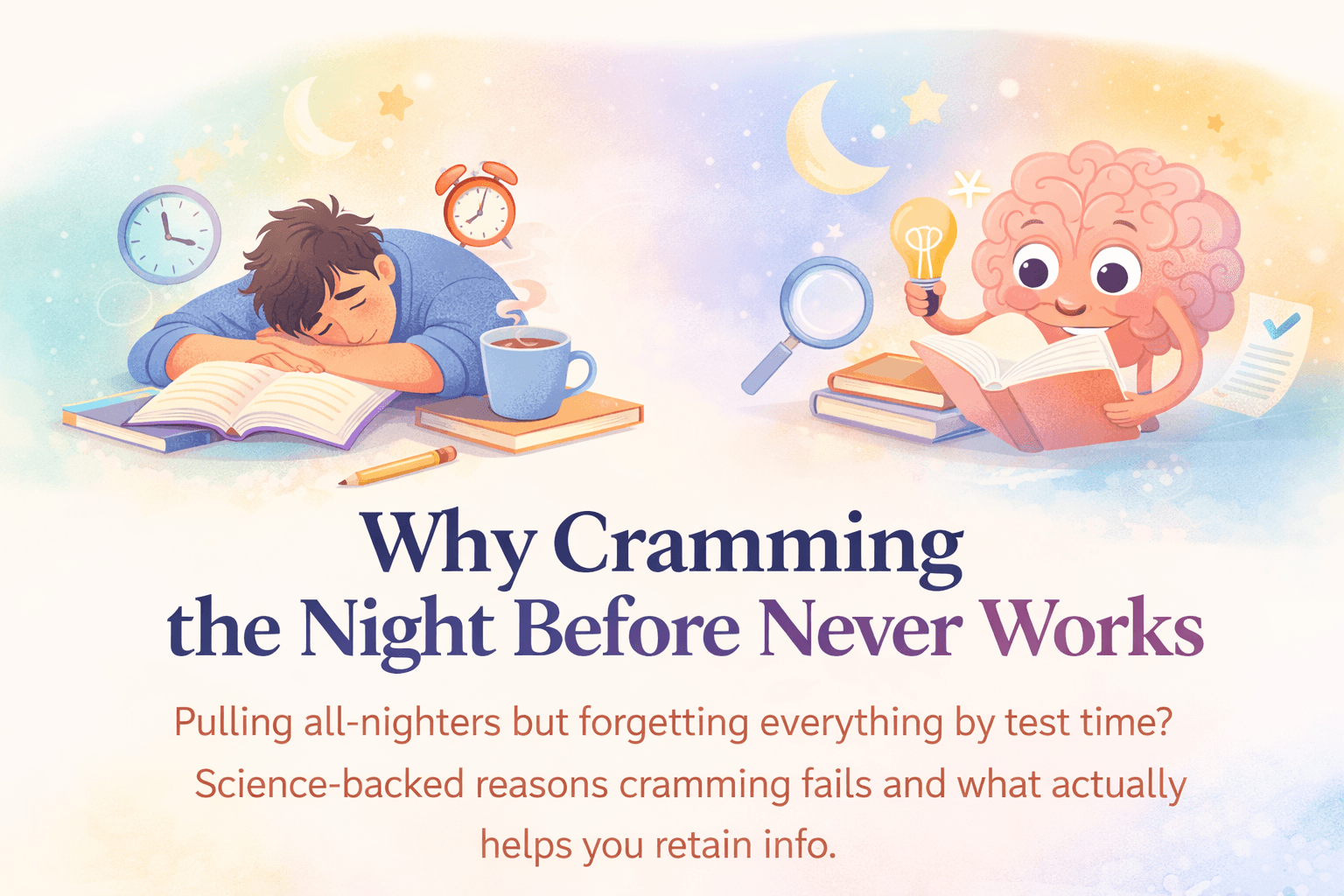
It is 2:00 AM. You are surrounded by empty energy drink cans and a mountain of highlighted notes. Your eyes are burning, and you are trying to force one last chemical equation into your brain before your 8:00 AM exam. You feel like you might actually pass. But when you sit down for the test just six hours later, your mind goes blank. The information is gone.
This scenario is a rite of passage for almost every student, but it is also one of the least effective ways to learn. We often treat our brains like empty suitcases that we can stuff full of clothes right before a trip. Unfortunately, biology does not work that way. When you try to force-feed your brain gigabytes of information in a single night, you are fighting against the way your memory is wired.
The good news is that you are not "bad at test-taking" or "lazy." You are simply using a method that is biologically designed to fail. By understanding a few simple rules about how your brain processes information, you can study less, sleep more, and actually remember what you learned.
Here is what we will cover in this guide:
The Illusion of Competence: Why reading your notes makes you think you know more than you do.
The "Save Button" Theory: How sleep actually physically changes your brain to store memories.
The Stress Block: Why anxiety hormones literally disconnect your memory centers during a test.
The Forgetting Curve: How fast you lose information and how to stop it.
Actionable Strategies: Proven methods like spaced repetition and active recall that replace cramming.
The Illusion of Competence
One of the biggest reasons students cram is because it feels like it works—at least in the moment. When you read your textbook or look over your notes for the fifth time, the information starts to feel familiar. You see a definition and think, "Oh yeah, I know that."
Psychologists call this the "Illusion of Competence." You are confusing familiarity with mastery. Just because you recognize the words on the page does not mean you can pull that information out of your brain when the page is gone.
The Music Analogy
Think of it like listening to a popular song. After hearing it ten times on the radio, you can hum along perfectly. You might say, "I know this song!" But if someone handed you a guitar and said, "Play it," you would freeze.
Recognizing the song is passive; playing it is active. Cramming relies on passive recognition. You read and re-read until the material looks familiar. But a test requires you to "play the song" from memory. Because you never practiced the active part, retrieving the information without looking—you fail when it matters most.
Real learning requires you to close the book and recite the answer. If you cannot explain it without looking at your notes, you do not know it yet. Cramming rarely gives you enough time for this step, leaving you with a false sense of confidence that crumbles the moment the exam starts.
Your Brain Needs Sleep to Save Files
You might think of sleep as a time when your brain shuts down, but it is actually when your brain does its most important work. To understand this, imagine typing a 20-page essay on your computer. You type for hours, but you never click "Save." If you just pull the plug (wake up) without saving, all that work is lost.
Your brain works the same way. When you learn something new during the day, it is stored in a temporary holding area called the hippocampus. This storage space is small and fragile. It can only hold so much before it gets overwritten or fades away.
Moving Memories to the Hard Drive
Sleep is the "Save" button. specifically, a deep stage of sleep known as Slow-Wave Sleep (SWS) and Rapid Eye Movement (REM) sleep. During these stages, your brain replays the day's information and moves it from the temporary hippocampus to the neocortex, which acts like your brain's permanent hard drive.
According to the Sleep Foundation, this process is called memory consolidation. If you pull an all-nighter to cram, you are skipping the save process. You might have the information in your head at 4:00 AM, but without sleep to consolidate it, those memories remain fragile. By 8:00 AM, they have largely evaporated because they were never permanently stored.
The Role of REM Sleep
It gets even more specific. Different stages of sleep help with different types of learning.
Deep Sleep helps with facts, names, and dates.
REM Sleep helps with complex problem-solving and connecting ideas.
If you are studying for a math or physics exam where you need to apply formulas to new problems, you desperately need REM sleep. Cutting your sleep short to study two extra hours is often a bad trade. You are trading a fully functioning brain for a little bit of extra temporary data that you likely won't remember anyway.
Stress Hormones Block Your Memory
Have you ever looked at a test question that you know you studied, but your mind is completely blank? You can picture the page it was on, but the words just won't come. Then, ten minutes after the exam ends, the answer pops into your head.
This is not a coincidence. It is biology.
When you cram, you are usually doing it under high pressure. You are worried about failing, you are sleep-deprived, and you are fueling yourself with caffeine. This cocktail triggers your body's "fight or flight" response, flooding your system with a stress hormone called cortisol.
The Cortisol Blockade
Research from the National Institutes of Health (NIH) has shown that high levels of cortisol temporarily impair the hippocampus, the very part of your brain responsible for retrieving memories.
Think of your brain like a library. The hippocampus is the librarian who knows where every book is filed. Cortisol is like a fire alarm going off in the library. When the alarm rings (stress), the librarian stops looking for books and focuses on escaping the danger.
During a cramming session, you are building up this stress. When you sit down for the test, the pressure peaks, and the cortisol blockade slams shut. The information is in there, but the librarian is too panicked to find it. Once the exam is over and you relax, your cortisol levels drop, the "fire alarm" turns off, and suddenly you remember everything.
The Forgetting Curve Explained
In the late 1800s, a German psychologist named Hermann Ebbinghaus discovered a harsh truth about human memory: we are designed to forget. He plotted his findings on a graph now famous as the Forgetting Curve.
The curve shows that without review, you forget about 50% of what you learned within one day. By the end of the week, you might recall as little as 10% of the material.
Why One Night Is Not Enough
Cramming tries to fight this curve with brute force at the very last second. You are trying to hold 100% of the material in your head against a biological tide that wants to wash it away.
Because you learned the material all at once (massed practice), the memory traces in your brain are weak. They haven't been reinforced over time. This is why you can ace a quiz on Monday after cramming Sunday night, but fail the final exam at the end of the semester. The information was never truly learned; it was just temporarily balanced on the edge of your mind.
To beat the curve, you cannot just push harder at the end. You have to interrupt the forgetting process at specific intervals.
Better Alternatives to Cramming
If cramming is the "fast food" of studying (quick, cheap, but bad for you), then what is the healthy alternative? The answer lies in two scientifically proven techniques: Spaced Repetition and Active Recall.
Spaced Repetition: The Anti-Cram
Spaced repetition is the exact opposite of cramming. Instead of studying for five hours in one night, you study for 30 minutes a day for ten days.
This technique works because every time you are about to forget something, you review it. This "reset" strengthens the neural pathway in your brain. Research from BrainFacts.org explains that spacing out your study sessions signals to your brain that this information is important and needs to be kept long-term.
How to apply it:
Day 1: Learn the material.
Day 2: Review it for 10 minutes.
Day 4: Review it again.
Day 7: Final review.
You are spending the same total amount of time studying, but because you spaced it out, your retention rate skyrockets.
Active Recall: Testing, Not Reading
As mentioned earlier, reading your notes is passive. Active recall is the process of testing yourself. You force your brain to "pull" the information out without help.
This is difficult. It feels frustrating because you will realize how much you don't know. But that struggle is where the learning happens. Every time you struggle to remember a fact and then successfully find the answer, you are building a super-highway to that memory.
Simple ways to use Active Recall:
Flashcards: But do not flip them over immediately. Force yourself to say the answer out loud first.
Blurting: Read a page of a textbook, close the book, and write down everything you remember on a blank sheet of paper. Then open the book and check what you missed.
Practice Tests: Take them without your notes, just like the real exam.
Using Tools for Active Recall
Sometimes it is hard to force yourself to do active recall because it is mentally taxing. It is much easier to just passively highlight a textbook. This is where having a tool or a partner helps.
If you don't have a study buddy available at 10 PM, you can use AI tools to simulate that experience. For example, the Memory Coach from our prompts library is designed specifically for this purpose.
The Memory Coach prompt acts like a strict but helpful tutor. Instead of just giving you answers, it breaks your material into small chunks and quizzes you. It uses a "Drill Mode" to help you practice and a "Test Mode" to check your retention.
The key feature here is that it forces you to type the answers back. You cannot just nod along; you have to actively produce the information. It also prevents you from moving on until you have mastered the current chunk, ensuring you don't build on a shaky foundation.
Creating a Realistic Study Schedule
Knowing you should space out your studying is easy; actually doing it is hard. Procrastination is the main reason we end up cramming in the first place. To break the cycle, you need a plan that is too easy to fail.
The "20-Minute Rule"
Do not plan to study for four hours. That is intimidating, and you will put it off until it is too late. Instead, plan to study for just 20 minutes.
Anyone can study for 20 minutes. It is short enough that it doesn't feel like a burden. But here is the trick: once you start, you will often find it easy to keep going. Even if you stop after 20 minutes, that is 20 minutes of quality, focused work that you wouldn't have done otherwise.
Work Backwards from the Test Date
Look at your calendar. If your test is on Friday:
Thursday: Light review (20 mins). Go to bed early.
Wednesday: Practice test (45 mins). Identify weak spots.
Tuesday: Active recall on difficult concepts (30 mins).
Monday: Initial review of notes and organizing material (30 mins).
This schedule sums up to about two hours of total work, far less than a panic-fueled all-nighter, but the results will be significantly better because you slept in between sessions.
Prioritize Difficult Topics
When we study, we often start with the easy stuff because it makes us feel smart. But you need to tackle the hardest concepts first when your brain is fresh. Use your spaced repetition sessions to focus 80% of your energy on the 20% of the material you find most confusing.
Conclusion
Cramming is a comforting lie. It promises that you can make up for lost time with a heroic burst of effort, but biology disagrees. Between the lack of sleep preventing memory consolidation, the stress hormones blocking retrieval, and the natural forgetting curve, cramming is stacking the deck against yourself.
You are capable of learning difficult things. You just need to work with your brain, not against it. By switching to spaced repetition and prioritizing sleep, you will not only get better grades, but you will also feel less anxious and more in control.
Key takeaways to remember:
Sleep is non-negotiable: It is when your brain permanently saves new information.
Familiarity isn't mastery: Just because you recognize it doesn't mean you know it. Test yourself.
Stress causes blanking: High cortisol levels disconnect your memory centers during exams.
Space it out: Studying 20 minutes a day is far more effective than 5 hours in one night.
Use active recall: Tools like Memory Coach or physical flashcards are essential for locking in facts.
Next time you have a big exam coming up, close the book early, get a full night's sleep, and trust the process. Your brain will thank you.