Introduction
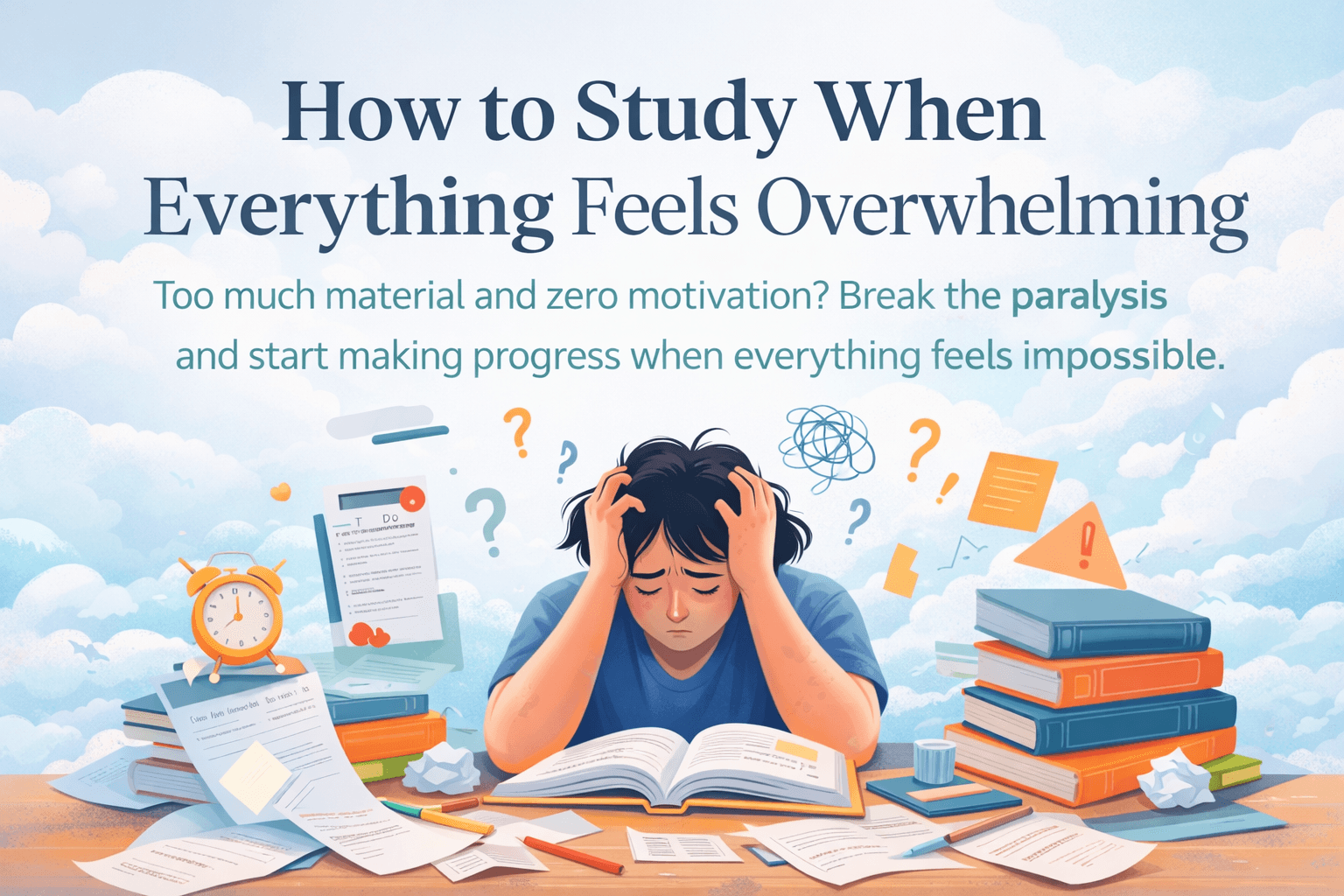
We have all been there. You look at your desk and see a stack of heavy textbooks, three different notebooks, and a laptop with twelve tabs open. You know you have a mountain of work to do. You know you should have started three hours ago. But instead of studying, you are frozen.
You might feel a tightness in your chest or a sense of dread in your stomach. You pick up your phone, scroll through social media for "just a minute," and suddenly another hour is gone. Now you feel even more guilty, and the mountain looks even bigger.
This feeling is not laziness. It is a very real psychological reaction called "overwhelm." When your brain sees too many tasks at once, it hits the panic button and shuts down. The good news is that you can trick your brain into unlocking itself.
In this guide, you will learn:
Why your brain freezes when you have too much to do.
The 5-minute trick that forces you to start.
How to use AI to turn complex chapters into simple English.
Why "B-minus work" is better than no work at all.
Why You Feel Paralyzed (The Science)
It is easy to beat yourself up and say, "I am just being lazy." But science tells us a different story. When you look at a huge pile of work, your brain views it as a threat. It triggers a stress response similar to seeing a wild animal.
Psychologists call this Analysis Paralysis. Your brain is so busy trying to figure out the "perfect" place to start that it runs out of energy to actually do the work. You are not refusing to work; you are stuck in a loop of overthinking.
This is often made worse by the "Paradox of Choice." When you have to choose between studying history, math, or biology, the fear of making the wrong choice keeps you from choosing anything. You can read more about how this affects decision-making in this guide on Analysis Paralysis by Verywell Mind.
To fix this, we have to stop looking at the whole mountain and just look at the first step.
The "Five-Minute Rule" to Break Inertia
The hardest part of studying is not the studying itself. It is the start. It is the moment you have to close TikTok and open your textbook. This is where 90% of the resistance lives.
To get past this, use the Five-Minute Rule.
Tell yourself, "I am not going to study for three hours. I am just going to do this for five minutes. If I want to quit after five minutes, I can."
Why this works:
It lowers the stakes: Five minutes is not scary. Your brain knows it can survive five minutes of math.
It breaks the seal: Once you start, the fear goes away. Usually, once you have your book open and your pen moving, you won't want to stop.
Think of it like pushing a stalled car. You have to push incredibly hard just to get the wheels to turn one inch. But once the car is rolling, it is much easier to keep it moving.
Shrink the Mountain (Chunking)
Your working memory is like a small cup. It can only hold a few things at once. If you try to pour a gallon of water (an entire textbook chapter) into that cup, it just spills everywhere. This is why you can read a page three times and remember nothing.
The solution is a technique called Chunking.
Chunking means breaking big, scary information into tiny, manageable groups. Instead of trying to memorize a 10-digit phone number all at once (5558675309), you break it into chunks (555-867-5309).
How to apply this to studying:
Take one chapter.
Break it into three main headings.
Ignore everything else.
Focus only on understanding the first heading.
By focusing on small pieces, you stop the feeling of drowning in information. You can learn more about the psychology behind this method in this overview of Chunking on Wikipedia.
Use AI to Simplify Complex Topics
Sometimes, the overwhelm comes because the material is just too hard. You read a paragraph, and it sounds like gibberish. You feel stupid, so you want to quit.
This is where you can use Artificial Intelligence as a translator. You don't need the AI to do the work for you; you need it to explain the work to you in plain English.
We built a specific tool for this exact moment called the Simplifier Specialist. It takes complex, academic language and rewrites it so a 5th grader could understand it.
Try this prompt:
"I am pasting a paragraph about cellular respiration below. It is too complicated. Please rewrite it for me using simple analogies and everyday language. Explain it like I am 12 years old."
Why this helps: It removes the friction of confusion. Once you understand the basic concept, the complicated textbook version starts to make sense. You can find this specific tool in our Simplifier Specialist prompt library.
Focus on "Good Enough" (Perfectionism)
Perfectionism is the enemy of progress. Many students are overwhelmed because they think they need to produce A-plus work on the first try. They stare at a blank page because they are afraid of writing a bad sentence.
Give yourself permission to do "bad work."
Write a messy essay draft. You can fix the grammar later.
Do the math problems quickly. You can check the answers later.
Make ugly flashcards. They don't need to look like art projects.
The goal is not to be perfect. The goal is to be done. A messy assignment turned in on time is worth more points than a perfect assignment that effectively sits in your head forever.
Manage Your Energy, Not Just Time
When you are behind, your instinct is to pull an "all-nighter." You think you need to chain yourself to the desk for six hours straight.
This is a mistake. Your brain runs on glucose and oxygen. After about 30 to 50 minutes of intense focus, your fuel tank runs dry. If you keep pushing, you are just looking at words without learning them.
Instead, use the Pomodoro Technique.
Set a timer for 25 minutes.
Work with zero distractions.
When the timer beeps, take a 5-minute break.
Repeat.
During your break, stand up. Walk away from the screen. This lets your brain "reset" so you can come back fresh. You can read more about how to set this up in our guide on how to turn your phone into a study tool.
If you want a deep dive into why this timing works for productivity, check out this article on the Pomodoro Study Method by Coursera.
Create a "Panic Plan"
When anxiety hits, you lose your ability to plan. You need a pre-made plan ready to go. Think of this like a fire drill for your grades.
Your Panic Plan Checklist:
Clear the desk: Remove everything except the one thing you are working on.
Pick one task: Choose the assignment that is due soonest or is worth the most points.
Set the timer: 25 minutes.
Phone away: Put it in another room.
If you are really struggling to figure out what to do first, you can use AI to build the schedule for you. We have a guide on how to create an exaConclusionm study schedule with AI that helps you prioritize automatically.
Conclusion
The feeling of overwhelm is heavy, but it is not permanent. It is just a signal from your brain that you are trying to do too much at once.
The secret to studying when you feel like quitting is to stop trying to be a superhero. Do not try to climb the whole mountain in one jump. Just put your shoes on. Then take one step. Then another.
Key Takeaways:
Acknowledge the feeling: You are not lazy; you are stuck in analysis paralysis.
Use the 5-Minute Rule: trick your brain into starting by lowering the stakes.
Chunk the info: Break big chapters into tiny, safe pieces.
Simplify the hard stuff: Use the Simplifier Specialist to translate jargon into plain English.
Rest: Use the Pomodoro technique to keep your brain fresh.
Close this tab. Put your phone on silent. Set a timer for five minutes. You can do this.