Introduction
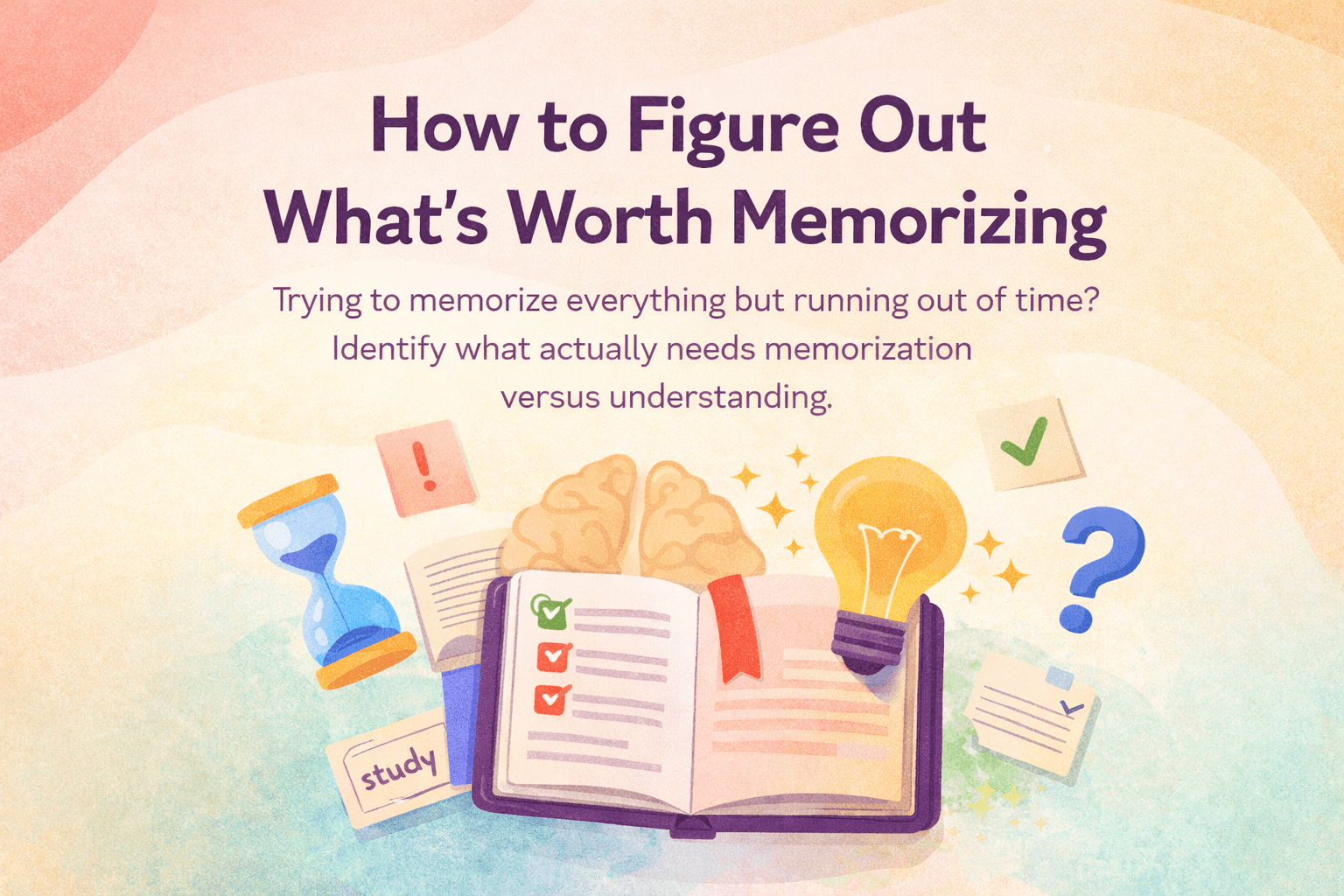
Have you ever looked at a textbook chapter the night before an exam and felt your stomach drop because there are 30 pages of information and you only have four hours? You grab your highlighter and start trying to shove every single sentence into your brain.
It feels productive, but it is actually a trap. You are trying to memorize the ocean with a teaspoon.
The truth is, you were never meant to memorize everything. Most successful students don't have photographic memories. They just have a better filter. They know how to look at a page of notes and instantly separate the "must-memorize" facts from the "must-understand" concepts.
In this post, we will cover:
Why trying to memorize everything actually hurts your grades.
The clear difference between memorization and understanding.
A simple 3-question filter to decide what to study.
How to use tools like the Learning Planner to organize your time.
The Trap of Trying to Memorize Everything
Your brain has a limit. Scientists call this Cognitive Load. Think of your working memory like a small desk. You can only put a few items on it at a time. If you try to pile every date, name, formula, and definition onto that desk, everything falls off.
When you try to memorize complex ideas instead of understanding them, you are creating "brittle" knowledge. If you memorize a physics definition word-for-word but don't know what it means, you will fail if the teacher asks the question in a slightly different way.
Memorization vs. Understanding: What is the Difference?
Before you can decide what to study, you need to know how you are studying.
Memorization (Rote Learning) is about recall. It is like carrying a dictionary. You have the raw data, but you might not know how to use it.
Examples: Dates, vocabulary words, chemical symbols, formulas.
Goal: To spit out the exact information when triggered.
Understanding (Conceptual Learning) is about connection. It is like knowing how to write a sentence. You understand how the pieces fit together to create meaning.
Examples: Why a war started, how photosynthesis works, why a math formula is used.
Goal: To apply the information to solve a new problem.
If you are interested in the science behind this, educators use a framework called Bloom's Taxonomy to rank these levels of thinking. Memorizing is the very bottom step. You want to climb higher.
The "Need-to-Know" Filter: 3 Questions to Ask
So, how do you choose? When you are staring at your notes, ask these three questions to filter your content.
1. Is this a "Building Block"?
Some things are foundational. You cannot speak a language if you don't memorize the vocabulary. You cannot do calculus if you don't memorize the multiplication tables.
If YES: Memorize it. These are your raw materials.
If NO: It might be a concept.
2. Can I derive this logic?
This is the most powerful question. If you forget the exact wording of a history definition, can you explain it in your own words? If you forget a math formula, can you figure it out using a simpler one?
If YES: Do not memorize it. Focus on understanding the logic so you can rebuild the answer during the test.
If NO: You might need to memorize the specific steps or rule.
3. Will this be provided on the exam?
Always check your syllabus. In many advanced math or science classes, you are given a formula sheet.
If YES: Do not waste a single second memorizing it. Practice using it instead.
High-Yield Information: What to Memorize
According to the Pareto Principle (or 80/20 rule), about 20% of the information usually accounts for 80% of the grade. Identify that 20% and use "Spaced Repetition" (flashcards) to lock it in.
Memorize these:
Specific Terminology: You need to speak the language of the subject.
Formulas (if not provided): You need these to solve problems.
Key Dates: Only the ones that mark a major turning point (e.g., the start of a war, not the birthday of a general).
Lists and Steps: If a process has a specific order (like Mitosis phases), memorize the acronym or order.
If you need help creating flashcards quickly, you can use AI tools to generate them for you. We reviewed some great options in our post on 7 Best AI Tools for Exam Prep.
Conceptual Frameworks: What to Understand
For the rest of your material, put away the flashcards. You need to use active learning methods.
Understand these:
"Why" Questions: Why did this event happen? Why does this chemical react this way?
Relationships: How does Concept A affect Concept B?
Systems: How does the whole process work from start to finish?
The best way to test your understanding is the Feynman Technique. Try to explain the concept to an imaginary 5-year-old. If you use jargon or get stuck, you don't understand it yet. Go back and read again.
How to Organize Your Study Plan
Once you have sorted your notes into "Memorize" and "Understand," you need a plan. Do not try to do both at the same time.
Phase 1: The Understanding Phase Do this first. Read your textbook and rewrite the concepts in your own words. Draw diagrams. Connect ideas. If you try to memorize something you don't understand, it won't stick.
Phase 2: The Memorization Phase Do this second. Once you get the "big picture," extract the specific facts (dates, definitions) and put them on flashcards. Review these in short bursts.
Phase 3: The Application Phase Do this last. Take practice tests. This forces you to combine your memorized facts with your conceptual understanding to solve problems.
Tools to Help You Decide
It can still be hard to look at a messy pile of notes and decide where to start. Sometimes, writing things out by hand can help you slow down and process the information, which we discuss in our article on handwriting vs. typing.
However, if you are short on time, you can use AI to help you sort your material.
We have a specific tool called the Learning Planner in our Prompt Library. You paste in your topic or notes, and it acts as a strategist. It tells you exactly what to memorize, what to review, and how to structure your study sessions so you aren't wasting time on the wrong things.
You can try it here: Learning Planner Prompt.
Conclusion
You don't get extra points for struggling. You get points for knowing the right answers.
By separating your study material into "Memorize" and "Understand," you free up a massive amount of brain power. You stop cluttering your mind with useless facts and start building a deep understanding of the subject.
Key Takeaways:
Filter First: Don't just start reading. Ask "Do I need to memorize this or understand it?"
Memorize Facts: Use flashcards for dates, definitions, and formulas.
Understand Concepts: Use the Feynman Technique for processes and "why" questions.
Use Tools: Use the Learning Planner to save time and build a strategy.
Next time you sit down to study, take five minutes to plan before you panic. Your grades (and your stress levels) will thank you.