Introduction
We have all been there. You sit down to study. You have your books, your laptop, and a fresh cup of coffee. You tell yourself, "I am going to work for two solid hours."
Ten minutes later, you are scrolling through TikTok.
It feels like your brain is fighting you, right? You might think you are just lazy or that you are "bad at studying." But here is the good news: it is not your fault. Your brain is just reacting to the world around it. If your environment is full of distractions, your brain will get distracted.
In this guide, we are going to fix that. We will look at simple, practical changes you can make today to boost your focus. We will cover:
Why your brain loves distractions.
The "Phone Jail" rule that changes everything.
How to set up your desk for success.
A simple timer trick used by millions.
Let’s get your focus back.
Why Your Brain Hates Studying (And How to Fix It)
First, let’s look at the science. Imagine your concentration is like a muscle. According to experts at PBS, concentration is something you have to build up over time. You wouldn’t walk into a gym and try to lift 500 pounds on your first day. But that is exactly what you do when you try to study for three hours straight without practice.
Your brain loves dopamine. That is a chemical that makes you feel good. Checking your phone gives you a quick hit of dopamine. Reading a history textbook does not. Your brain naturally wants the easy reward. To fix this, we don't fight the brain. We just make the "boring" stuff a little easier and the distractions a lot harder to reach.
The "Phone Jail" Rule
This is the most important tip in this entire post. If your phone is on your desk, you have already lost.
Even if it is on silent. Even if it is face down. If you can see it, a part of your brain is waiting for it to light up. It takes energy to ignore it. That is energy you should be using to study.
Try this today:
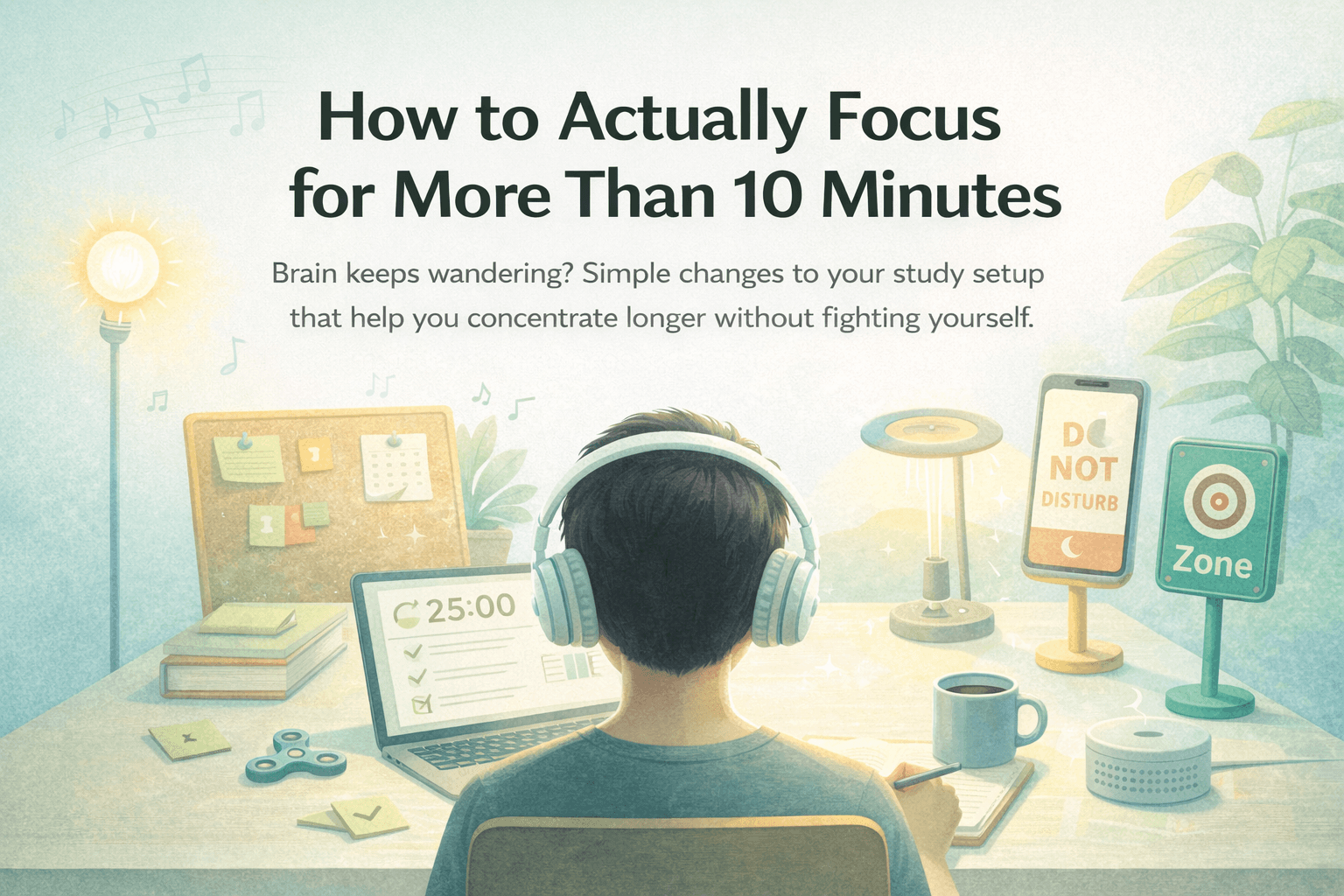
Put your phone on "Do Not Disturb."
Take it to another room (the kitchen, the living room, anywhere but here).
Leave it there until your break time.
This is often called Digital Minimalism. By removing the temptation completely, you don't have to use willpower to ignore it. You can just focus on your work.
Your Study Spot is Sabotaging You
Look at your desk right now. Is it covered in random papers, old coffee cups, or video game controllers?
Clutter creates noise in your brain. A messy desk makes it harder to focus because your eyes are constantly darting around at all the stuff. You need a "Clean Slate."
The Ideal Setup:
Lighting: Natural light is best. If you can, set up your desk near a window. Good lighting helps keep you alert.
Comfort: You don't need a fancy chair, but you shouldn't be in pain. If your back hurts, you can't focus.
Supplies: Have your water, pens, and notebooks ready before you sit down. Getting up to find a pencil is a classic procrastination trap.
The 25-Minute Magic Trick
The biggest reason we procrastinate is that the task feels too big. "Study for Biology Exam" sounds scary and hard.
The solution is to make it small. There is a famous method called the Pomodoro Technique. Don't let the fancy name scare you. It is actually very simple.
How to do it:
Set a timer for 25 minutes.
Commit to working only until the timer goes off.
When it rings, stop. Take a 5-minute break.
Repeat.
Anyone can focus for 25 minutes. It is short enough that it doesn't feel painful, but long enough to get real work done. After four rounds, take a longer break. This keeps your brain fresh and prevents burnout.
Stop Starting on "Hard Mode"
Starting is the hardest part. It is like pushing a broken-down car. Getting it moving takes a ton of effort, but once it is rolling, it is easy to keep it going.
Don't start your study session with the hardest, most confusing math problem. You will get frustrated and quit. Instead, start with something easy.
Review your vocabulary flashcards.
Re-read the summary of the last chapter.
Organize your notes.
This is like a "warm-up" for your brain. It gets you into "study mode" without the stress. Once you are in the flow, then tackle the hard stuff.
Use AI to Keep You on Track
Sometimes, studying alone is tough. It is easy to zone out when no one is watching. This is where modern tools can help.
You can use AI as a "study buddy." It won't get tired, and it won't judge you for asking the same question twice. For example, you can use the prompts in our Prompt Library to turn generic AI into a personal tutor.
Imagine you are reading a complex paragraph and you just don't get it. Instead of giving up, you can paste it into an AI tool and ask, "Explain this to me like I'm 12 years old." Suddenly, the roadblock is gone, and you can keep moving.
Feed Your Focus
You are a biological machine. If you put bad fuel in a car, it won't run well. The same goes for your brain.
Hydrate: Your brain is mostly water. If you are thirsty, you will feel tired and foggy. Keep a water bottle on your desk.
Snack Smart: Sugary energy drinks give you a quick boost, but then you crash hard. Try snacks that give you steady energy, like nuts or fruit.
Sleep: This is the unsexy truth. No amount of coffee replaces a good night's sleep. Your brain needs sleep to store the information you learned during the day.
Conclusion
Focus isn't a magical gift that some people have and others don't. It is a skill you build by setting up the right environment. You don't need to be perfect. You just need to make it a little easier for your brain to do the work.
Let’s recap the plan:
Hide the phone: Put it in another room. Seriously.
Clean your desk: Remove the visual clutter.
Use a timer: Work in 25-minute chunks.
Start easy: Warm up your brain with simple tasks.
Use the right tools: Check out our features to see how we can help you learn faster.
Try just one of these tips today. You will be surprised at how much more you can get done when you stop fighting your brain and start working with it.