Introduction
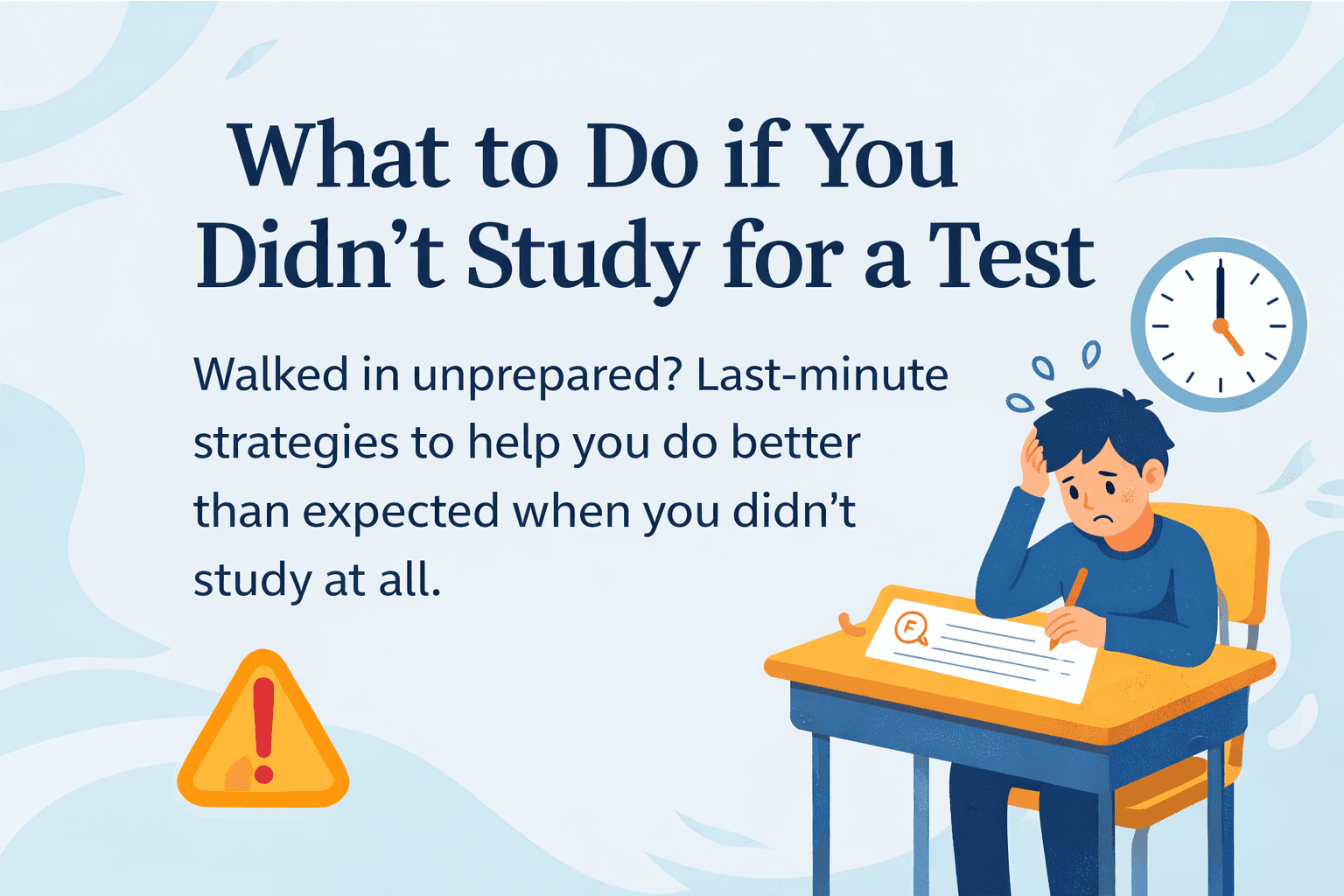
It is a terrifying feeling. You are sitting at your desk, the teacher is passing out the papers, and you realize you have absolutely no idea what is going to be on the test. Maybe you forgot, maybe you ran out of time, or maybe life just got in the way. Whatever the reason, the test is happening right now, and you need a plan.
Panic is your enemy. If you freeze up, you guarantee a bad grade. But if you stay calm and use smart test-taking strategies, you can often scrape together a passing grade—or at least do better than you thought possible. This guide isn't about magic tricks; it is about damage control. We are going to look at how to maximize every single point you can get, even when your brain feels empty.
In this post, we will cover:
How to calm your physical panic response so you can think clearly.
The "Brain Dump" technique to save the few facts you do remember.
Scientific guessing strategies for multiple-choice questions.
How to structure essay answers when you don't know the full answer.
What to do after the test so this doesn't happen again.
Get Your Head Right Immediately
The first thing you need to do happens before you even pick up your pencil. When you realize you are unprepared, your body goes into "fight or flight" mode. Your heart beats faster, your palms sweat, and your mind goes blank. This is biology, not stupidity. If you try to take the test in this state, you will fail.
You need to hack your biology to calm down. A simple method recommended by experts like the Mayo Clinic is deep breathing. It sounds too simple to work, but it sends a signal to your brain that you are safe. Close your eyes for ten seconds. Take a deep breath in through your nose, hold it for a second, and let it out slowly through your mouth. Do this three times.
Once you are calm, accept the situation. Tell yourself: "I cannot change that I didn't study. I can only change what I do in the next hour." This shift in mindset helps you move from "panicking" to "solving."
The "Brain Dump" Technique
The moment you are allowed to start writing, do not look at the first question. Instead, find a blank space on the back of the test paper or use your scratch paper.
Write down everything you can currently remember.
Did you memorize a formula? Write it down.
Do you remember a specific date or name? Write it down.
Do you remember a mnemonic device (like "PEMDAS" for math)? Write it down.
This is called a "Brain Dump." Your short-term memory is fragile. As soon as you start reading stress-inducing questions, you might forget those few precious facts you are holding onto. By writing them down immediately, you create a "cheat sheet" that is 100% legal because you wrote it after the test started.
A common mistake students make when they are unprepared is getting stuck on the first hard question. They stare at it for 20 minutes, get frustrated, and run out of time for the easy questions they actually could have answered.
Use the "Scan and Plan" method. Read through the entire test quickly. Identify the questions you know the answer to (or at least have a good guess). Do those first. This does two things:
It guarantees points. You ensure you get credit for everything you actually know.
It builds confidence. Answering a few questions correctly calms your nerves.
Leave the questions you have no clue about for the end. If you run out of time, it is better to leave a hard question blank than an easy one.
How to Guess Like a Pro
If the test is multiple-choice, you have a statistical advantage. Even if you know nothing, you have a 25% chance of guessing right. But we can improve those odds using deduction.
According to test-taking guides from universities like the University of Toronto, there are patterns in how tests are written that can give you clues.
Look for these common giveaways:
The "Odd One Out" is usually wrong: If three answers are very similar (e.g., 10.5, 10.6, 10.7) and one is totally different (e.g., 500), the different one is usually incorrect. Eliminate it.
Avoid Absolutes: In subjects like history, psychology, or biology, things rarely happen "always" or "never." If an answer uses words like always, never, every, or none, it is likely wrong. Look for softer words like usually, often, or some.
Grammar Clues: Read the question and the answer together. If the question ends in "an" and only one answer starts with a vowel, that is likely the right one. Teachers sometimes make grammatical mistakes when writing incorrect options.
The Longest Answer: Teachers often have to use more words to make the correct answer scientifically accurate. Incorrect answers are often short and simple. If one answer is much longer and more detailed than the others, it is a strong candidate.
Do better next time: guessing can only get you so far, the best strategy is to be actually prepared.
By eliminating just two obviously wrong answers, you raise your guessing chance from 25% to 50%.
Surviving the Written Sections
Short answer and essay questions are the hardest when you haven't studied because you can't just guess "C". However, you can still get partial credit.
Never leave a written question blank. A blank space is a guaranteed zero. A bad answer might get you 1 or 2 points for effort or hitting a keyword.
Follow these tips to scrape up points:
Restate the Question: Start your answer by rephrasing the question. If the question is "Explain the causes of the War of 1812," start with "There were several key causes of the War of 1812." This shows you understand the topic and gets your pen moving.
Focus on Structure: Even if your facts are weak, use good formatting. Use paragraphs. If you are listing things, use bullet points. A well-organized answer looks more professional and might earn you points for communication skills.
Define Key Terms: Look at the words in the question. Do you know what any of them mean? Define them. If the question asks about "photosynthesis," and you only remember that it involves plants and the sun, write that down. "Photosynthesis is a process used by plants involving the sun." It’s not a full answer, but it is factually correct.
For more on how to identify what you actually know versus what you are guessing, you can read our guide on how to use AI to find what you don't understand yet. It explains how breaking down big topics can help you find small wins.
What to Do After the Test
Once you hand in that paper, let it go. Stressing about it now won't change the grade. However, you need to make sure this doesn't happen again.
The worst feeling is knowing you could have done well if you had just spent 20 minutes preparing. You don't need to study for hours to see a difference. Next time, try using a focused tool to help you prepare quickly.
Our Prompt Library has a specific tool called the Memory Coach. It doesn't just give you answers; it uses a method called "Active Recall" to quiz you repeatedly until the facts stick in your brain. It is perfect for those times when you only have a short amount of time to study and need to memorize definitions fast.
Conclusion
Walking into a test unprepared is a nightmare, but it doesn't have to be a disaster. By staying calm, managing your time, and using smart guessing strategies, you can salvage your grade.
Remember these steps for next time:
Breathe: Calm your body first.
Dump: Write down facts immediately.
Scan: Do the easy questions first.
Deduce: Use logic to eliminate wrong multiple-choice answers.
Write: Never leave a question blank.
One bad test grade does not define your intelligence or your future. It is just a signal that you need to adjust your strategy for next time. Take a deep breath, do your best, and then start planning to be ready for the next one.