Introduction
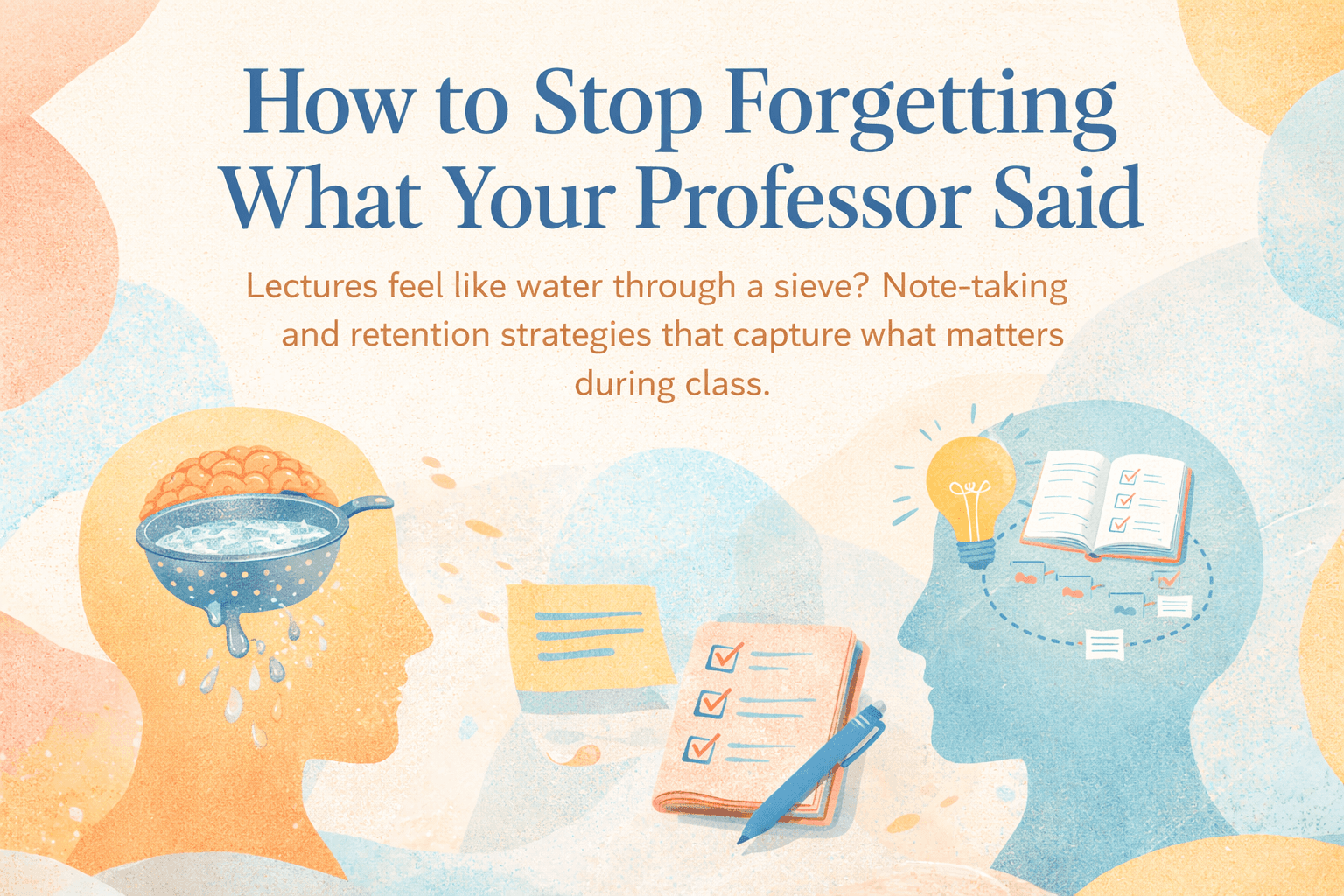
You sit in class. You listen. You take notes. You feel like you understand everything the professor is saying. But three days later, you look at your notebook and realize you have absolutely no idea what any of it means. It feels like the information just fell out of your head.
This is not your fault. It is actually a biological problem. Your brain is wired to forget things that it deems unimportant. If you do not convince your brain that the lecture was important within a few hours, it hits the "delete" button to save space.
The good news is that you can hack this process. You do not need a photographic memory to remember your lectures. You just need a better system for capturing information. In this guide, we will break down exactly how to stop your lectures from feeling like water slipping through a sieve.
We will cover:
Why your brain deletes 50% of a lecture within 24 hours
How to "prime" your brain before class to learn faster
The difference between hearing and active listening
Three note-taking systems that prevent memory loss
How to use AI to quiz you on what you just heard
Why We Forget Lectures So Fast
Scientists have studied this problem for over a hundred years. In 1885, a psychologist named Hermann Ebbinghaus discovered something called the Forgetting Curve.
The Forgetting Curve is a model that shows how quickly we lose new information if we do not review it. The results are scary. Research from the University of Minnesota shows that if you do nothing with the information you learned in class, you will forget about 50% of it within 24 hours.
By the time a week has passed, you might remember only 20% of the lecture.
Why does this happen? Your brain is protecting you. You are bombarded with millions of data points every day, from the color of a passing car to the lyrics of a song on the radio. If you remembered everything, you would go crazy. So, your brain constantly flushes out "useless" data.
The problem is that your brain treats your Biology lecture as "useless data" unless you signal that it matters. The strategies in this post are all about sending a big, loud signal to your brain that says: "Keep this! I need it!"
Preparing Before Class Even Starts
Most students walk into class cold. They sit down, open their laptop, and wait for the professor to start talking. This is the hard way to learn.
Think of your brain like a velcro wall. If the wall is smooth, nothing sticks to it. If the wall has hooks, the information can grab onto something. You need to build those hooks before the lecture begins.
The "Priming" Technique Priming is a simple method to warm up your brain. It takes about five minutes.
Check the Syllabus: Look at what the topic for the day is.
Scan the Readings: Do not read every word. Just look at the bold headings, the chapter summary, and any charts or images.
Ask Two Questions: Write down two things you expect to learn. For example: "What exactly is a mitochondria?" or "Why did the war start?"
When you walk into class with questions in your head, your brain automatically switches to "hunter mode." It is looking for the answers. This small shift makes it much harder to zone out because you have a specific goal.
The Art of Active Listening
There is a big difference between hearing and listening. Hearing is passive; it happens to you. Active listening is a skill you perform. It means you are engaging with the words, not just letting them wash over you.
Many students try to write down every single word the professor says. This is a trap. If you are focused on typing fast, you are not thinking about the meaning. You are acting like a transcription machine, not a student.
What to Listen For Professors usually give you clues about what is important. They are like signposts on a road. You just need to know what they look like.
Listen for these "Signpost Phrases":
"The most important thing is..." (This will be on the test.)
"In contrast to..." (This means a comparison question is coming.)
"For example..." (This helps you understand the concept.)
"Therefore..." (This is the conclusion or the result.)
"There are three main reasons..." (Get ready to write a numbered list.)
When you hear these phrases, your ears should perk up. Stop worrying about spelling and get the main idea down.
Note-Taking Systems That Actually Work
If your notes look like a wall of text, you will never read them again. You need a structure that forces you to organize your thoughts.
Here are three proven systems. Pick the one that fits your style.
1. The Cornell Method
This is the gold standard for retention. It was developed at Cornell University and it forces you to review your notes constantly.
How it works:
Divide your page into two columns. The right column is big (for notes). The left column is small (for "cues").
During class: Write your notes in the big right column.
After class: Look at your notes and write keywords or questions in the small left column. For example, if you wrote a paragraph about photosynthesis, write "How do plants eat?" in the left column.
To study: Cover the right side and try to answer the questions on the left.
You can see a full breakdown of The Anatomy of the Cornell Note-taking System from the University of Toronto.
2. The Outline Method
This is the simplest method and works best for organized lectures.
How it works:
Write the Main Topic as a header.
Indent to the right and write a Sub-topic.
Indent again to write a Supporting Fact.
It looks like a staircase of information. It helps you see which ideas are big concepts and which are just small details.
3. The Mind Map
If you are a visual learner, lists might bore you. Try mapping instead.
How it works:
Write the main topic in a bubble in the center of the page.
Draw branches out to sub-topics.
Connect ideas with lines and arrows.
This is great for subjects like History or Literature where ideas are connected in a web, rather than a straight line.
If you already have a notebook full of messy scribbles, don't panic. You can fix them. Check out our guide on What to Do When Your Notes Don't Make Sense to learn how to turn chaos into a study guide.
What to Do Immediately After Class
Remember the Forgetting Curve? The clock starts ticking the moment you walk out of the lecture hall. You need to stop the memory drain immediately.
The 5-Minute Review You do not need to study for an hour. You just need five minutes. Find a bench or a quiet corner right after class. Open your notes. Read through them and highlight the things you don't understand. Put a big question mark next to anything confusing.
The "Blurting" Method This is a powerful technique for testing what you actually kept.
Take a blank sheet of paper.
Write the topic of the lecture at the top.
Without looking at your notes, write down everything you remember.
Compare your "blurt" to your real notes.
The things you forgot to write down are your weak spots. This is one of the best ways to Know What You Don't Know Yet so you can fix it before the exam.
Using AI to Reinforce Your Memory
Sometimes, you listen and take notes, but the concept still feels fuzzy. This is where AI can be a massive help. You can use AI to simulate a tutor who checks your understanding.
The goal is to force your brain to explain the topic. When you have to explain something, you learn it twice as fast.
Try the Active Listener Prompt We built a specific tool for this called the Active Listener. It acts like a curious student who asks you questions about what you just learned.
How to use it:
Open the Active Listener prompt.
Tell the AI what your lecture was about (e.g., "I just learned about Supply and Demand").
The AI will ask you to explain it in your own words.
If you get stuck, it will give you a hint without giving away the answer.
This forces you to "retrieve" the information, which strengthens your memory pathways. It turns passive listening into an active conversation.
Common Mistakes That Kill Retention
Even smart students fall into bad habits that sabotage their memory. Avoid these three traps.
1. The Transcription Trap We mentioned this earlier, but it bears repeating. Do not try to write every word. It is physically impossible and mentally draining. The Fix: Summarize. If the professor talks for two minutes about a story, write one sentence: "Prof told story about apple tree to explain gravity."
2. The "I'll Look It Up Later" Trap When you hear a word you don't know, you might think, "I'll Google that later." You won't. You will forget. The Fix: Mark it immediately. Put a big box around it in your notes so it screams at you when you open your notebook again.
3. The Digital Distraction Trap Taking notes on a laptop is risky. One notification can break your focus for 20 minutes. The Fix: Consider switching to paper for complex classes. We explored the science of this in our post Does Writing Things Down Help You Remember Better?. The short answer is: often, yes.
Conclusion
Forgetting your lectures is not a sign that you are bad at school. It just means you are fighting millions of years of biology. Your brain wants to forget, so you have to work a little bit to make it remember.
You do not have to overhaul your entire life overnight. Start small. Pick one strategy from this list to try in your next class.
Key Takeaways:
Prime your brain: Spend 5 minutes reviewing the topic before class begins.
Listen for signposts: Focus on phrases like "The most important thing is..."
Structure your notes: Use the Cornell Method or Outlining to keep things organized.
Review immediately: Spend 5 minutes after class fixing your notes while the memory is fresh.
Test yourself: Use tools like the Active Listener to ensure you truly understand the material.
The next time you walk into a lecture hall, you won't be a passive observer letting words wash over you. You will be an active hunter, capturing the knowledge you need to succeed. You've got this.