Introduction
Imagine your brain is like the battery in your phone. If you run a high-power app (like studying Calculus or memorizing history dates) for four hours straight without charging, what happens? It crashes. The screen goes black, and you are left with nothing.
Most students try to power through their study sessions like a marathon runner, believing that stopping is a sign of weakness. They think that if they sit in the chair for six hours, they have done six hours of work. But that is simply not true. Science shows that without a "pit stop," your brain’s ability to retain information drops off a cliff after a certain point.
It is not about having enough willpower; it is about rhythm. If you take too many breaks, you never get into the zone. If you take too few, you burn out and end up staring at the same page for thirty minutes without reading a word.
In this guide, we are going to look at the exact science of study breaks. We will ditch the complex academic jargon and give you a simple, practical schedule to keep your "brain battery" in the green zone so you can finish studying faster and actually remember what you learned.
Why Your Brain Needs a Pit Stop
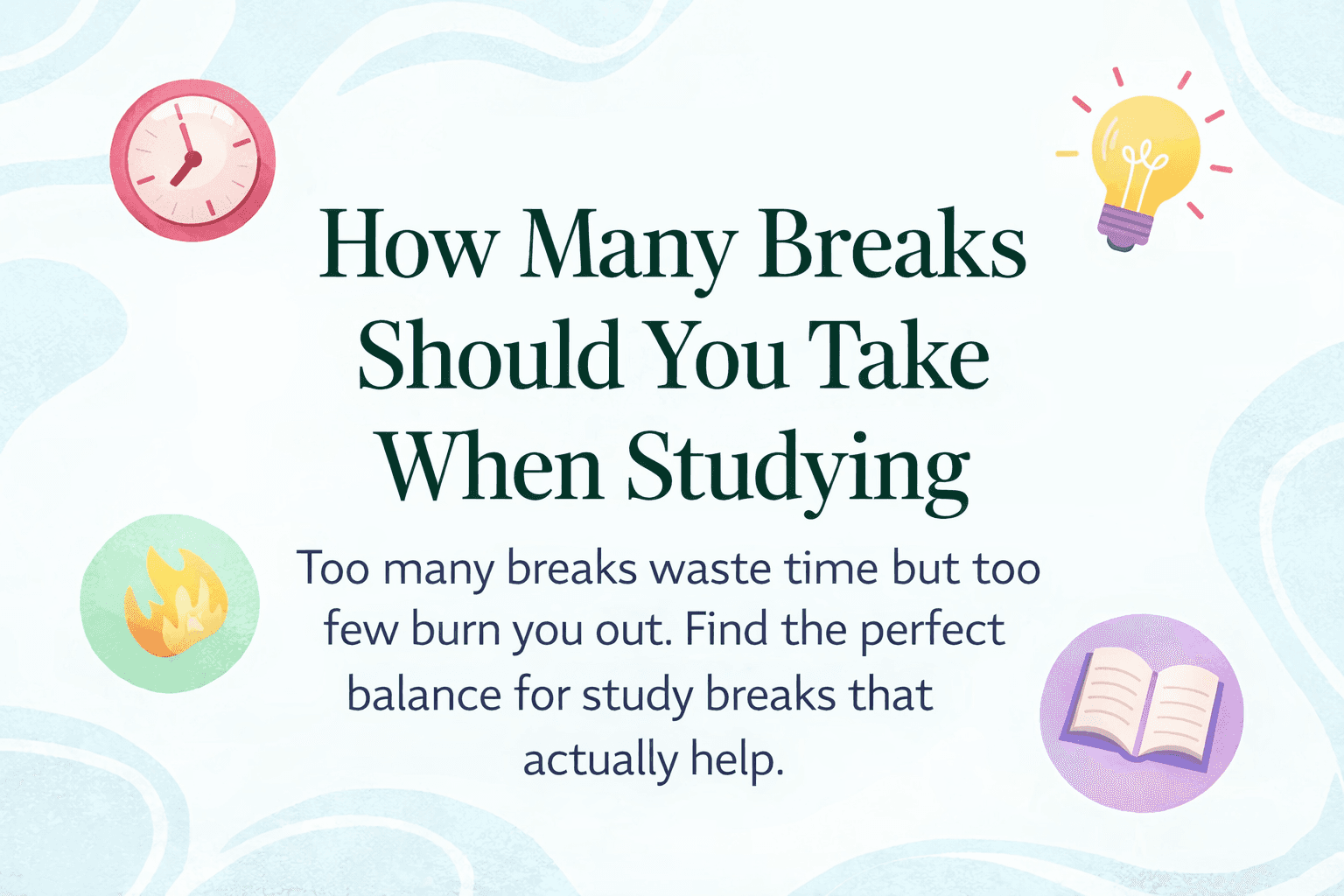
Title: How Many Breaks Should You Take When Studying Subheading: Too many breaks waste time but too few burn you out. Find the perfect balance for study breaks that actually help.
Introduction
Imagine your brain is like the battery in your phone. If you run a high-power app (like studying Calculus or memorizing history dates) for four hours straight without charging, what happens? It crashes. The screen goes black, and you are left with nothing.
Most students try to power through their study sessions like a marathon runner, believing that stopping is a sign of weakness. They think that if they sit in the chair for six hours, they have done six hours of work. But that is simply not true. Science shows that without a "pit stop," your brain’s ability to retain information drops off a cliff after a certain point.
It is not about having enough willpower; it is about rhythm. If you take too many breaks, you never get into the zone. If you take too few, you burn out and end up staring at the same page for thirty minutes without reading a word.
In this guide, we are going to look at the exact science of study breaks. We will ditch the complex academic jargon and give you a simple, practical schedule to keep your "brain battery" in the green zone so you can finish studying faster and actually remember what you learned.
Why Your Brain Needs a Pit Stop
You might feel like you can push through the fatigue, but your neurons disagree. When you focus intensely, your brain consumes glucose and oxygen at a rapid rate. After a while, you start to experience "cognitive fatigue." This is just a fancy way of saying your brain is tired of focusing on one thing.
According to research from Cornell Health, taking purposeful breaks refreshes your brain and body, which actually increases your productivity. Think of it like a reset button. When you step away, your brain doesn't just stop working; it switches modes. It moves from "focused mode" to "diffuse mode," which allows it to process and consolidate the information you just fed it. This is often when those "aha!" moments happen.
The Goldilocks Zone: How Long Should You Break?
So, what is the magic number? How long should you pause before you lose your momentum?
Research suggests there is a "Goldilocks zone"—not too short, not too long. If your break is just two minutes, your brain doesn't have time to reset. If it is forty-five minutes, you lose the mental thread of what you were studying, and it takes too long to get back into the flow.
A study discussed by the JHU Hub suggests that for learning new skills, the breaks are just as important as the practice. The sweet spot for most students usually lands between 5 to 15 minutes for every hour of work. However, this depends on the type of schedule you use. Let's look at the three most popular methods so you can pick the one that fits your style.
The Pomodoro Technique: The Classic 25/5
This is the most famous method in the world for a reason: it works. The Pomodoro Technique was invented to combat procrastination. It is perfect if you struggle to just start working.
The Work: You set a timer for 25 minutes of pure, distraction-free focus.
The Break: You take a 5-minute break.
The Reset: After doing this four times (which is about two hours), you take a longer break of 15–30 minutes.
Why does this work? Because 25 minutes is short enough that it doesn't feel scary. You can do anything for 25 minutes. If you are using our Generalist Teacher prompt from the Prompt Library, you can even ask the AI to quiz you for exactly one "Pomodoro" cycle to keep you on track.
The 52/17 Rule: The Data-Backed Alternative
f 25 minutes feels too short for you, maybe you are writing an essay or solving long math problems, you might prefer the 52/17 rule.
This method comes from a study by a productivity app called DeskTime. They tracked the habits of the most productive employees and found a strange pattern: the top performers worked for 52 minutes and then took a break for 17 minutes.
This roughly one-hour cycle (one hour of work, roughly 20 minutes of rest) aligns well with your body's natural energy rhythms. It allows you to go deeper into a topic without getting interrupted by a timer every 20 minutes.
The "Animedoro" Method: For the Binge-Watchers
Let’s be real, sometimes a 5-minute break is just annoying. You can’t really do anything fun in 5 minutes. Enter the "Animedoro" (or "Dramadoro") method, a favorite among students who love a good story.
The Work: You study for 40 to 60 minutes.
The Reward: You watch one episode of an anime or a sitcom (usually about 20 minutes).
This creates a powerful incentive. You earn your episode. Instead of binge-watching Netflix and feeling guilty about not studying, you are using the show as fuel to get your work done. Just be careful, you have to have the discipline to stop after one episode!
What to Do During a Break (To Actually Recharge)
This is where most students get it wrong. If your "break" is just scrolling through TikTok or Instagram, you are not actually resting your brain. You are just blasting it with new information, bright lights, and dopamine spikes. That is not a break; that is just a different kind of distraction.
According to Edutopia, the best breaks involve physical movement or a sensory change. Here is a list of high-quality break activities:
Move your body: Do ten pushups, stretch your back, or just walk to the kitchen.
Hydrate: Drink a full glass of water.
Get outside: Step out the front door and look at the sky for five minutes.
Talk to a human: Say hi to your roommate or family member (face-to-face, not over text).
Tidy up: Clean your desk for five minutes. A clean space helps a clear mind.
Using AI to Manage Your Schedule
Keeping track of these timers can be a hassle. This is where modern tools can help you build better traditional study habits. You don't need a fancy app; you can use the AI tools you already have.
For example, you can use the Memory Coach prompt from our library. You can tell it: "I am going to study for 52 minutes. Quiz me on these definitions, but stop me when the time is up."
This turns your study session into an active game rather than a passive reading session. The AI acts as your timekeeper and your tutor wrapped in one. If you are struggling to plan out exactly what to do in those 52 minutes, check out our guide on best apps for personalized AI learning to see how you can structure your entire week in seconds.
Signs You Need a Break Right Now
Sometimes, you shouldn't wait for the timer. Your body will tell you when it has had enough. If you ignore these signs, you are just wasting time.
Watch out for these "Red Flags":
The Reading Loop: You read the same sentence three times and still don't know what it said.
The Fidgets: You can't stop clicking your pen, shaking your leg, or checking your phone.
The Glaze: You are staring at your screen, but your eyes are out of focus.
Irritability: You suddenly feel annoyed by small sounds, like a clock ticking or someone chewing.
If you hit any of these, stop immediately. Stand up. Walk away. A ten-minute break now will save you an hour of frustrated struggling later.
Conclusion
Taking breaks isn't lazy; it is strategic. Whether you choose the rapid-fire Pomodoro method (25/5), the balanced 52/17 rule, or the reward-based Animedoro, the goal is the same: to protect your energy so you can finish strong.
Remember, the goal of studying is not to see how much pain you can endure. The goal is to learn. By respecting your brain's natural need for rest, you will find that you can get more done in less time, with less stress.