Most students use AI the same way: they open ChatGPT, type a random question, read the answer, and close the tab. That is not a study system. That is Googling with extra steps. And it is not going to help you retain anything.
The students getting the most out of AI have a repeatable framework they follow for every class, every week, every exam. It takes about 30 minutes to set up. Once it is in place, it saves hours every week and dramatically improves retention. The difference between random AI use and systematic AI use is the difference between checking the weather once a week and actually packing an umbrella.
Think about how you currently use AI for studying. You probably open it when you are stuck on a problem, ask it to explain something, read the explanation, and move on. That is reactive use. A study system is proactive - you use AI at specific points in your learning process, for specific purposes, in a specific order. The structure is what makes it work. Without it, AI just becomes another distraction disguised as productivity.
Here is the entire system. It works with ChatGPT, Claude, Gemini, or any other AI tool. You do not need to pay for anything. You do not need to be tech-savvy. You just need to follow the three phases consistently.
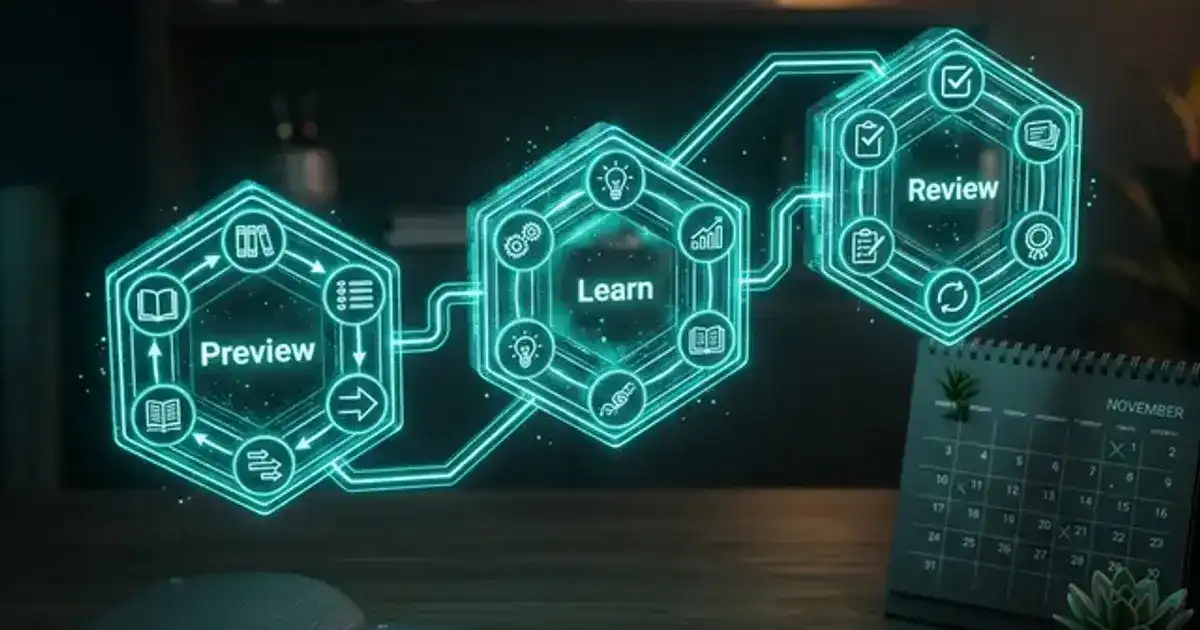
The Three-Phase AI Study Framework
Every effective study session has three phases. AI fits into two of them - but the middle phase (the actual learning) happens without AI. This is critical. If you skip the middle, you are just consuming information without processing it.
The reason most students fail with AI is they treat it like a magic answer machine instead of a study partner. They ask a question, read the response, and move on. That is not learning - it is information consumption. A real study system uses AI strategically at the right moments to enhance what your brain is already doing. Think of it like a workout: the AI is the personal trainer who tells you what exercises to do and checks your form, but you still have to lift the weights yourself.
Phase 1: Preview
Before class, use AI to preview the topic. This primes your brain so the lecture makes sense on first pass instead of feeling like a foreign language.
Try this: "Give me a 5-sentence overview of [topic]. What are the 3 most important concepts I should listen for in tomorrow's lecture?"
Phase 2: Learn
During and after class, take your own notes. AI stays off. Your brain does the work. The struggle of trying to understand is the learning. This is non-negotiable. Even if you do not understand everything, the act of wrestling with the material creates neural pathways that passive reading never will. You will remember more from 20 minutes of confused note-taking than from an hour of reading a perfect AI summary.
No AI in this phase. The effort of processing information yourself is what builds memory.
Phase 3: Review
After class, use AI to test yourself, find gaps, and generate practice questions. This is where AI shines: turning your notes into active recall exercises that lock the material in.
Try this: "Here are my notes on [topic]. Quiz me with 10 questions - mix easy and hard. Do not give me the answers until I try."
Each Phase in Detail
Phase 1: The 10-Minute Preview
Do this the night before class or in the morning. It takes about 10 minutes and makes the lecture dramatically more useful. Research on priming shows that when your brain has encountered key vocabulary and concepts before hearing a lecture, comprehension jumps significantly. You are not pre-learning - you are giving your brain a roadmap so that when the professor starts talking, you know roughly where they are going.
Most students walk into lectures cold. They have never seen the vocabulary, have no framework for organizing the information, and spend the first 15 minutes trying to figure out what the professor is even talking about. By that point, they have already missed the foundation. A 10-minute preview eliminates this entirely.
Get the topic overview - ask AI for a plain-language summary of what the upcoming lecture will cover. Most professors post their syllabus or slides ahead of time. Use those as input. Even just reading the chapter titles and asking AI to summarize each one gives you a huge advantage.
Identify the key vocabulary - ask for the 5-10 most important terms you will encounter. Having these in your head before the lecture means you are not hearing them for the first time while trying to take notes.
Write 2-3 questions you want answered - this gives your brain a mission during the lecture. Instead of passively absorbing, you are actively listening for answers to specific questions.
Preview prompt:
"I have a lecture tomorrow on [topic] in my [course name] class. Give me: (1) a 5-sentence overview, (2) the 10 most important terms I will hear, and (3) 3 questions I should try to answer during the lecture."
Phase 2: Active Learning (AI Off)
This is where the real learning happens. AI cannot do this for you.
During class, take notes in your own words. Do not transcribe what the professor says - translate it. If your professor explains a concept, write it down the way you would explain it to a friend. This forces your brain to process the information instead of just copying it. After class, spend 10 minutes rewriting your messiest notes while the lecture is still fresh. This brief rewrite is more effective than re-reading notes three times later.
This phase is the one that most students skip, and it is the most important one. It is tempting to go straight from the AI preview to the AI review and feel like you covered everything. But you skipped the part where your brain actually does the work of understanding. The preview gives you context. The review tests your recall. But the learning itself happens in this messy middle phase where you are struggling to make sense of new information on your own.
Why no AI in this phase?
Because learning requires struggle. When AI explains something perfectly, you feel like you understand it - but you have not encoded it. The messy process of trying to understand on your own is what builds the neural pathways that make knowledge stick. AI explanations feel productive but skip the step that actually matters.
Phase 3: AI-Powered Review
This is where AI earns its keep. After you have done the hard work of learning, AI helps you find what you missed and lock in what you learned. The key difference between this phase and just "asking AI to explain stuff" is that you are testing yourself, not receiving a lecture. You are the one doing the cognitive work. AI is just providing the questions and evaluating your answers.
Paste your notes and get quizzed - give AI your notes and ask for 10 questions at your level. Answer them. Get corrected. This is active recall, the single most effective study technique according to cognitive science research.
Ask AI to find your gaps - paste your notes and ask "What concepts from this topic am I missing?" AI will compare what you wrote against what the topic typically covers and flag what you did not capture.
Explain concepts back to AI - try explaining a key concept to AI as if it were a confused classmate. Ask AI to tell you what you got right and what you are confused about. This is the highest level of understanding testing.
Generate flashcard-style summaries - ask AI to create 15 question-answer pairs from your notes. Use these for spaced repetition review over the following days.
Review prompt:
"Here are my notes from today's [course name] lecture on [topic]. (1) Quiz me with 10 questions - mix difficulty levels. (2) After I answer, tell me what I got wrong and why. (3) Then tell me what major concepts from this topic are missing from my notes."
Skip the prompt writing entirely
The Vertech Library has ready-made prompts for previewing, quizzing, and reviewing. Just paste your topic and go.
Try the Free Chemistry Tutor PromptA Weekly AI Study Schedule
Here is a realistic schedule that takes about 80 minutes per week - spread across four sessions. This is not a lot of time, but because the sessions are spaced out and use active recall, they are dramatically more effective than cramming.
The secret to this schedule is that no single session is longer than 30 minutes. That keeps it manageable even during busy weeks. If you miss a session, just pick it back up next time. The system is designed to be forgiving because consistency over weeks matters more than perfection in any single week.
Scan your syllabus, preview topics with AI, write your guiding questions for each class.
Paste your Monday and Tuesday notes into AI. Get quizzed. Identify weak spots while the material is still fresh.
Have AI create question-answer pairs from the full week's notes. Start reviewing them for spaced repetition.
Have AI create a full practice quiz covering everything from the past week. Grade yourself. Focus next week's previews on anything you got wrong.
Consistency beats intensity
80 minutes per week spread across four sessions beats five hours of cramming the night before an exam. The system works because it distributes your effort and uses active recall at every step. Your brain retains information better when it encounters it multiple times over days, not hours.
Exam Week Emergency Adaptation
If you have been following the system, exam prep is mostly handled. The weekly reviews have already identified your weak spots and the spaced repetition has built strong recall. But if you need to cram - maybe you just discovered this system two weeks before finals - here is how to use the same framework in compressed mode:
Day 1-2: Identify gaps
Paste all your notes from the semester into AI and ask: "Based on these notes, what are the 10 topics I am weakest on?" Focus your study time there, not on material you already know.
Day 3-4: Practice test marathon
Have AI generate practice exams in the same format as your actual test (multiple choice, short answer, essay). Take them under timed conditions. Review your mistakes. Repeat.
Day 5: Teach it back
Explain each key concept to AI from memory. If you can teach it clearly, you know it. If you stumble, review that topic one more time.
Night before: Quick review only
Skim your flashcards and review any concepts you got wrong during practice tests. Do not try to learn new material the night before an exam. Sleep is more important than one more hour of cramming. Your brain consolidates memories during sleep, so a well-rested brain remembers more than an exhausted one that crammed until 3 AM. Seriously - put the notes away and go to bed.
Common Mistakes That Sabotage the System
Using AI instead of studying
Reading AI explanations is not studying. Studying is struggling with the material, testing yourself, and finding where your understanding breaks. AI helps you test yourself - it should not replace the effort.
Skipping Phase 2
If you go straight from AI preview to AI review without learning the material yourself, you are building a house on sand. The middle phase is where understanding happens.
Vague prompts
Typing "help me study biology" gives you generic results. Typing "quiz me on the 4 stages of mitosis from my cell biology 101 notes" gives you practice that actually matches your exam.
Only studying before exams
The system only works if you follow it weekly. Distributed practice over a semester beats two intense weeks of exam cramming every time. Start the habit early.
These mistakes are common because they all feel productive in the moment. Reading AI explanations feels like studying. Going straight from preview to review feels efficient. Typing vague prompts feels like you are using AI. But none of them produce the deep encoding that actually sticks. The system works because it forces your brain to do work at every stage. Anything that shortcuts the effort shortcuts the learning.
If you are looking for the exact tools to use with this framework, our guide to the five best AI tools for students covers our top recommendations. And if you are brand new to using AI for studying, start with our complete beginner guide. For a full comparison of which AI tool works best for different tasks, check out our ChatGPT vs Claude vs Gemini comparison.