Introduction
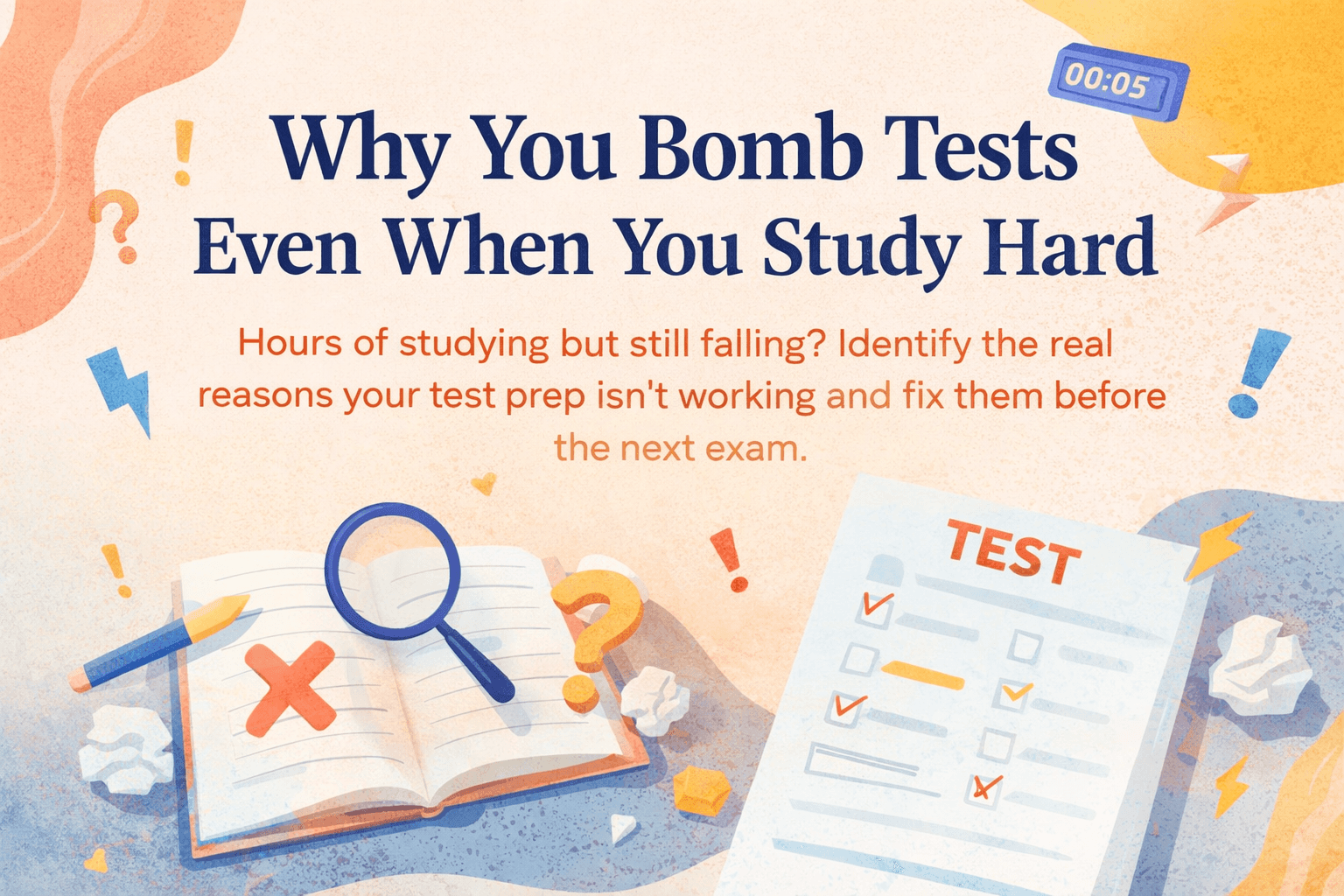
It is the night before the big exam. You have your energy drink ready, your highlighters are laid out, and you are prepared to grind for six hours straight. You read every chapter. You highlight every key term. You look over your notes until your eyes burn. By 2:00 AM, you feel confident. You recognize every word on the page.
Then, you walk into the classroom the next morning. The teacher hands out the test. You look at the first question, and your mind goes completely blank.
The panic sets in. You know you studied this. You saw this exact definition last night. But now that the textbook is closed, the information is locked behind a wall you cannot get past. You end up guessing, leaving sections blank, and walking out feeling defeated.
Does this sound familiar?
If so, you are not alone. This is one of the most frustrating experiences in school, but here is the good news: You are not "bad at taking tests." You are just studying in a way that tricks your brain into thinking it knows more than it actually does.
In this guide, we are going to break down exactly why traditional study methods fail you and give you the practical tools to fix it. Here is what we will cover:
The "Passive Review" Trap: Why reading is not learning.
The Illusion of Competence: Why feeling ready is dangerous.
The Biology of Memory: Why cramming physically cannot work.
Test Anxiety: How stress chemicals block your brain.
The Solution: Active strategies to guarantee you pass.
Let’s turn your hard work into actual grades.
You Are Relying on Passive Review
The number one reason students fail after studying for hours is that they spend all their time on passive review.
Passive review is any study method where you are simply consuming information without doing anything with it. This includes:
Re-reading your textbook.
Looking over your notes.
Highlighting sentences.
Listening to recorded lectures.
Watching YouTube videos on the topic.
The Problem with Recognition vs. Recall
When you read your notes, your brain recognizes the words. It says, "Oh yes, I have seen that before." This creates a feeling of familiarity. However, recognition is not the same as recall.
Think of it like recognizing a song on the radio. You might hear a song and sing along perfectly because the singer is giving you the lyrics. But if someone turned off the music and asked you to sing the second verse a cappella, you would probably freeze.
When you re-read your notes, the textbook is the singer. It is giving you the cues, so you feel like you know the material. The test is the a cappella performance. There are no cues, and because you never practiced retrieving the information from your own brain, you cannot do it.
The Science of "Hard" Learning
Research into active recall versus passive reading shows that passive methods are significantly less effective for long-term retention. Your brain is efficient; it wants to save energy. If you just read, your brain glides over the surface. It does not build the strong neural pathways needed to pull that information out later.
To actually learn, you have to struggle a little. You have to force your brain to work. If your study session feels easy and smooth, you probably are not learning as much as you think.
You Have Fallen for the Illusion of Competence
This leads us to a psychological trap known as the Illusion of Competence.
This happens when you confuse "understanding the explanation" with "knowing the material." It is easy to watch a teacher solve a math problem on the board and follow along. You nod your head and think, "Okay, that makes sense. I get it."
But "getting it" when someone else does it is very different from being able to do it yourself.
The "Open Book" Mistake
A common way this happens is studying with your notes open right next to you. You try to answer a practice question, get stuck, glance at your notes for two seconds, and say, "Oh, right, that's the formula." Then you finish the problem.
In your mind, you mark that question as "Correct." You tell yourself you knew it; you just needed a tiny hint. But on the test, there are no tiny hints. That split-second glance at your notes bridged a gap in your knowledge that is still there.
Why Your Brain Lies to You
We are wired to be overconfident in our short-term memory. According to experts on the illusion of competence, this cognitive bias makes us overestimate our abilities because the information is fresh in our minds.
If you read a chapter at 4:00 PM, you can probably answer questions about it at 4:15 PM. This boosts your confidence. You assume that because you know it now, you will know it tomorrow during the exam. But without reinforcing that memory, it fades rapidly. You are walking into the test with a false sense of security, which makes the shock of blanking out even worse.
You Are Cramming Instead of Spacing
We have all done it. The "all-nighter." You wait until the day before the test and try to shove three weeks of chemistry into one six-hour session.
You might feel like a hero for staying up until dawn, but biologically, you are fighting a losing battle.
The Spacing Effect
Your brain is not a hard drive. You cannot just download files onto it instantly. Learning is a physical process where neurons build connections. This process takes time and, crucially, sleep.
Psychologists call this the Spacing Effect. The evidence is overwhelming: studying for one hour a day for seven days is vastly superior to studying for seven hours in one day.
When you space out your studying, you are forcing your brain to reload the information multiple times. Each time you reload it, the memory gets stronger and the "forgetting curve" flattens out.
The Role of Sleep
If you are cutting sleep to study, you are shooting yourself in the foot. Sleep is when your brain takes what you learned in the short term (the hippocampus) and moves it to long-term storage (the cortex).
If you study for five hours and then sleep for three hours, you are throwing away most of that effort. You would actually score higher if you studied for three hours and slept for eight.
You Are Memorizing Instead of Understanding
Are you a "fact collector"?
Many students approach tests by trying to memorize a list of isolated facts. They make flashcards with a term on one side and a definition on the other. They memorize the exact wording of the definition.
Fact: The mitochondria is the powerhouse of the cell.
Fact: The War of 1812 ended with the Treaty of Ghent.
This works fine for basic vocabulary quizzes. It fails miserably for exams that require critical thinking.
The Context Problem
Teachers rarely ask for a definition word-for-word. Instead, they ask you to apply the concept. They might ask, "How would a defect in the mitochondria affect a muscle cell's ability to function?"
If you only memorized the definition, you are stuck. You have the fact, but you don't have the web of connections around it. You don't understand the function, the process, or the relationship to other parts of the cell.
Shallow Encoding
When you memorize without understanding, you are using "shallow encoding." The information is fragile. If the question is phrased slightly differently than your flashcard, you might not even realize it is asking about the same topic.
To pass difficult exams, you need "deep encoding." This means connecting new information to things you already know, understanding the "why" and "how," and being able to explain the concept in your own words, not just the textbook's words.
Test Anxiety Is Hijacking Your Brain
Sometimes, your study method is perfect. You spaced it out, you used active recall, and you know the material inside and out. But you still fail.
This is often due to Test Anxiety.
The Cortisol Block
When you sit down for a test and start to panic, your body enters "fight or flight" mode. Your brain releases stress hormones like cortisol and adrenaline.
Evolutionarily, this is great if you need to run away from a bear. It shuts down non-essential functions to focus on survival. Unfortunately, your brain considers "complex memory retrieval" to be a non-essential function.
High levels of cortisol literally block access to the prefrontal cortex—the part of your brain responsible for thinking and memory. This is why you go blank. The information is there, but the door is locked.
The Vicious Cycle
This creates a spiral. You blank out -> You panic more -> More cortisol is released -> You blank out worse.
It is only after you leave the exam room and calm down that the door unlocks. That is why you suddenly remember all the answers five minutes after handing in the test. It is incredibly frustrating, but understanding that this is a physical reaction, not a lack of intelligence, is the first step to managing test anxiety strategies.
How to Fix It: Active Strategies
Enough about the problems. Let’s talk about the solutions. If you want to stop bombing tests, you need to switch from passive to active learning.
Here are four specific strategies you can use today.
1. The "Blurting" Method
This is the ultimate cure for the Illusion of Competence.
Take a blank sheet of paper.
Pick a topic (e.g., "Photosynthesis" or "Causes of WWII").
Without looking at any notes, write down everything you can remember about that topic. Draw diagrams, write definitions, connect ideas with arrows.
Push yourself until you cannot remember a single other detail.
Only then open your notes.
Compare your "blurt" to your notes. Everything you wrote down is what you actually know. Everything you missed is what you thought you knew but didn't. This instantly highlights your weak spots so you don't waste time studying what you already have mastered.
We actually have a great guide on why this works in our post on writing things down to remember better.
2. Stop Reading, Start Testing
The single most effective way to study is Retrieval Practice. This means testing yourself repeatedly.
Don't just read the chapter; answer the questions at the back. Don't just look at your math homework; try to solve a new problem from scratch.
Use AI as a Study Buddy
One of the easiest ways to do this is using AI tools to generate practice tests for you. You don't have to wait for your teacher to give you a quiz.
We built a specific tool for this called the Pocket Quiz. You can paste your notes or a topic into the AI, and it will generate a quick, interactive quiz to test your knowledge.
Why it works: It forces you to retrieve information without help.
How to use it: If you get a question wrong, the prompt helps you understand why, turning a mistake into a learning moment.
You can try the Pocket Quiz prompt here. It is a game-changer for finding those hidden gaps in your knowledge.
3. Simulate the Test Environment
If you study on your bed, in your pajamas, with Lo-Fi beats playing and a bag of chips open, you are not preparing for the test environment.
State-dependent memory suggests we recall information best in the same environment where we learned it. Since you cannot take the test in your bedroom, you should try to make your study environment look like the classroom.
Sit at a hard desk or table.
Turn off the music.
Put your phone in another room.
Set a timer.
This trains your brain to focus in silence and reduces the shock factor when you walk into the real exam. For more on this, check out our deep dive on test-taking strategies.
4. Explain it simply (The Feynman Technique)
Albert Einstein is often quoted as saying, "If you can't explain it simply, you don't understand it well enough."
Pick a complex concept and try to explain it out loud as if you were talking to a five-year-old. Use simple words. Avoid jargon.
If you find yourself saying, "Well, it's complicated..." or using big words to cover up a gap, stop. That is a hole in your understanding. Go back to the material and figure out how to simplify it. If you can teach it, you know it.
Conclusion
Failing a test when you tried your hardest is painful. It makes you question your intelligence and your potential. But please remember this: Grades are not a measure of how smart you are. They are a measure of how well you prepared.
If you have been bombing tests, it does not mean you are incapable. It just means you have been stuck in the "Passive Review" trap. You have been reading instead of retrieving. You have been memorizing instead of understanding.
Key Takeaways to Acing Your Next Exam:
Ditch the highlighter: Passive reading is the enemy of retention.
Test yourself constantly: Use the "Blurting" method or the Pocket Quiz to find your weak spots.
Space it out: Study for 30 minutes a day for a week, not 5 hours the night before.
Simulate the exam: Practice in silence to build mental endurance.
Prioritize sleep: Your brain needs rest to lock in the answers.
You have the work ethic. You are putting in the hours. Now, it is time to upgrade your strategy. Try these active methods for your next test, and you will see the difference when you turn that paper over and realize you actually know the answers.
You've got this.