Introduction
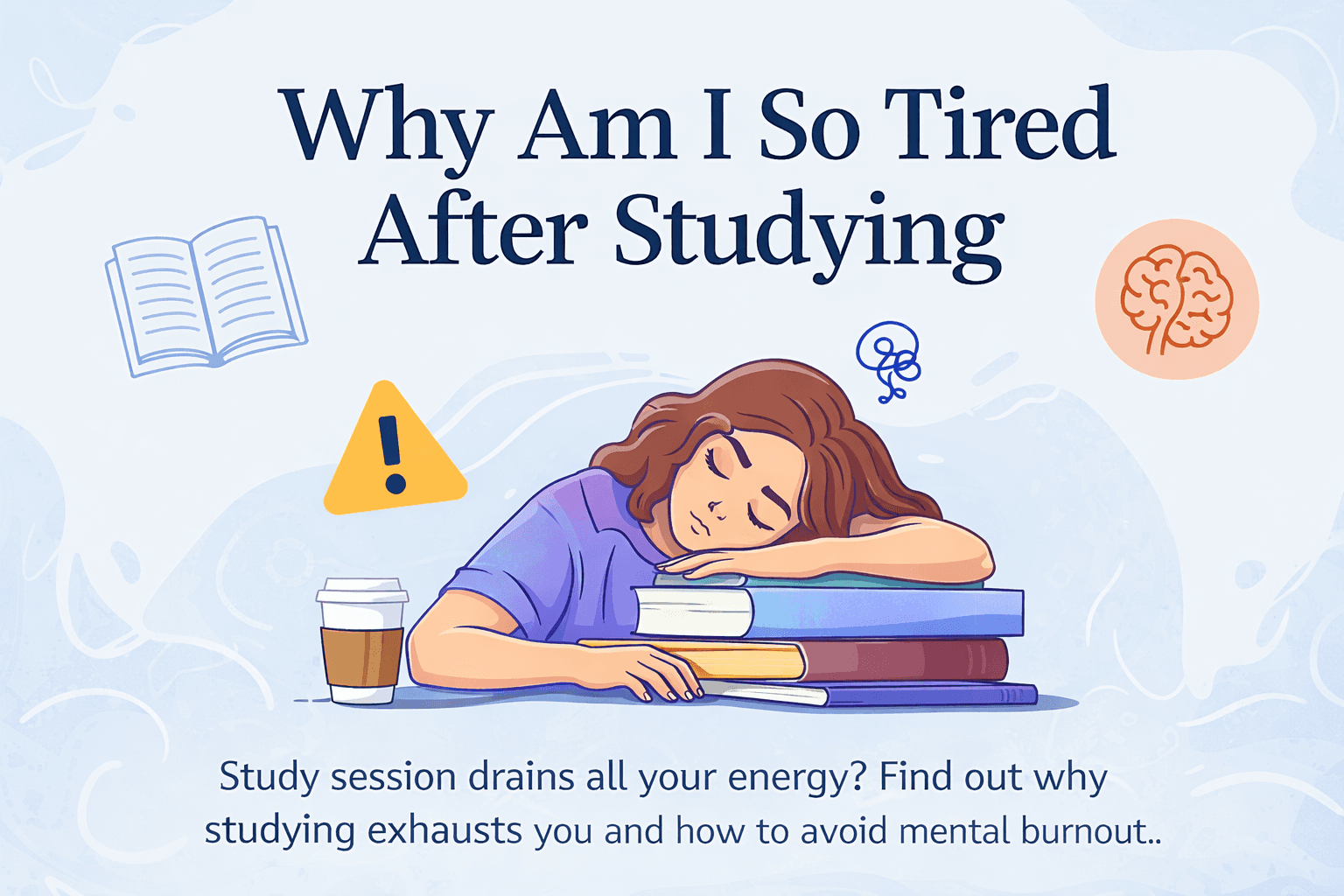
Imagine running a marathon while sitting completely still. That is exactly what your body feels like after a long study session. You haven’t moved a muscle, yet you feel like you just carried a heavy backpack up a mountain. It is confusing, right? You look at your desk, your books, and your laptop, and wonder how reading and thinking could possibly leave you this wiped out.
This is not just "laziness" or "boredom." There are real, biological reasons why your brain feels like it has shut down. Understanding these reasons is the first step to fixing them. In this post, we are going to break down exactly what is happening inside your head and body.
Here is what we will cover:
The energy cost of thinking: Why your brain burns more fuel than you think.
The "Cognitive Load": How too much information crashes your system.
Physical factors: How posture, eyes, and snacks play a huge role.
The fix: Simple changes to study longer without the crash.
Let’s dive into the science of why you are so tired, and how to get your energy back.
Your Brain is an Energy Hog
You might think that because your brain is small, only about 2% of your body weight, it doesn’t need much fuel. That is a huge misconception. Your brain is actually the most "expensive" organ you have. Even when you are resting, it uses up about 20% of your body’s total energy.
When you start studying hard, solving math problems, writing essays, or trying to understand complex history, that energy usage goes up. Your brain runs on glucose (sugar). As you focus, your neurons are firing rapidly, sending electrical signals back and forth. This process burns through your glucose reserves faster than normal.
According to research from Bond University, deep thinking requires a steady stream of oxygen and blood flow. When you study for hours without a break, you are essentially driving a car with the gas pedal floored. Eventually, the tank runs dry. That feeling of "brain fog" is your body telling you that your fuel supplies are low and you need a refill.
You Are Overloading Your "Working Memory"
Think of your brain like a computer. You have "hard drive" storage (long-term memory) and you have "RAM" (working memory). Your working memory is where you hold information while you are using it, like keeping a phone number in your head while you dial it.
Studying usually demands a lot from your working memory. You are trying to hold new definitions, connect them to old ideas, and maybe solve a problem all at once. The problem is, your working memory is tiny. It can only hold a few items at a time.
When you try to cram too much information in at once, you experience Cognitive Overload. This is mentally exhausting. It is like trying to juggle 10 balls when you can only handle 3. Your brain stresses out, cortisol (the stress hormone) spikes, and you feel tired.
This is where AI tools can act as a safety net. Instead of burning energy trying to brainstorm entirely from scratch or worrying if your logic makes sense, you can use a tool to guide you. For example, our Critical Thinking Expert prompt acts like a coach. It helps you generate creative ideas or spot weak points in your arguments. By letting the AI handle the structure and "checking," you save your brain power for the actual learning.
The Hidden Drain of Decision Fatigue
Have you ever noticed that deciding what to study is sometimes harder than actually studying? This is called Decision Fatigue.
Every time you have to make a choice, you use a little bit of mental energy.
"Should I start with math or history?"
"Which chapter should I read?"
"Should I take notes or just read?"
"Is this important for the test?"
If you spend the first hour of your study time just trying to organize your materials and decide what to do, you have already wasted a huge chunk of your battery. By the time you actually start learning, you are already half-tired.
To fix this, you need a plan before you sit down. If you are juggling multiple subjects, check out our guide on the Best Way to Study for Multiple Tests Same Week. It gives you a clear structure so you don't have to waste energy deciding what to do next.
Your Environment is Physically Draining You
Sometimes, the tiredness is not in your brain, it is in your body. But because you are focused on your book, you don't notice it until you stand up.
Eye Strain: Staring at a screen or a book for hours forces your eyes to maintain a fixed focus. This tires out the tiny muscles around your eyes. We often blink less when we focus, leading to dry, irritated eyes. This physical discomfort signals your brain that you are "tired" and need to sleep, even if your mind is still awake.
Poor Posture: Slouching over a desk restricts your breathing. If your lungs are compressed, you take shallow breaths. Less oxygen in your lungs means less oxygen in your blood, and less oxygen for your brain. It is a chain reaction.
Lighting: If your room is too dark, your brain produces melatonin, the sleep hormone. If it is too bright or harsh (like fluorescent office lights), it can cause headaches. You need a happy medium, natural light is best.
You Are Studying Passively (Which is Boring and Tiring)
There is a big difference between "Active Recall" and "Passive Review."
Passive Review: Re-reading your notes, highlighting text, or watching a lecture without pausing.
Active Recall: Quizzing yourself, teaching the material to an invisible class, or writing summaries from memory.
Believe it or not, passive studying often makes you more tired than active studying. Why? Because it is boring. When you are bored, your brain has to fight to stay awake. You are using energy just to force yourself to pay attention.
Active studying keeps your brain engaged. It wakes you up. It is harder work in the short term, but it prevents that sleepy, glazing-over feeling. If you are struggling to make information stick, read our article on How to Remember What You Studied for a Test. It explains how to switch from passive to active learning so you don't fall asleep in your textbook.
Stress and Anxiety Burn Energy Fast
If you are worried about failing, your body enters "Fight or Flight" mode. Your heart beats faster, your muscles tense up, and your adrenaline spikes. This is great if you are running from a bear, but it is terrible if you are sitting in a chair trying to learn chemistry.
Being in a high-stress state burns energy incredibly fast. After a few hours of anxiety-fueled studying, you will experience an "adrenaline crash." You will suddenly feel exhausted, shaky, and maybe even emotional. This is a classic sign of Mental Exhaustion.
You have to lower the stakes. Remind yourself that one study session will not make or break your life. Taking deep breaths and calming your nervous system will literally save you physical energy.
The Sugar Rollercoaster
What do you eat while studying? If the answer is candy, energy drinks, or chips, you have found the culprit.
Sugar gives you a quick burst of energy (glucose) which helps for about 30 minutes. But then, your insulin spikes to clear that sugar away, and your blood sugar crashes. When your blood sugar drops, your brain panics. You get brain fog, you get irritable, and you get sleepy.
Better Brain Fuel:
Water (Dehydration is the #1 cause of fatigue).
Nuts (Healthy fats for long-term energy).
Fruit (Natural sugar with fiber).
Oatmeal (Slow-release energy).
How to Fix Study Fatigue
Now that we know why you are tired, let’s look at how to fix it. You don't have to stop studying; you just have to study differently.
1. The Power of Micro-Breaks
Do not study for 3 hours straight. It is biologically impossible to maintain peak focus for that long. Use the Pomodoro Technique:
Study for 25 minutes.
Break for 5 minutes (Stand up, look away from screens).
Repeat. This keeps your glucose levels steady and prevents eye strain.
2. Beat the Blank Page
A lot of mental fatigue comes from "starting friction", staring at a blank page and not knowing where to begin. This is where AI helps most. Use our Critical Thinking Expert prompt to get unstuck. Paste your topic in, and it can help you brainstorm angles, check if your sources are trustworthy, or even spot bias in the articles you are reading. It removes the heavy lifting of "getting started" so you can focus on writing and learning.
3. Sleep is Non-Negotiable
You cannot study your way out of sleep deprivation. Sleep is when your brain actually "saves" the information you learned. If you study for 5 hours but only sleep 4 hours, you will likely forget most of what you studied.
According to Medical News Today, lack of sleep creates "cognitive debt" that caffeine cannot fix. Prioritize sleep, and your study sessions will be half as long because you will be twice as fast.
4. Switch Subjects
If you feel your brain dying on Math, switch to English. Different subjects use different parts of the brain. It is like switching from doing pushups to doing squats. You are still working out, but you are resting the tired muscle group.
Conclusion
Feeling tired after studying is normal, but feeling completely drained and burnt out is not. It is a sign that you are working against your body, not with it.
Remember, your brain is a biological machine. It needs fuel, oxygen, breaks, and the right environment to work well. If you treat it poorly—by feeding it junk food, skipping sleep, and forcing it to work for 4 hours without a break—it will shut down to protect itself.
To recap, here is your checklist to beat study fatigue:
Eat real food: Avoid sugar crashes.
Move your body: Fix your posture and get blood flowing.
Use Active Recall: Don't just read; engage.
Use Tools: Leverage AI prompts like our Critical Thinking Expert to spot errors and save brain power.
Take Breaks: Your brain needs to recharge every 30 minutes.
Next time you sit down to study, treat your brain like the high-performance engine it is. You will be surprised at how much longer your energy lasts.