Introduction
It happens to almost everyone. You walk into class on the first day. You sit down. The teacher hands out the syllabus. Then, you see it. It is in big, bold letters.
"No Artificial Intelligence Allowed."
Your heart sinks. You use AI for everything. You use it to plan your week. You use it to help you understand hard books. You might even use it to help you start your essays. Now, you feel like you are stuck. You feel like you have to go back to the Stone Age of studying.
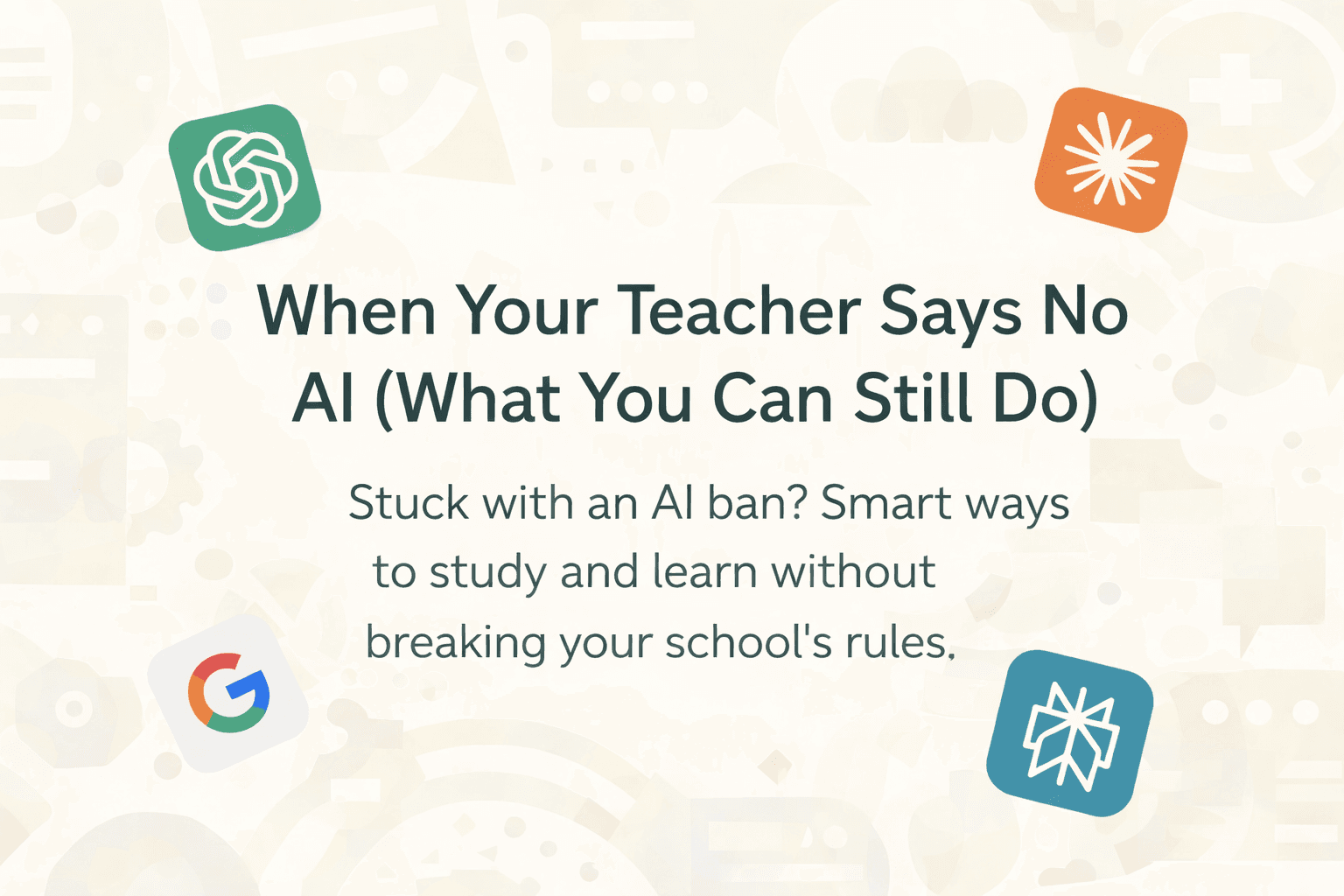
But here is the good news. When a teacher says "No AI," they usually mean "No cheating." They do not want you to ask ChatGPT to write your paper for you. They do not want you to copy and paste answers without thinking.
However, there are still many ways you can use these tools to help you learn without breaking the rules. You just have to be smart about it. You have to be honest. And you have to use AI as a tool, not a crutch.
In this guide, we will look at exactly what you can still do when your teacher bans AI. We will show you how to study smarter, not harder.
Why Do Teachers Ban AI?
Before we look at the solutions, we need to understand the problem. Why are teachers so scared of AI?
They are not trying to be mean. They are worried about your brain.
When you go to the gym, you lift weights to make your muscles stronger. If you asked a robot to lift the weights for you, you would not get stronger. You would just stand there watching a robot work out.
School is the same thing. Writing an essay is like lifting a weight for your brain. It teaches you how to think. It teaches you how to argue a point. If you let an app do it for you, your brain stays weak.
Teachers want to make sure you are actually learning. They want to know that you know the material, not that a computer knows it.
Once you understand this, it is easier to talk to your teacher. You can show them that you want to use AI to help you lift the weight, not to lift it for you.
The First Step: Talk to Your Teacher
This is the most important advice in this entire post. Ask permission.
Don't guess. Don't assume. Go up to your teacher after class. Be polite. Be honest.
You can say something like this:
"Hey, I saw that we cannot use AI to write our papers. I completely understand that. But I sometimes use it to help me brainstorm ideas or check my spelling. Is that okay?"
Most teachers will say yes. They will appreciate that you asked. They will see that you care about being honest.
If they say no, then you must respect that. But often, they will give you clear rules. They might say, "You can use it for ideas, but not for writing sentences."
That is a huge win. Now you know exactly what you can do.
Use AI for Brainstorming Ideas
The hardest part of any assignment is starting. You stare at a blank page. The cursor blinks at you. You have no idea what to write.
This is where AI shines. And this is usually allowed, because you are not asking it to do the work. You are just asking for a push.
Let's say you have to write an essay about Macbeth. You can ask a chatbot for ten interesting topics about Macbeth.
It might give you ideas about:
Fate vs. Free Will
The role of guilt
How power corrupts people
[Insert Image: A screenshot of a chat interface showing a list of 10 essay topic ideas for a high school English class, clearly labeled as 'Brainstorming Only']
You pick the one you like best. Then, you write the paper yourself. The AI did not write a single word of your essay. It just helped you pick a path. This is just like talking to a friend to get ideas.
If you are stuck on how to come up with good ideas, we have a tool that can help. Our Brainstorming Expert prompt is designed to give you creative angles without doing the writing for you. You can find it in our Prompts Library.
Use AI as a Tutor (The Socratic Method)
This is the best way to use AI, and it is almost always ethical. Use it to explain things to you.
Imagine you are in biology class. The teacher is talking about "mitosis." You are lost. You have no idea what is going on.
You can go home and ask AI to explain it to you. But don't just say, "What is mitosis?"
Say this instead: "Explain mitosis to me like I am 12 years old. Use an analogy about pizza."
Now, the AI gives you a simple explanation. It helps you understand. You are not copying an answer. You are learning the concept.
This is called the Socratic Method. It is a fancy way of saying "learning by asking questions."
We actually built a specific tool for this called the Generalist Teacher. It turns any AI into a tutor that quizzes you and guides you, rather than just giving you the answer. It forces you to think. You can check it out in our Prompts Library.
This helps you study for tests. If you understand the material because an AI explained it clearly, you will do better on the exam. And since the exam is just you and a piece of paper, the teacher will see that you really learned it.
For more on how to think deeply instead of just copying, read our guide on building critical thinking skills.
Checking Your Grammar and Spelling
Most teachers are okay with tools like spell check. You have been using the red squiggly line in Word or Google Docs for years. That is a basic form of AI.
Newer tools are just better versions of that. They can tell you if your sentence is clunky. They can tell you if you used the wrong "there/their/they're."
If your teacher allows tools like Grammarly, they will likely allow you to paste your essay into a chatbot and ask: "Can you find any grammar mistakes in this text? Don't rewrite it, just point out the errors."
Notice the command: "Don't rewrite it."
This is key. You want the AI to act like a strict English teacher. You want it to point at a mistake so you can fix it. You do not want it to rewrite the whole paragraph for you. If it rewrites it, it is not your voice anymore.
Summarizing Long Readings
Sometimes, you get assigned a 50-page PDF to read. It is dense. The words are old and hard to read. You try to read it, but your eyes glaze over.
You can use AI to help you get the main points. You can upload the PDF and ask for a summary of each chapter.
[Insert Image: An infographic showing a student holding a thick textbook next to a smartphone screen displaying a 5-point summary bullet list]
This gives you a map. Now, when you read the real text, you know what to look for. You know the main characters. You know the main argument. It makes reading the real thing much easier.
Warning: Do not use the summary instead of reading. Use it while you read. If you only read the summary, you will miss the details. You will miss the quotes you need for your essay. And if the teacher asks a specific question about page 42, you will not know the answer.
If you are looking for the best free tools to handle PDF summaries, there are great options out there. We listed some of the top ones in our best free AI tools guide.
What About Citations?
One of the biggest no-nos in school is making up facts. This is called "hallucinating." Chatbots do this sometimes. They will invent a book that does not exist. They will make up a quote.
If you turn in a paper with a fake quote, you will get in trouble.
So, be very careful asking AI for facts.
Instead, use AI to help you format your citations.
Let's say you found a great book for your history paper. You have the title, the author, and the year. But you don't know how to write the citation in MLA format.
You can give the info to the AI and say: "Turn this into an MLA citation for me."
It will put the periods and commas in the right place. This is a huge time saver. And it is not cheating. It is just formatting.
For more rules on how to cite things properly, you should check out the Purdue OWL (Online Writing Lab). It is the gold standard for writing rules.
The "Red Line" You Should Never Cross
We have talked about what you can do. Now, let's be super clear about what you should never do.
Never ask AI to write your essay. Teachers can tell. Your writing has a "voice." AI sounds like a robot. It uses boring words. It repeats itself.
Never copy and paste. Even if you change a few words, it is still plagiarism.
Never use AI during a test. This is just cheating. Don't do it.
Never use AI without permission. Tell your teacher how and why you plan to use it from the start.
If you stick to these rules, you will be safe. You can use technology to help you learn, but you are still doing the hard work.
Conclusion
When a teacher says "No AI," it can feel like a roadblock. But it is actually just a guardrail.
They want to keep you safe. They want to make sure you learn.
You can still use these amazing tools. You just have to change how you use them.
Don't use them to write.
Do use them to brainstorm.
Don't use them to cheat.
Do use them to explain hard concepts.
How to Cite AI Usage
Most forward-thinking teachers will actually let you use AI, as long as you admit it.
They might say, "You can use ChatGPT for ideas, but you have to cite it."
How do you cite a robot?
It is usually simple. You add a note at the end of your paper. It might look like this: "I used ChatGPT to help me brainstorm the topic for this paper. I also used it to check my grammar."
Being honest is a superpower. Teachers love honesty. If you hide it, you look guilty. If you admit it, you look responsible.
For more details on academic honesty, you can read about plagiarism and integrity on Plagiarism.org.
Learning the Basics First
There is one last thing to remember. You cannot use a calculator if you don't know what numbers are. You should never use a spell checker if you cannot read.
You need to know the basics.
If you rely on AI for everything, you will forget how to do simple things. You will forget how to write a nice email. You will forget how to summarize a meeting.
Use AI to speed you up, not to replace you.
A great place to make sure you still have your basics down is Khan Academy. They offer free courses on almost everything.
If you follow the advice in this post, you will be the smartest student in the room. You will have the power of AI, but you will also have the respect of your teacher.
And remember, the goal of school isn't to get a grade. It is to build a brain that works. Use the tools that help you build that brain, and avoid the ones that do the work for you, If you go to the gym, you wouldn't expect somebody else to lift the weights for you, why should school be any different?