Introduction
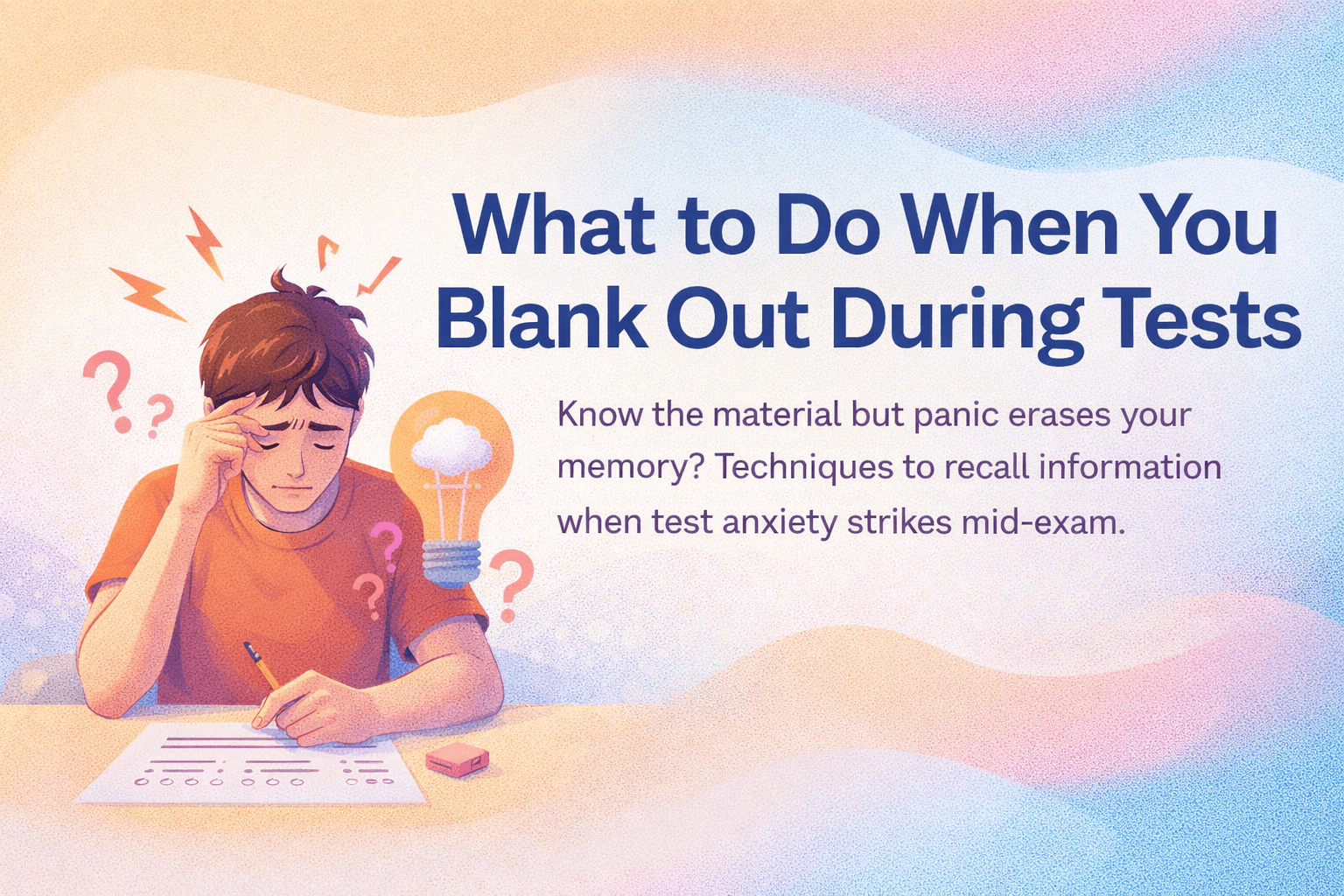
We have all been there. You studied for weeks. You know the material backward and forward. You sit down, flip over the exam paper, and suddenly... nothing.
Your mind goes completely blank.
The information is in there, but you cannot reach it. It feels like a door has slammed shut in your brain. Your palms sweat, your heart races, and the panic sets in. This is not just "forgetting." This is a physiological reaction that blocks your memory.
The good news? You can unlock that door. You do not need to re-learn the material; you just need to calm your body down enough to access it again.
This guide covers exactly what to do the moment you blank out. We will look at why it happens, how to reset your brain in 60 seconds, and how to make sure it never happens again.
Why Your Brain Freezes
To fix the problem, you need to understand what is happening inside your head. You are not "stupid," and you did not "waste your time studying." You are just experiencing a biological false alarm.
When you feel high pressure, your body enters "fight or flight" mode. Your brain releases a stress hormone called cortisol.
Cortisol is great if you need to run away from a tiger. It pumps energy to your muscles and shuts down non-essential systems. Unfortunately, your brain considers memory retrieval a "non-essential system" during a crisis.
Specifically, high levels of cortisol temporarily disable the hippocampus. This is the part of the brain responsible for accessing facts and memories.
Think of it like this: Your memory is a library. The books are all there. But when you panic, the librarian (your hippocampus) runs out of the building screaming. Until the librarian comes back, you cannot find the book you need.
Your goal during a test is simply to get the librarian to come back inside.
The First 60 Seconds: Reset Your Body
When the blank hits, your first instinct is to try harder to remember. Do not do this.
Straining to remember only increases your stress. This releases more cortisol, which blocks your memory even more. It becomes a vicious cycle.
Instead, you need to manually switch off your "fight or flight" response. You can do this with physical actions that signal safety to your brain.
The Box Breathing Technique
This is the fastest way to lower your heart rate. It is used by Navy SEALs to stay calm in high-stress situations. It is subtle enough that no one in the exam hall will notice you doing it.
Inhale slowly through your nose for a count of 4.
Hold your breath for a count of 4.
Exhale slowly through your mouth for a count of 4.
Hold your empty breath for a count of 4.
Repeat this cycle three or four times. This forces your nervous system to shift from "panic" mode to "calm" mode.
Grounding Your Senses
If breathing does not work, try the "5-4-3-2-1" grounding method. This distracts your brain from the internal panic and reconnects you with the physical room.
Look for 5 things you can see (the clock, a pencil, a shoe).
Feel 4 things you can touch (the desk, your shirt fabric).
Listen for 3 sounds (a cough, a scratching pen).
Smell 2 scents (eraser dust, fresh paper).
Taste 1 thing (a sip of water, or just notice the inside of your mouth).
By the time you finish this list, your cortisol levels will drop, and your "librarian" will start heading back to work.
The "Brain Dump" Strategy
Once you have calmed down, do not try to answer Question #1 immediately.
Instead, flip your test paper over to a blank page or use scrap paper. Write down anything you remember.
Formulas
Dates
Names
Acronyms
Mnemonics you memorized
Get it all out of your head and onto the paper.
Why this works: This relieves the cognitive load on your working memory. You no longer have to "hold" that information while trying to solve a problem. You are creating a safety net.
Once you see facts written on the page, your confidence will spike. Seeing one formula often triggers the memory of another. You are essentially building your own cheat sheet using the knowledge that was locked away just moments ago.
Use Context to Trigger Recall
Memory is "context-dependent." This means your brain links information to the environment where you learned it.
If you are stuck on a specific topic, close your eyes for a moment. visualize the place where you studied that material.
Ask yourself these questions:
Where were you sitting? (At your desk? In the library? On the bus?)
What did the page look like? (Was the information in a blue box? Was it highlighted yellow?)
Who explained it to you? (Can you hear your teacher's voice? Can you remember a specific joke they made?)
Research on context-dependent memory shows that mentally recreating the study environment can unlock the neural pathways to that information.
This is also why we recommend studying in an environment that mimics the test room. If you always study in your bed with music on, the silence of a classroom can feel alien and block your recall.
The "Skip and Circle" Method
Staring at a question you do not know is a recipe for panic. If you read a question and the answer does not come within 30 seconds, skip it.
Circle the question number so you do not forget it, and move immediately to the next one.
This serves two purposes:
It builds momentum. Answering easier questions gives you small "wins." Each correct answer lowers your stress level and reduces cortisol.
It works in the background. Your brain is an amazing parallel processor. While you are consciously working on Question #5, your subconscious mind is still scanning its files for the answer to Question #1.
Many students find that the answer to a skipped question suddenly "pops" into their head twenty minutes later while they are working on a completely different section.
Prevention: Stop the Blank Before It Starts
The best way to handle a memory blank is to prevent it from happening. You can "panic-proof" your knowledge by changing how you study.
Practice Active Recall
Passive studying (like re-reading notes) creates a weak memory. It is like looking at a map without actually driving the route. You recognize the material, but you cannot retrieve it on your own.
Active recall forces you to pull information out of your brain without help.
Use flashcards.
Cover your notes and try to explain the concept out loud.
Take practice tests without looking at the textbook.
When you struggle to remember an answer during practice, you are strengthening the neural pathway. This makes the memory "stickier" and harder to lose under stress.
For a deeper dive into this, read our guide on how to look at a problem from different angles. It explains how shifting your perspective during study sessions can build more robust memories.
Simulate the Pressure
If you only practice when you are relaxed, you will not be ready for the stress of exam day.
Try to mimic the testing conditions. Clear your desk. Set a timer. Do not allow yourself to check your phone.
You can also use tools to simulate this environment. The Memory Coach from our Prompts Library is designed for this exact purpose.
It acts like a drill sergeant for your brain. It asks you questions, waits for your answer, and then gives immediate feedback. It uses spaced repetition to drill the facts until they become automatic.
When a fact becomes "second nature," it bypasses the panic response. You do not have to "think" about it; you just "know" it.
Manage Your Physical State
Your brain needs fuel to function. Skipping breakfast or pulling an all-nighter guarantees higher cortisol levels.
Sleep: A tired brain is a stressed brain. Prioritize sleep the night before.
Hydration: Even mild dehydration can fog your memory. Drink water before the test.
Relaxation: Learn Progressive Muscle Relaxation. This involves tensing and releasing muscle groups to physically drive tension out of your body.
For more on how simple habits affect your brain, check out our post on writing things down to remember better.