Introduction: The "Silo" Trap
In school, we learn subjects in "silos", History at 9 AM, Biology at 10 AM, Literature at 11 AM. We rarely stop to ask how they connect.
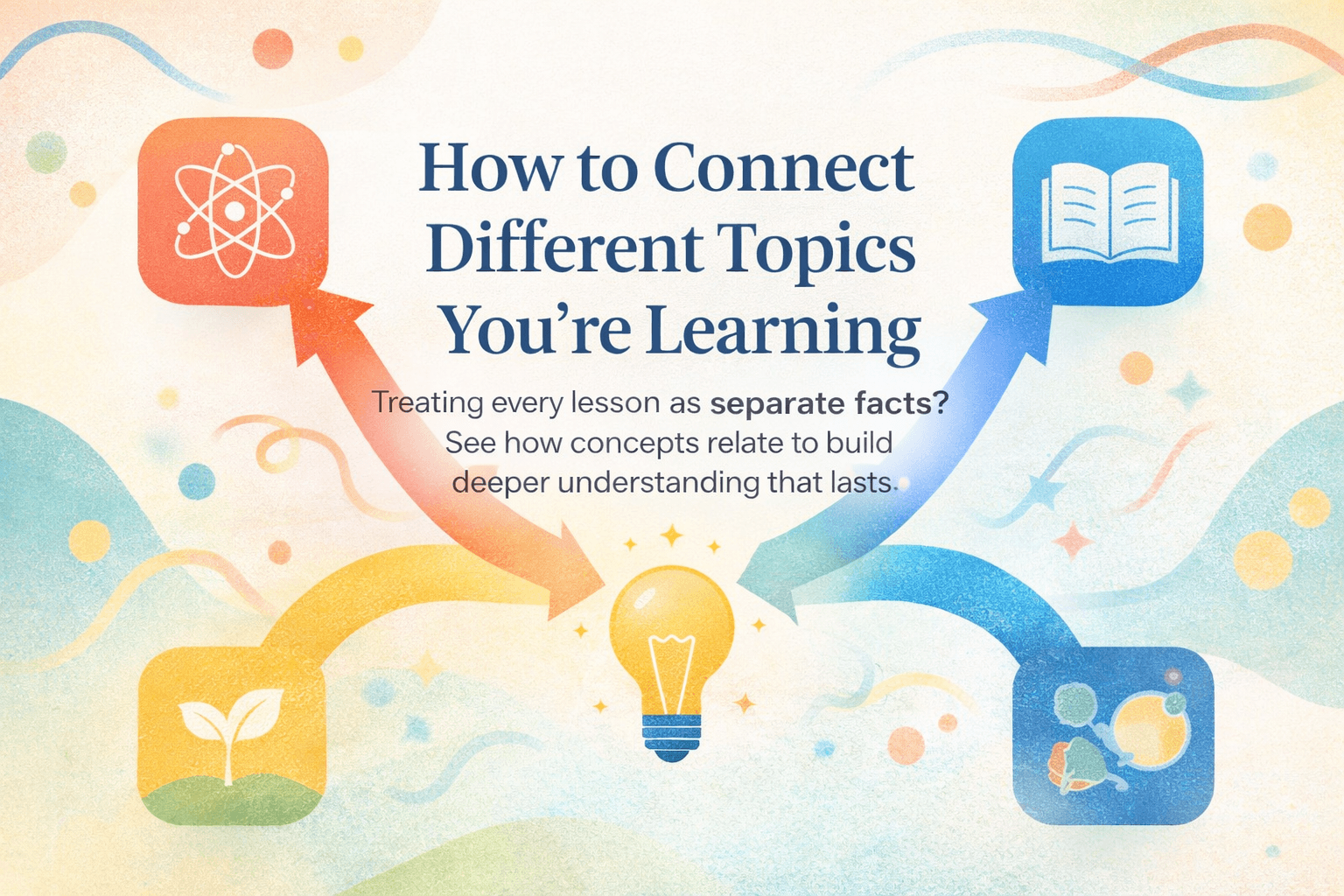
But true expertise comes from Interdisciplinary Learning, the ability to see the invisible threads linking different fields.
Gemini (formerly Bard) is uniquely suited for this because of its Multimodal capabilities. Unlike other AIs, it can analyze text, images, and data simultaneously to find patterns a human might miss.
Here is a step-by-step workflow to break down the walls between your classes.
1. Start Simple: Find the Hidden Link
The first step is to break the isolation between two topics. You need to ask Gemini to build a bridge between them.
The Prompt: "I am studying [Topic A, e.g., The Industrial Revolution] in History and [Topic B, e.g., Thermodynamics] in Physics. Explain the connection between these two topics. How did advancements in one field influence the other?"
Why it works: Gemini synthesizes information from its vast dataset to show causal relationships, like how the laws of thermodynamics enabled the steam engines that powered the Industrial Revolution.
The Result: You stop seeing "physics equations" and start seeing the "engine of history."
2. Go Visual: Map the Connection
Once you understand the link verbally, you need to see it visually. This is where Gemini Canvas shines.
Upload Materials: Upload a PDF of your history notes and a photo of your physics textbook diagram.
The Prompt: "Create a chronological table that compares the timeline of [Topic A] with the scientific discoveries of [Topic B]. Highlight the specific years where they intersect."
The Benefit: You get a structured visual guide that maps out the overlapping timeline, helping you visualize the "cause and effect" across disciplines.
3. Apply It: Solve a Real-World Mystery
Now that you have the theory and the visual map, apply it to a real-world problem. This moves you from "memorizing" to "synthesizing."
The Prompt: "I want to understand [Real World Issue, e.g., Climate Change]. Explain it through the lens of [Subject 1, e.g., Economics], [Subject 2, e.g., Biology], and [Subject 3, e.g., Political Science]. Synthesize these perspectives into one cohesive explanation."
Why it works: This forces you to engage in Systems Thinking, seeing the whole picture rather than just one part. It simulates the kind of complex problem-solving required in the real workforce.
4. Dive Deeper: Automate Your Research
Finally, for a major term paper that spans multiple subjects, you need more than a quick summary. You need a research assistant.
The Tool: Gemini Deep Research can browse the web, read academic papers, and synthesize findings into a comprehensive report.
The Action: Ask it to "Research the intersection of [Topic A] and [Topic B]. Find 5 key academic papers that discuss this overlap and summarize their main arguments in a bulleted list with citations.".
Conclusion: You can become a Polymath
The world isn't divided into subjects; only schools are. By using Gemini to connect the dots, you stop being a student of "subjects" and become a student of the world. You will write better essays, solve harder problems, and understand the "why" behind what you learn.
Next Step: Open Gemini and try the "Concept Bridge" prompt with two of your current classes. You might be surprised by what you find.