Introduction
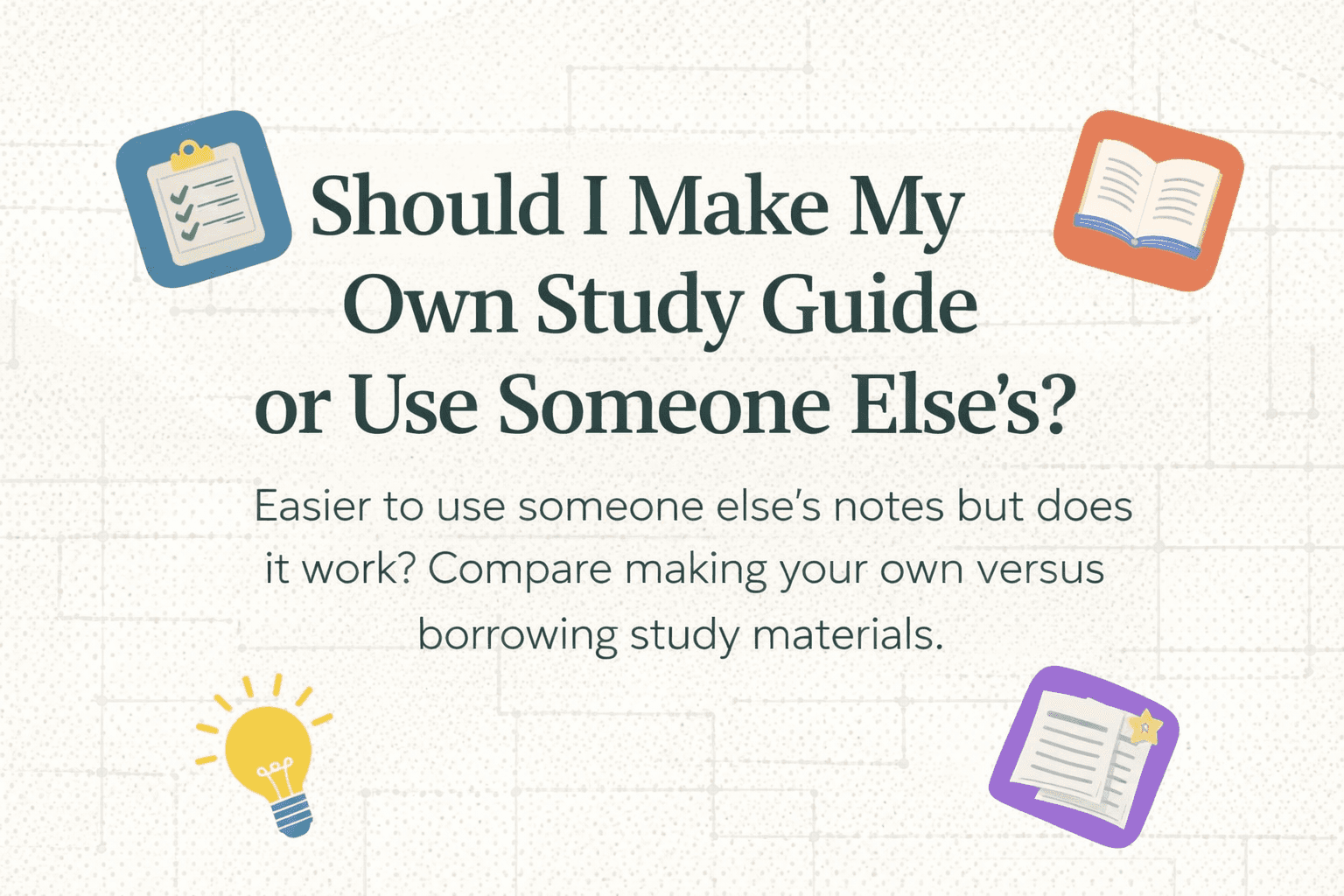
Getting ready for a big test can feel like a lot of work. You have piles of papers, books, and online notes to go through. One of the first things most students ask is whether they should spend time making their own study guide. It is a big choice because making a guide takes a lot of hours. On the other hand, finding a guide that a friend or a teacher made is much faster.
In this post, we will look at which choice is better for your grades and your brain. We want to help you figure out the best way to spend your time so you can get that A.
Here is what we will cover today:
Why borrowing notes is so popular
The science behind making your own materials
How your brain learns when you write things down
When it is okay to use a guide from someone else
Tips for making your own guide without getting tired
How to use AI to make your messy notes look great
Our goal at Vertech Academy is to help you study smarter, not just harder. We want you to feel ready when you walk into class. Let's dive in and see which study path is right for you.
The Temptation of Borrowing Notes
It is very easy to see why people want to use someone else's notes. When you have a lot of homework, finding a shortcut feels great. You might have a friend who is very good at taking notes. Their handwriting is neat, and they have everything color-coded. It looks perfect. You think to yourself that if you just read their notes, you will know everything they know.
Another reason people borrow guides is to save time. Making a study guide from scratch can take three or four hours. If you just download one, you save those hours. You can use that time to relax or sleep. However, there is a big difference between looking at information and actually learning it. Just because the information is in front of your eyes does not mean it is in your head.
When you use a guide you did not make, you are being passive. This means you are just sitting there and letting the words pass by. It is like watching a video of someone working out at the gym. You can see how they do it, but your own muscles won't get stronger. To get "brain muscles," you have to do the heavy lifting yourself. This is a key part of our philosophy on the Vertech Academy blog where we focus on real learning.
The Science of the Generation Effect
There is a very cool thing scientists call the "Generation Effect." This is a fancy way of saying that your brain remembers things much better when you create them yourself. When you read a book, you are taking in information. When you write a summary of that book, you are generating information.
A study from Psychological Science shows that students who make their own materials remember things longer. This happens because your brain has to work harder to put thoughts into your own words. You have to think about what is important and what is not. This extra work makes the memory "stickier."
Why Writing Matters
When you write out your own guide, you are doing three things at once:
You are reading the original source.
You are thinking about how to explain it simply.
You are physically writing or typing the words.
This triple action tells your brain that this information is very important. If you just read a guide someone else made, your brain might think it is just a random story and forget it by the next morning.
Why Making Guides Helps You Remember
Making a study guide is basically a long session of testing yourself. Every time you have to decide how to group two topics together, you are learning. This process is called active learning. High-level schools like Harvard University say that active learning is the best way to get good grades.
When you build your own guide, you are creating a "map" in your head. You know exactly where every piece of information came from. If you forget a detail during the test, you can often "see" your study guide in your mind. You remember the blue ink you used or the way you drew a little star next to a hard word. This mental picture is a huge help when you are stressed.
If you are studying for multiple tests in the same week, this map is even more important. It keeps the subjects from getting mixed up in your head. Your history guide feels different from your math guide because you built them differently.
When to Use Someone Else's Study Guide
We are not saying you should never use a borrowed guide. Sometimes it is actually a smart move. For example, if you were sick and missed three days of class, you need to see what happened. Borrowing a friend's notes is the only way to catch up.
Another good time to use someone else's guide is as a "check-up." You can make your own guide first. Then, look at a guide from a top student or your teacher. Did they include something you missed? Did they explain a math problem in a way that makes more sense? Using their guide to fill in the gaps of your own is a great strategy.
You can find more tips on how to use resources effectively in the Stanford Learning Lab guide. They talk about how to mix different types of study materials for the best results. The key is to make sure you are not using the borrowed guide as a "crutch" to avoid doing the work.
How to Make a Great Study Guide Without Wasting Time
The biggest problem with making your own guide is the time it takes. But you can be fast if you have a plan. You don't need to write down every single word the teacher said. That is a waste of energy.
Follow these simple steps to be fast:
Pick the main ideas: Look at the bold words in your textbook.
Use bullet points: Don't write long stories. Use short sentences.
Draw pictures: A quick sketch of a cell or a map can replace 100 words.
Group things together: Put all the dates in one spot and all the names in another.
If your notes are a total mess, it can be hard to start. This is where technology can help. We have a tool called the Notes Organizer in our prompts library. It helps you take your messy, scattered study notes and organize them into clear, structured formats that make sense and are easy to review. Using a tool like this helps you get the "Generation Effect" benefit without spending hours on formatting.
Using AI to Clean Up Your Notes
AI is changing the way we study, but you have to use it the right way. You should not ask AI to "write a study guide for me." If you do that, you lose all the learning benefits we talked about. Instead, you should use AI as a partner.
Think of AI like a neatness coach. You give it the rough ideas you wrote down, and it helps you organize them. For example, you can take your handwritten notes, type them up quickly, and then use the Notes Organizer from our library to make them look professional.
This way, you are still the one choosing the information. You are still the one doing the thinking. The AI just takes away the boring part of making things look pretty. This saves you time while keeping the learning strong. According to Edutopia, the way you organize your notes is just as important as what is in them. A clear layout helps your brain find information faster during your review.
Common Mistakes to Avoid When Studying
Even if you make your own guide, you can still make mistakes. The most common one is "passive re-reading." This is when you spend hours just looking at your guide over and over. You feel like you are studying, but your brain is actually on "autopilot."
To avoid this, you need to use your guide for active recall. Cover up one side of the paper and try to remember what is there. If you can't remember it, you haven't learned it yet. This is a big part of remembering what you studied for a test.
Another mistake is making the guide too long. If your guide is 50 pages long, it is not a guide. It is just another book. Try to keep your guide to just a few pages. This forces you to pick only the most important stuff. If you can't explain a topic in one or two sentences, you probably don't understand it well enough yet.
The Vertech Academy Way to an A
At Vertech Academy, we believe every student can get an A if they use the right tools. We are so sure about this that we have a 90-day guarantee. If you use our prompts and study tips for 90 days and don't get an A, we give you double your money back. We want to see you succeed.
We focus on methods like the Socratic method and active recall because they work. Whether you are using our Notes Organizer or our "Generalist Teacher" prompt, you are doing the real work that leads to high grades. Making your own study guide is a big part of that journey. It shows that you are taking control of your education.
Don't be afraid of the hard work. The time you spend making your own materials is an investment in your future. It makes you a better thinker and a better student.
Conclusion
Deciding whether to make your own study guide or borrow one is a choice between a shortcut and a long-term win. While borrowing might save you some time today, making your own guide will save your grade tomorrow.
Let's look at what we learned:
Personalized guides win: Your own words are the ones you remember best.
The Generation Effect: Creating your own study path makes memories stick.
Borrowing has a limit: Use other people's notes to check your work, not to replace it.
AI can help: Use tools like our Notes Organizer to clean up your rough drafts.
Active study is key: Always test yourself instead of just reading.
If you want to start getting better grades today, try making a one-page guide for your next quiz. See how much more you remember. If you need more help, check out our other posts on the Vertech Academy blog or explore our prompt library to find the perfect study partner. You have the power to master any subject, and we are here to help you do it.