Your resume is probably costing you interviews. Not because your experience is bad, but because the way you describe it is. Most student resumes read like a list of job duties: "Responsible for managing social media. Assisted with event planning. Completed coursework in data analysis." These descriptions tell a recruiter what you were assigned, not what you achieved. And that difference is why your applications disappear into the void.
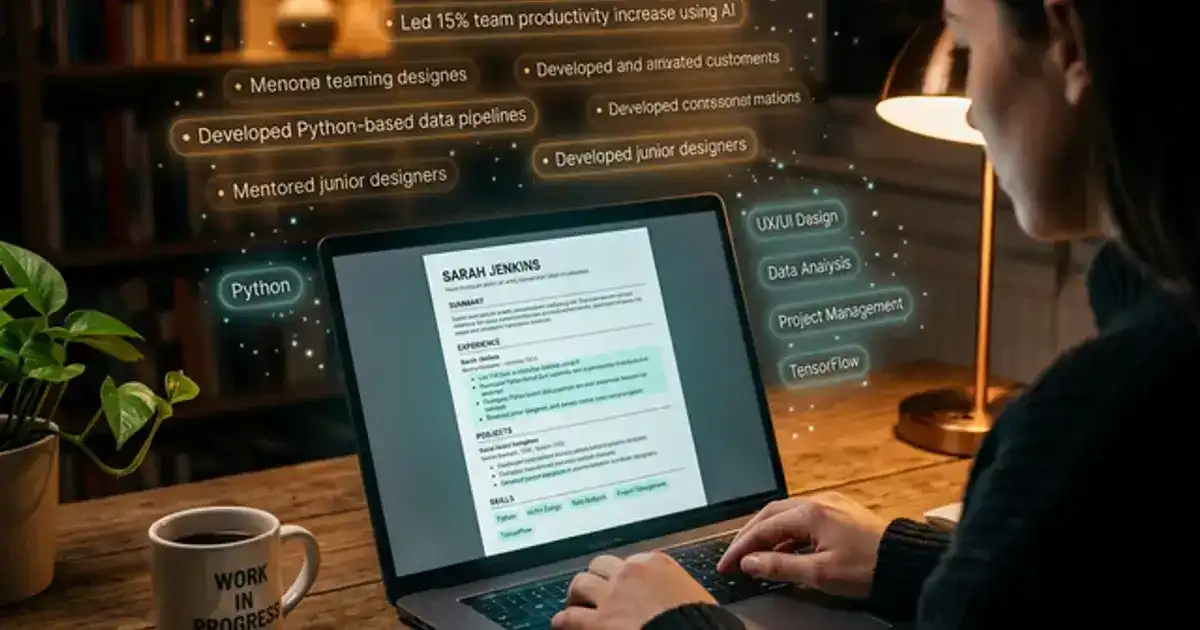
AI fixes the presentation, not the substance. You still need real experiences. You still need to be truthful. But AI transforms "responsible for managing social media" into "grew Instagram engagement 45% over 3 months by implementing a content calendar and A/B testing post formats." Same experience, completely different impact.
This guide covers the complete AI-powered resume workflow: building a master resume, writing impactful bullet points, tailoring for each application, optimizing for ATS filters, and getting AI feedback on your final draft. Every technique uses free tools.
Step 1: Build Your Master Resume
Before you tailor anything, you need a master resume: a complete document listing every experience, skill, project, and accomplishment you have. This is not what you submit. It is the raw material AI will pull from for each tailored version.
Master resume brain dump prompt:
"I am building a master resume to use when applying for [target industry] jobs after graduation. Help me brainstorm all my relevant experiences by asking me about: (1) jobs and internships, (2) campus organizations and leadership, (3) major class projects, (4) volunteer work, (5) technical skills and certifications, (6) awards and achievements. For each, ask follow-up questions to pull out specific accomplishments and numbers."
This conversational approach extracts experiences you have forgotten about. Most students undervalue their contributions because they seem small. The group project where you coordinated 5 schedules, the part-time job where you trained new employees, the club event you organized that attracted 100 attendees. These are legitimate accomplishments that belong on your resume.
Save everything in a single document. You will pull from this master list for every application, selecting the most relevant experiences for each specific job.
Step 2: Write Bullet Points That Actually Work
The formula for strong resume bullet points is: Action verb + What you did + Measurable result. Most students get the first two parts but miss the result. "Managed social media accounts" becomes "Managed social media accounts for 200-member student organization, increasing follower engagement 35% over one semester through a data-driven content calendar."
Bullet point transformation prompt:
"Transform these weak resume bullet points into strong ones using the format: [action verb] + [what I did] + [result/impact with numbers when possible]. Keep each bullet to one line (under 120 characters ideally). My weak bullet points: [paste your bullets]. My role was [title] at [organization]."
| Weak | Strong |
|---|---|
| Responsible for tutoring students | Tutored 15+ students weekly in organic chemistry, improving average exam scores by 12% |
| Helped with data entry | Processed 500+ patient records using Excel, reducing data entry errors by 20% |
| Organized campus events | Planned and executed 4 campus events for 100+ attendees, managing $3K budgets |
| Completed research project | Conducted 6-month research study analyzing 200+ survey responses, presenting findings at department symposium |
A note on numbers: if you do not have exact metrics, estimate reasonably. "Approximately 15 students" is better than no number. "Several events" is weaker than "4 events." Numbers make accomplishments concrete and credible. Just make sure you can defend any number in an interview.
Action verb variety. Ask AI: "Give me 20 strong action verbs for a resume in [your industry], avoiding overused words like 'managed,' 'helped,' and 'assisted.'" You get verbs like: orchestrated, spearheaded, streamlined, automated, analyzed, launched, resolved, mentored, optimized, and implemented. Each verb carries more weight than the generic alternatives.
Balancing job search with studying?
Our Chemistry Tutor prompt helps you study efficiently so you have time for career prep.
Try the Chemistry Tutor Prompt - Free →Step 3: Tailor Your Resume to Every Job Description
Sending the same resume to every job is the single biggest mistake students make. Recruiters can tell. They see your generic bullet points that do not map to their requirements. More critically, ATS software filters you out before a human even reads your application.
Resume tailoring prompt:
"Here is the job description for [role] at [company]: [paste full JD]. Here is my master resume: [paste resume]. (1) Identify the top 10 keywords and skills in the job description. (2) Highlight which of these keywords are already in my resume and which are missing. (3) Suggest specific edits to my bullet points that naturally incorporate missing keywords. (4) Recommend which experiences to emphasize and which to de-emphasize for this specific role."
This process takes 10-15 minutes per application with AI, compared to 30-45 minutes manually. The output is a tailored resume that mirrors the language of the job description while staying truthful to your experience. Recruiters unconsciously look for alignment between their requirements and your qualifications. When the same terminology appears in both, your resume feels like a natural fit.
The 80/20 rule of tailoring: You do not need to rewrite the entire resume for each application. Usually, 3-4 bullet point adjustments and a tweaked summary are enough. Focus on the top requirements in the job description and make sure your resume addresses them explicitly.
Keep a folder for each application: the job description, your tailored resume, and the cover letter. This organized approach prevents accidentally sending the wrong version and gives you reference material for interview prep. For the full AI interview preparation workflow, see our interview prep guide.
Step 4: ATS Optimization (Getting Past the Robots)
Most large companies use Applicant Tracking Systems (ATS) that scan your resume before any human sees it. If your resume does not include the right keywords in the right format, it gets filtered out automatically. You could be the perfect candidate and never get considered.
ATS optimization prompt:
"Review my resume for ATS compatibility: [paste resume]. Check for: (1) formatting issues (tables, columns, headers the ATS might not parse), (2) keyword density compared to this job description: [paste JD], (3) any creative formatting that might confuse automated scanning, (4) whether my section headers match standard ATS categories (Education, Experience, Skills). Give me specific fixes."
Key ATS rules:
Use standard section headers: Experience, Education, Skills, Projects. ATS software looks for these exact words.
Include both the spelled-out version and acronym of skills: "Search Engine Optimization (SEO)" so both forms get matched.
Use tables, columns, text boxes, or images. Most ATS systems cannot parse these correctly and your information gets lost.
Submit as PDF unless requested. Some older ATS systems struggle with PDFs. When in doubt, use .docx format.
Step 5: The Resume Summary (Your Elevator Pitch)
The top of your resume is the first thing a recruiter reads. A strong summary immediately communicates who you are, what you can do, and why you are relevant. Most student resumes either skip this section or fill it with empty phrases like "motivated team player seeking challenging opportunities."
Summary writing prompt:
"Write a 2-3 sentence resume summary for a [your major] student graduating in [year] applying for [target role]. Include: (1) my degree and university, (2) my strongest relevant skill or experience, (3) one measurable accomplishment that demonstrates my capability. Avoid cliches like 'motivated,' 'passionate,' or 'team player.' Be specific and results-oriented."
A strong summary: "Computer Science student at [University] with experience building full-stack web applications. Developed an inventory management tool during a summer internship that reduced manual data entry by 40%. Seeking software engineering roles where I can apply my skills in React, Python, and database design."
This tells the recruiter exactly who you are, what you have done, and what you want. No fluff. Every word earns its place.
Step 6: AI Resume Review (Brutal Honest Feedback)
Before you submit, get AI to review your resume the way a recruiter would. This is the most underused AI resume feature: honest, specific feedback with no social politeness.
Resume review prompt:
"You are a senior recruiter at a [industry] company reviewing resumes for [role]. Rate this resume on a scale of 1-10 and explain your rating. Specifically evaluate: (1) impact of bullet points - do they show results or just duties? (2) relevance to the target role, (3) formatting and readability, (4) any red flags or gaps, (5) what is missing that would make me a stronger candidate. Be brutally honest."
The feedback will be harsh. That is the point. Better to get harsh feedback from AI than a silent rejection email from a recruiter. Common issues AI catches: bullet points that describe duties instead of achievements, missing technical skills that the job requires, inconsistent formatting, and a summary that says nothing specific.
Run this review on every tailored version before submitting. Fix the issues AI identifies. Then run it once more. One round of AI revision typically transforms a 5/10 resume into a 7-8/10 resume.
Bonus: AI-Assisted Cover Letters
Cover letters follow the same AI workflow: start with your real reasons for wanting the job, then use AI to structure and polish.
Cover letter prompt:
"Write a cover letter for [role] at [company]. My relevant background: [2-3 sentences about why you are a fit]. Include: (1) a specific opening that shows I researched the company, (2) one paragraph connecting my experience to their needs, (3) a closing that expresses genuine interest and includes a specific call to action. Keep it under 300 words."
After AI generates a draft, rewrite the opening in your authentic voice and add a personal detail that AI cannot know: why you specifically find this company or role interesting. The combination of AI structure and personal authenticity creates cover letters that are both professional and genuine.
Resume Mistakes AI Cannot Fix (But You Should Know About)
Lying about your experience. AI can make your experiences sound better, but it cannot create experiences you do not have. Every bullet point should be something you can discuss in detail during an interview. If AI writes "Led a team of 10 engineers" but you actually managed a 3-person group project, fix it.
Over-polishing to the point of inauthenticity. If every bullet starts with "Spearheaded" and ends with "resulting in 300% growth," it reads as obvious AI generation. Mix strong verbs with simple ones. Vary your sentence structures. A resume that sounds like it was written by a real person who happens to be accomplished is more effective than one that sounds like a corporate press release.
Neglecting formatting basics. AI can write perfect content, but if you paste it into a cluttered template with 8pt font, inconsistent spacing, and no white space, it will not get read. Use a clean, single-column template with clear section headers, consistent bullet formatting, and enough white space to be easily scanned in 6 seconds. That is the average time a recruiter spends on a first-pass resume review.
One resume for everything. Tailoring takes 10-15 minutes per application with AI. Not tailoring costs you the interview. The 10 minutes of tailoring is always worth it. Every application.
This week's challenge
Build your master resume this week. Do the AI brain dump, then transform every bullet point using the action-verb formula. Even if you are not applying for jobs yet, having a master resume ready means you can respond to opportunities in hours, not days.