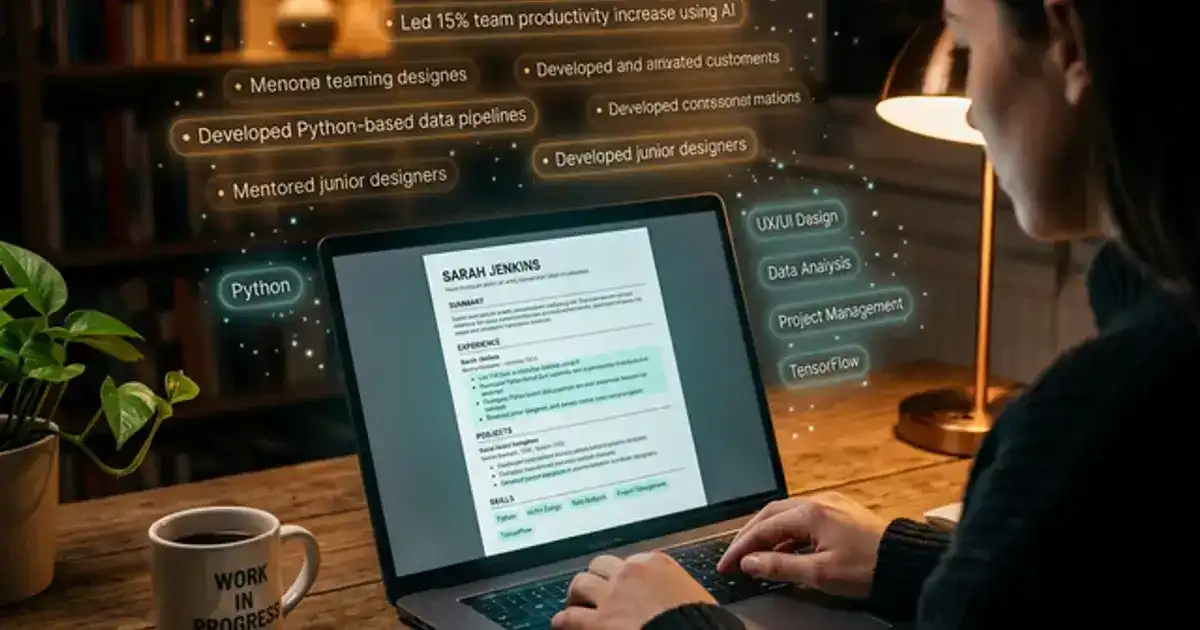
You have a job interview in 3 days. You know the company name, the role title, and approximately nothing else. You need to research the company, anticipate the questions they will ask, prepare compelling answers from your actual experience, practice delivering those answers without sounding robotic, and draft a thank-you email for after the interview. Before AI, this took 8-12 hours of scattered preparation. With AI, it takes 2-3 hours of focused, structured work.
This is not about using AI to generate fake answers or lie about your qualifications. It is about using AI to organize your real experiences into clear, compelling stories that interviewers remember. The students who use AI for interview prep are not cheating. They are preparing more efficiently and more thoroughly than candidates who wing it.
This guide covers the complete AI-powered interview preparation workflow: company research, question prediction, answer crafting with the STAR method, mock interviews, and follow-up. Every technique uses free tools.
Step 1: Deep Company Research in 15 Minutes
Most candidates do surface-level research: they skim the company's "About" page, check the stock price, and call it done. Interviewers can tell. When they ask "Why do you want to work here?" and you give a generic answer, you signal that you did not care enough to dig deeper.
AI makes deep research fast. Use Perplexity AI for company research because it searches the web and cites its sources, so you can verify everything.
Company research prompt (for Perplexity):
"I have a job interview at [company] for the [role title] position. Give me: (1) a brief company overview and mission, (2) their main products/services and target market, (3) recent news from the last 6 months (launches, funding, leadership changes), (4) their main competitors and how they differentiate, (5) their company culture and values (from Glassdoor, LinkedIn, or their own statements), (6) any challenges or opportunities the company is facing right now."
Then go deeper with a role-specific prompt:
Role-specific research prompt:
"For the [role title] position at [company]: (1) What are the likely day-to-day responsibilities based on similar roles? (2) What skills and tools does this team probably use? (3) What are the biggest challenges someone in this role would face? (4) What career progression typically follows this role?"
This research gives you material for every common interview question: "Why this company?" (reference their mission and recent work), "Why this role?" (connect to your skills and interests), "What do you know about us?" (demonstrate deep understanding, not surface knowledge).
Save the research output in a document you can review before the interview. Knowing specific details about the company's recent product launch or their competitor landscape shows preparation that 90% of candidates do not demonstrate.
Step 2: Predict the Interview Questions
Interviewers do not pull questions from thin air. Their questions are designed to assess whether you have the skills listed in the job description and whether you fit the team culture. AI can reverse-engineer the likely questions from the job posting.
Question prediction prompt:
"Here is the job description for [role] at [company]: [paste full job description]. Based on this, generate: (1) 5 behavioral questions they are likely to ask (based on the skills emphasized), (2) 5 situational questions (hypothetical scenarios related to the role's responsibilities), (3) 3 technical questions (if applicable), (4) 3 culture-fit questions (based on the company values), (5) the 'Tell me about yourself' question tailored to this specific role."
The key insight: behavioral questions ("Tell me about a time when...") are based on the competencies in the job description. If the job posting mentions "cross-functional collaboration," expect "Tell me about a time you worked with a team from a different department." If it mentions "fast-paced environment," expect "Tell me about a time you had to manage multiple priorities." AI maps these competencies to questions systematically.
For each predicted question, you will now craft an answer using the STAR method. That is Step 3.
Studying while job hunting?
Our Chemistry Tutor prompt helps you balance interview prep with coursework by breaking down complex concepts quickly.
Try the Chemistry Tutor Prompt - Free →Step 3: Build STAR Method Answers from Your Real Experience
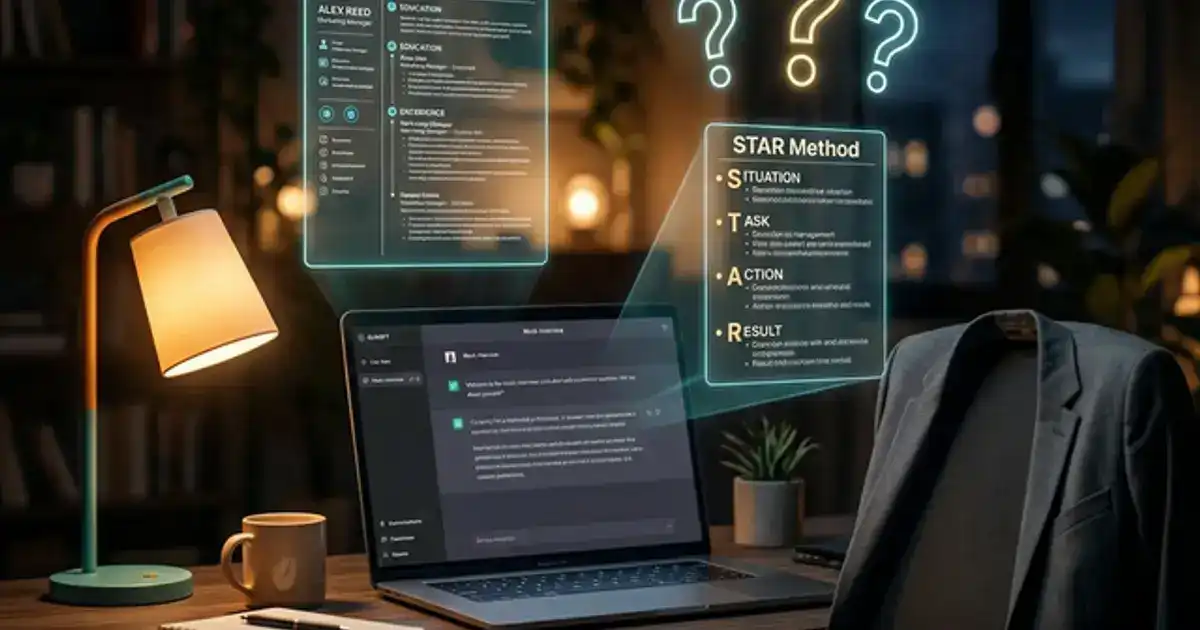
The STAR method (Situation, Task, Action, Result) is the standard framework for behavioral interview answers. The problem: most students know about STAR but struggle to turn their actual experiences into structured stories. AI helps you mine your experience for the best material.
S
Situation
Set the scene. Where were you? What was the context?
T
Task
What was your specific responsibility?
A
Action
What did YOU do? Be specific.
R
Result
What happened? Use numbers if possible.
STAR method prompt:
"I need to prepare answers for behavioral interview questions. Here are my experiences: [list 5-8 experiences from internships, jobs, school projects, clubs, volunteer work - brief descriptions are fine]. For each of the following questions, recommend which experience to use and help me structure the answer using the STAR method. Keep each answer under 2 minutes when spoken aloud (roughly 250-300 words). Questions: [paste your predicted questions from Step 2]."
The genius of this approach: you are not asking AI to fabricate answers. You are giving AI your real experiences and asking it to organize them into compelling stories. The content is 100% yours. The structure is AI-assisted.
After AI generates the STAR answers, refine them: add specific details only you would know (the professor's reaction, the exact number of users, the name of the project). These details make answers authentic and memorable. Generic answers sound rehearsed. Specific answers sound genuine.
The "versatile experience" trick: Some experiences can answer multiple questions depending on which aspect you emphasize. A group project experience can answer "Tell me about teamwork," "Tell me about conflict resolution," or "Tell me about leadership." Ask AI: "How can I reframe this experience to answer [different question] by emphasizing a different aspect?" This gives you flexibility if you get an unexpected question.
Step 4: Mock Interview with AI (The Game-Changer)
Reading your answers is not the same as saying them. Most candidates prepare written answers but never practice saying them out loud. Then in the interview, they stumble, ramble, or forget their structure. Mock interviews fix this, and AI makes them free, private, and available at midnight when your anxiety peaks.
Mock interview prompt:
"You are an interviewer for [company] hiring for [role]. Conduct a realistic 30-minute interview. Ask me one question at a time, wait for my response, then give me brief feedback before asking the next question. Start with 'Tell me about yourself,' then ask 5 behavioral questions, 2 situational questions, and end with 'Do you have any questions for us?' After the interview, give me a summary: my 3 strongest answers, my 3 weakest answers, and specific suggestions for improvement."
ChatGPT Voice Mode is the best tool for this. Instead of typing answers, speak them. This simulates the actual interview experience: you practice pacing, reducing filler words ("um," "like"), and structuring your thoughts verbally. It is awkward the first time. By the third mock interview, your delivery is noticeably smoother.
Record yourself. Use your phone to record a mock interview session. Play it back and listen for: answers that ramble past 2 minutes (too long), answers that end abruptly (too short), filler words you did not notice, and moments where you lost your train of thought. Self-review is brutal but incredibly effective.
Practice the "Do you have questions for us?" section. This is the most wasted opportunity in interviews. Most candidates ask generic questions like "What does a typical day look like?" Instead, use your company research to ask informed questions: "I read about your recent [product launch / reorganization / expansion]. How does this role contribute to that initiative?" Interviewers remember candidates who ask smart questions because it shows genuine interest and preparation.
Step 5: Post-Interview Follow-Up
The thank-you email after an interview is not optional. Candidates who send a thoughtful follow-up within 24 hours stand out from those who do not. AI helps you write one that references specific conversation points.
Follow-up email prompt:
"Write a brief thank-you email after an interview for [role] at [company]. The interviewer's name is [name]. During the interview, we discussed: [2-3 specific topics or moments from the conversation]. Include: (1) a genuine thank you for their time, (2) a reference to one specific discussion point that excited me about the role, (3) a brief restatement of why I am a strong fit, (4) a professional close. Keep it under 150 words."
The "specific discussion point" is what makes this email effective. A generic "thank you for the opportunity" is forgettable. "I was especially excited when you described the team's approach to [specific thing they mentioned]" shows you were engaged and listening. AI structures the email; you fill in the genuine details from your interview.
Send the follow-up within 24 hours, ideally the same evening. If you interviewed with multiple people, send personalized emails to each, referencing different parts of each conversation.
Adapting AI Prep for Different Interview Types
Phone screens. These are shorter (15-20 minutes) and focus on basic fit. Practice concise answers: every response should be under 90 seconds. Use the prompt: "Give me 30-second versions of my STAR answers for a phone screen. Focus on the headline, not the full story."
Panel interviews. Multiple interviewers with different priorities. Ask AI: "I have a panel interview with [roles of interviewers]. What different priorities would each interviewer have? How should I tailor my answers to address all perspectives?" Maintain eye contact with whoever asked the question, but include the whole panel by shifting your gaze naturally.
Technical interviews. For coding or case-based interviews, AI generates practice problems: "Generate 5 [language/framework] coding interview questions at [difficulty level] for a [role] position. For each, give the expected approach and edge cases to consider." Practice solving them before looking at the solution.
Video interviews. Test your setup with a mock AI interview via ChatGPT Voice Mode. Check your camera angle, lighting, background, and audio quality. Look at the camera, not the screen, to simulate eye contact. Use a sticky note next to your camera as a reminder.
Group interviews. AI can simulate multi-candidate scenarios: "Simulate a group interview exercise where 4 candidates discuss [topic]. I am one of the candidates. Guide me on how to contribute actively without dominating." Group interviews test collaboration, not dominance. The goal is to make meaningful contributions while enabling others.
Mistakes That Kill Interview Performance
Memorizing AI-generated answers word for word. Memorized answers sound robotic. Use your STAR outlines as frameworks, not scripts. Know the key points you want to hit, but let the specific words be natural. If you forget the exact wording, the structure carries you.
Not customizing for each interview. Using the same answers for every interview is a red flag. Tailored answers that reference the specific company, role, and job description show genuine interest. Spend 20 minutes per interview customizing your prep.
Over-preparing and under-practicing. Spending 6 hours researching and writing answers but zero time saying them out loud is backwards. Aim for 50/50: half your prep time on content, half on verbal practice. Three mock interviews are worth more than ten pages of notes.
Using AI during the actual interview. This should be obvious, but some candidates try to use AI during virtual interviews (second screen, phone under the desk). Interviewers can tell: there are unnatural delays, eyes moving to a second location, and answers that sound too polished. It is dishonest and will get you immediately rejected or later terminated. AI is for preparation, never for the live interview.
Skipping the 'Do you have questions?' section. Having no questions signals disinterest. Having only generic questions signals laziness. Use your company research to ask 2-3 specifics. The best questions show you have already thought about how you would contribute to the team.
This week's challenge
Pick a job posting you are interested in (even if you are not applying yet). Run the complete workflow: research, question prediction, STAR answers, and one mock interview. Time yourself. Most students finish in under 2 hours and feel dramatically more confident about interviewing.