Learning a language in college is one of the most frustrating academic experiences. You sit in a 50-minute class three times a week, which gives you about 2.5 hours of exposure per week. Research says you need roughly 600-750 hours to reach conversational fluency in a "Category 1" language like Spanish or French. At 2.5 hours per week, that is over 5 years. You are expected to learn in 4 semesters. The math does not add up, and that is why most students finish their language requirement able to conjugate verbs on paper but unable to order coffee in the actual country.
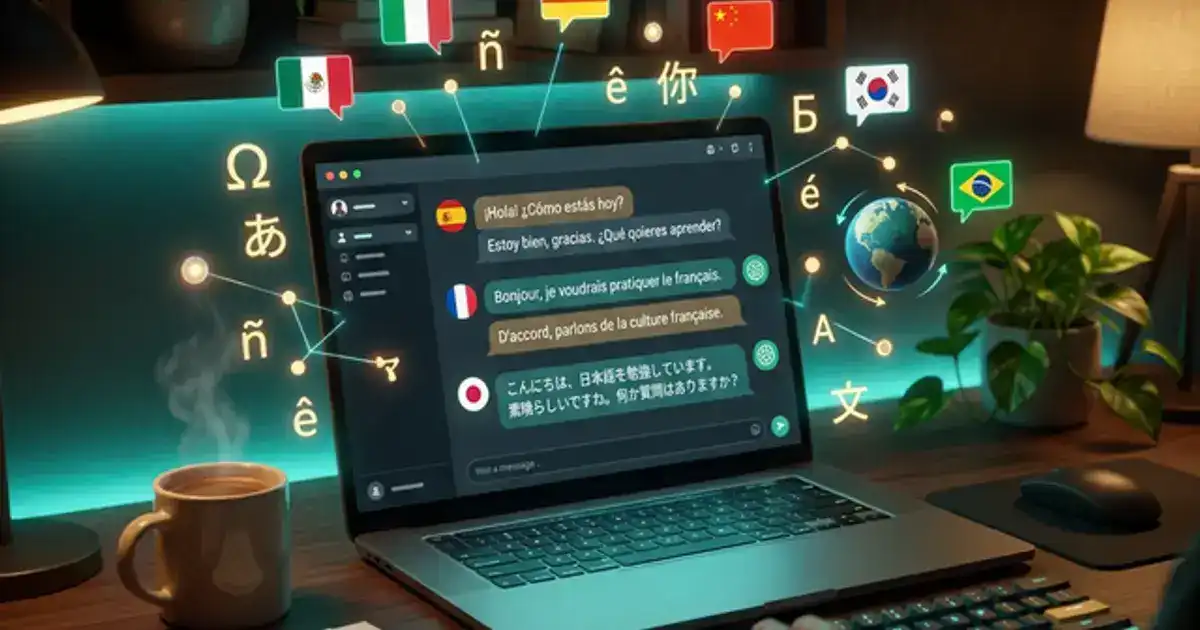
AI changes this equation dramatically. ChatGPT speaks dozens of languages and is available 24/7 for conversation practice with zero judgment. Duolingo uses AI to personalize your daily drills. Apps like Speak and Praktika give you pronunciation coaching that used to require a private tutor. The combination of these tools gives you something that was previously accessible only to wealthy students or people living abroad: immersive language practice on demand.
This guide covers how to use AI tools to accelerate language learning alongside your classes. Every technique uses free tools and is designed for students who already have a language class but need more practice than class provides.
Conversation Practice with ChatGPT (The Game-Changer)
The single most important thing for language learning is conversation practice. And the single biggest barrier is anxiety. Most students know more vocabulary and grammar than they think, but they freeze when trying to speak because they are afraid of sounding stupid. AI eliminates this barrier entirely. You cannot embarrass yourself in front of a chatbot.
Text Conversations (Building Confidence)
Conversation starter prompt:
"You are a friendly native [language] speaker. Have a casual conversation with me in [language]. I am a [beginner/intermediate/advanced] student. Rules: (1) Only use vocabulary and grammar appropriate for my level, (2) if I make a grammar mistake, gently correct it and explain why, (3) keep your responses to 2-3 sentences so I am not overwhelmed, (4) occasionally ask me questions to keep the conversation going."
This prompt creates the perfect conversation partner. It matches your level, corrects mistakes without making you feel bad, and keeps the conversation manageable. Most conversational prompts produce responses that are too long and complex. The "2-3 sentences" rule keeps it human and approachable.
Start with topics you actually care about. Talking about your weekend, your major, your hobbies, or your favorite shows is more engaging than textbook dialogues about buying train tickets. The vocabulary you learn from personally relevant conversations sticks better because it connects to your actual life.
Voice Conversations (The Real Breakthrough)
ChatGPT's Advanced Voice Mode is the closest thing to a free language tutor that exists in 2026. Open the mobile app, switch to voice mode, and start speaking in your target language. ChatGPT responds verbally, corrects your pronunciation, and maintains the conversation naturally.
Voice practice prompt (say this before switching to voice):
"I am going to practice speaking [language] with you using voice mode. I am at a [level]. Please: (1) speak slowly and clearly, (2) if I say something incorrectly, repeat the correct version, (3) ask me follow-up questions to keep me talking, (4) every 5 minutes, tell me one area I should work on."
Practice while walking to class, doing laundry, or cooking dinner. Even 10 minutes of voice practice per day gives you more speaking time than most language classes provide in a week. The lack of judgment is key: you will try sentences you would never risk in class, which is exactly how you push past your comfort zone and actually improve.
Building Vocabulary That Actually Sticks
The traditional approach to vocabulary (memorize word lists, flashcards with decontextualized translations) is one of the least effective methods for retention. AI enables a much better approach: learning words in context.
Contextual vocabulary prompt:
"I need to learn these 15 vocabulary words for my [language] class: [list words]. For each word: (1) use it in 2 example sentences showing different meanings or contexts, (2) give me a memorable mnemonic or association to help me remember it, (3) tell me one common mistake learners make with this word."
This transforms a flat word list into rich, memorable associations. Mnemonics are especially powerful. If you are learning the Spanish word "biblioteca" (library), the mnemonic "the Bible is in a teca (case) at the library" sticks far better than a flashcard that just says "biblioteca = library."
Duolingo
BEST FOR DAILY HABIT
Gamified vocabulary and grammar drills with AI-personalized difficulty. The streak system is addictive (in a good way). New AI features in Duolingo Max include roleplay conversations and detailed explanations.
Free tier: Full course access with ads
BEST FOR RETENTION
Generate flashcards with ChatGPT (include example sentences), import into Anki for scientifically-optimized spaced repetition. The algorithm ensures you review words right before you would forget them.
Free tier: Both free (Anki $25 on iOS)
Generate vocabulary flashcards instantly
Our Chemistry Tutor prompt can generate context-rich vocabulary cards for any language, ready to import into Anki or Quizlet.
Try the Chemistry Tutor Prompt - Free →Grammar That Makes Sense (Not Just Rules)
Language textbooks explain grammar through rules. Rules are great for tests but terrible for actual communication. Nobody thinks "this is a dative preposition requiring the accusative case" while speaking. AI can explain grammar through patterns and intuition instead.
Grammar explanation prompt:
"Explain [grammar concept] in [language] as if I am learning through conversation, not a textbook. Skip the formal rule and instead: (1) show me 5 example sentences that demonstrate the pattern, (2) highlight the pattern I should notice, (3) give me 3 sentences where native speakers would use this naturally, (4) show me a common mistake learners make and how a native speaker would actually say it."
This approach builds linguistic intuition. After seeing enough examples of the Spanish subjunctive in context, you start to "feel" when it sounds right, the same way native speakers do. This is fundamentally different from memorizing "the subjunctive is used after verbs of doubt, emotion, and desire."
For grammar drills, ask ChatGPT to quiz you: "Give me 10 fill-in-the-blank sentences testing [grammar concept] in [language]. After each answer, tell me if I am right, explain why, and give me the correct answer if I am wrong." Active recall through testing is far more effective than passive reading of grammar explanations.
Pronunciation Practice (Without a Native Speaker)
Pronunciation has traditionally required either a native speaker tutor or expensive software. AI tools now provide pronunciation feedback that is surprisingly accurate for major languages.
Speak
BEST PRONUNCIATION
AI speaking tutor with real-time pronunciation scoring. Focused entirely on speaking practice with guided conversations, roleplay scenarios, and pronunciation drills. Covers Spanish, French, Korean, Japanese, and more.
Free tier: Limited daily lessons
Praktika
BEST ROLEPLAY
AI avatars that simulate real-world conversations: ordering at a restaurant, negotiating a rental, or attending a job interview. Each avatar has a distinct personality and speaking style for realistic practice.
Free tier: Limited daily sessions
ChatGPT Voice Mode also provides pronunciation feedback, though less structured than dedicated apps. The advantage of ChatGPT is flexibility: you can practice any scenario you want rather than following preset lessons. The advantage of Speak and Praktika is structured progression with scoring.
Building an Immersion Environment (On a Student Budget)
Immersion accelerates language learning faster than anything else. But most students cannot afford to spend a semester abroad. AI lets you build a partial immersion environment without leaving campus.
Change your phone language. Set your phone's system language to your target language. You interact with your phone hundreds of times per day. Each interaction becomes a micro-exposure to vocabulary, numbers, and common phrases. It feels disorienting for a day, then quickly becomes normal.
AI-powered content consumption. Ask ChatGPT: "Recommend 5 YouTube channels in [language] that are entertaining and use simple, clear speech for intermediate learners. Suggest channels about topics I enjoy: [your interests]." Watching content you actually enjoy in your target language is dramatically more effective than watching "educational" content you find boring.
Daily journaling in your target language. Write 3-5 sentences about your day in your target language. Paste them into ChatGPT and ask for corrections with explanations. This builds writing skills AND identifies your specific weaknesses. Over a semester, you will see your common mistakes disappear as Claude or ChatGPT corrects the same patterns repeatedly.
AI as a reading companion. Find news articles in your target language (ask ChatGPT to suggest sites). When you encounter a word or sentence you do not understand, paste it into ChatGPT: "Translate this and explain the grammar structure. Why is [word] in [form] here?" This is more effective than dictionary lookups because you learn the contextual meaning and the grammatical reason simultaneously.
Mistakes That Slow Down Language Learning
Only studying, never practicing. Memorizing conjugation tables is studying. Having a conversation in your target language is practicing. Studying teaches you the rules. Practice teaches you to use them automatically. AI makes practice accessible anytime, so there is no excuse for a study-only approach. Aim for a 40/60 split: 40% studying grammar and vocab, 60% practicing through conversation, reading, and listening.
Practicing only with AI, never with humans. AI is an excellent practice partner, but human conversation has unpredictability, accents, slang, and social pressure that AI cannot replicate. Use AI to build confidence and fluency. Then test it with language exchange partners, conversation groups, or native speakers on campus. AI practice makes human conversation less intimidating, not unnecessary.
Obsessing over perfection. Students avoid speaking because they are afraid of making mistakes. But mistakes are how you learn. When ChatGPT corrects your grammar, that correction sticks because it is connected to something you were trying to express. Perfect grammar is the output of years of practice, not a prerequisite. Speak badly. Speak often. AI will help you improve gradually.
Ignoring listening comprehension. Most language AI tools focus on reading and writing. Listening is harder to practice but equally important. Use these: YouTube content in your target language (start with subtitles, remove them over time), podcasts designed for learners (Coffee Break Spanish, InnerFrench, etc.), and ChatGPT Voice Mode where you set it to respond only in your target language.
Skipping the daily habit. Language learning is a consistency game. Fifteen minutes every day beats two hours once a week. Duolingo's streak system exploits this by making you feel guilty for breaking the chain. Use it. Stack AI language practice onto an existing daily habit: voice practice during your morning walk, vocabulary review during lunch, a journaling session before bed. Small daily contacts with the language compound over a semester.
The Complete AI Language Learning System
Morning: 5-min Duolingo streak (Vocabulary)
Quick, gamified drills to start the day. Keep your streak alive. Focus on the daily lesson and one review session. This covers about 15 new vocabulary words per week on its own.
Commute: 10-min voice practice (Speaking)
Open ChatGPT Voice Mode and have a conversation in your target language. Talk about yesterday, today's plans, or something you learned in class. AI corrects you in real time.
After class: 10-min text conversation (Grammar)
Practice the grammar concept from today's lecture through a chat conversation with ChatGPT. Seeing the grammar in natural conversation locks it in better than textbook exercises.
Evening: 5-min journal + correction (Writing)
Write 3-5 sentences about your day in the target language. Paste into ChatGPT for corrections. Review what you got wrong. This daily writing habit builds fluency faster than weekly assignments.
Total: about 30 minutes per day, spread across natural breaks. This gives you more active practice time than most university language courses provide in a week. Combined with your actual class for structure and human interaction, this system dramatically accelerates progress toward conversational fluency.