Introduction
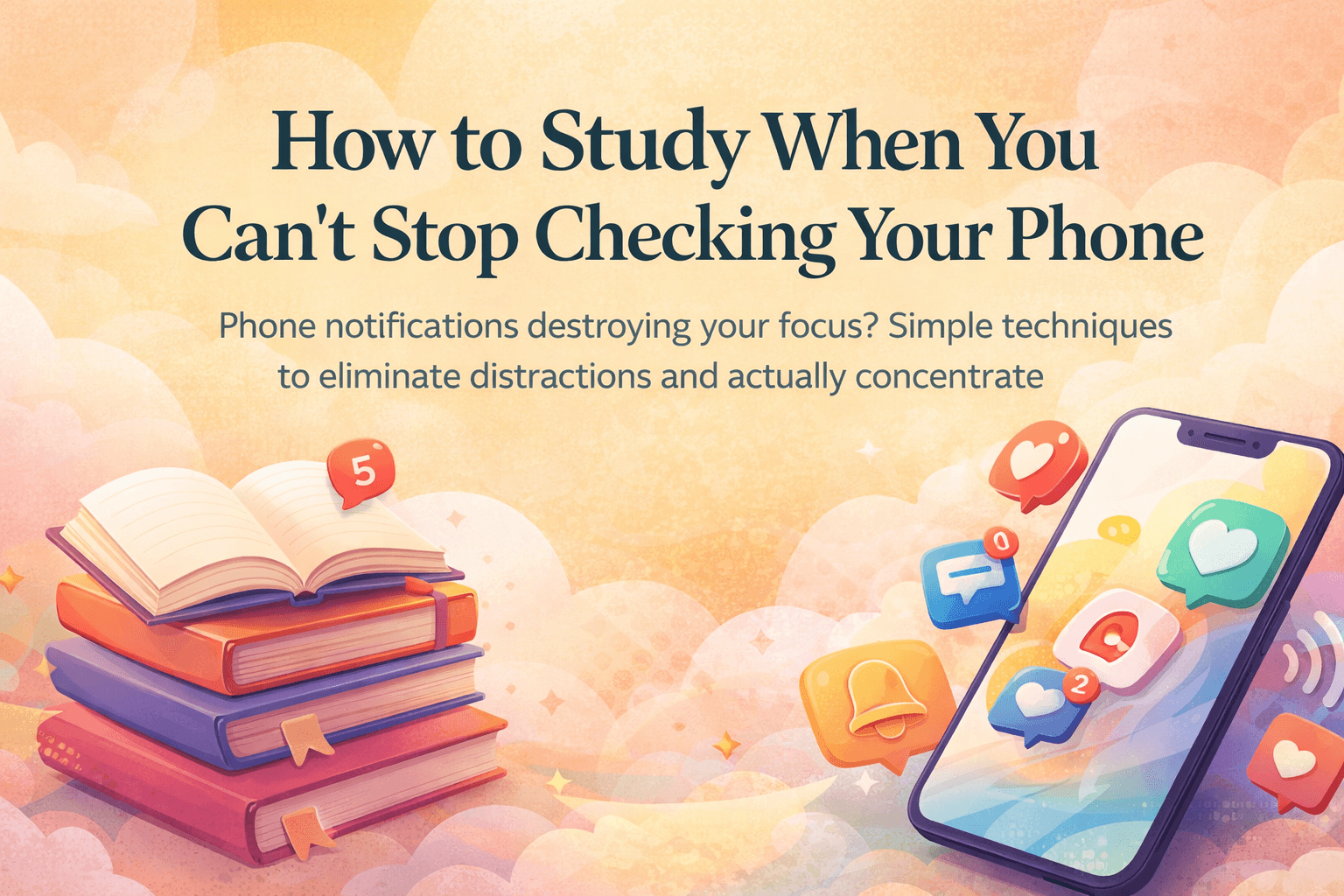
It starts with a buzz. Or maybe just a silent screen lighting up in the corner of your eye. You tell yourself, "I'll just check it for a second."
Twenty minutes later, you’re deep in a scrolling loop, your textbook is forgotten, and you have no idea what you just read. If this sounds familiar, you aren’t alone. In fact, research shows that students check their phones an average of 11 times per hour while studying. That is a guaranteed recipe for losing focus.
The problem isn’t just that you’re "distracted." It’s that your brain is fighting a battle against technology designed to keep you hooked. The good news? You can win this battle without throwing your phone in a lake.
In this guide, you will learn:
Why your brain craves that next notification.
The "Brain Drain" effect of just having your phone nearby.
4 simple strategies to break the addiction loop.
How to build a study plan that includes phone time (so you don't feel deprived).
Let’s get your focus back.
Why Your Phone Is So Hard to Resist (The Science)
You might feel guilty about your lack of willpower, but there is a biological reason why putting the phone down is so hard.
Your smartphone is a dopamine machine. Every time you get a like, a text, or see a funny video, your brain releases a hit of dopamine—the "feel-good" chemical. Over time, your brain starts to crave this feeling. Studying, on the other hand, usually doesn't give you instant rewards. It takes mental effort and the "payoff" (a good grade) is weeks away.
The "Brain Drain" Effect Did you know that just seeing your phone makes you less smart?
A study by the University of Texas at Austin found that having your phone within reach—even if it’s silent and face down, reduces your "cognitive capacity." Your brain has to actively work not to pick it up, which uses up the mental energy you need for algebra or history.
So, if you are studying with your phone on your desk, you are effectively studying with a fraction of your brain power.
Create a "Phone-Free" Zone That Actually Works
The most effective way to stop checking your phone is to make it physically impossible to do so easily. We call this "increasing friction."
If your phone is right next to you, the "friction" is low—it takes zero effort to grab it. If your phone is in another room, the friction is high. You have to stand up, walk over, and get it. That small barrier is often enough to stop the impulse.
Step-by-Step Setup:
Silence is Not Enough: Turn your phone on "Do Not Disturb" or Airplane Mode.
Out of Sight, Out of Mind: Put your phone in a different room, a kitchen drawer, or give it to a roommate/parent.
The 20-Second Rule: Psychology research suggests that if a distraction takes more than 20 seconds to access, you are far less likely to pursue it.
Pro Tip: If you absolutely need your phone for a timer, buy a cheap kitchen timer or a dedicated digital stopwatch. Keep your study space sacred and analog whenever possible.
The "Tech Break" Strategy: Using Distraction as a Reward
Going "cold turkey" for 4 hours usually fails. Your brain panics because it feels cut off. A better approach is to schedule your distractions using the "Tech Break" method.
This is based on the Pomodoro Technique. You promise yourself you can check your phone, but only at specific times.
How to do it:
Set a timer for 25 minutes. This is your "Deep Work" time. No phone allowed.
Focus on one task. Read one chapter, solve 5 problems, etc.
Take a 5-minute break. When the timer goes off, you must take a break. Grab your phone. Scroll Instagram. Text your friend.
Repeat. After 5 minutes, the phone goes back away.
This works because it satisfies your brain's craving. When you feel the urge to check your phone at minute 12, you can tell yourself, "Not yet. I can check it in 13 minutes." That is much easier than saying, "I can't check it until tonight."
Structured Planning: The Secret Weapon for Focus
One of the biggest reasons we reach for our phones is confusion. When you sit down and don't know exactly what to do, or the task feels too big (e.g., "Study for Biology"), you feel overwhelmed.
Overwhelming feelings trigger anxiety. To escape that anxiety, your brain looks for an easy comfort: your phone.
To stop this, you need a hyper-specific plan. You shouldn't just sit down to "study." You should sit down to "complete the practice quiz for Chapter 4."
Use AI to Build Your Schedule If you struggle to break big tasks into small steps, this is where AI tools can save you. A structured plan removes the decision fatigue that leads to scrolling.
We built the Learning Planner specifically for this.
Instead of staring at a blank page, you tell the AI: "I have a history exam in 3 days and 5 hours to study." The prompt will generate a step-by-step schedule for you, including:
Specific resources to read or watch.
Exact time blocks for each task.
Built-in break times (so you know when you can check your phone).
When you have a clear roadmap, you don't need to distract yourself because you know exactly what to do next.
Building Long-Term Focus Habits
Beating phone distraction isn't just about one study session; it's about training your brain to be comfortable with boredom.
Modern life has trained us to fill every quiet moment with a screen. Waiting for the bus? Phone. Commercial break? Phone. This constant stimulation weakens our "focus muscle."
3 Daily Habits to Retrain Your Brain:
The "Phone-Free" Morning: Don't check your phone for the first 15 minutes of the day. Let your brain wake up naturally.
Single-Tasking: When you eat lunch or walk to class, try doing it without your phone. Observe the world. It sounds boring, but it helps your brain practice being present.
App Limits: Use the "Screen Time" (iOS) or "Digital Wellbeing" (Android) features settings to put hard limits on your most addictive apps.
Recommended Tool: If you need help staying accountable, apps like Forest gamify the experience by letting you grow a virtual tree that dies if you leave the app to check social media.
Conclusion
Stopping the scroll isn't about having superhuman willpower. It is about outsmarting your habits.
Your phone is a tool, not a master. By moving it out of sight, scheduling your "tech breaks," and using structured plans to reduce anxiety, you can reclaim your brain power.
Key Takeaways:
Distance is key: The simple act of putting your phone in another room boosts cognitive capacity.
Don't ban it, schedule it: Use 5-minute "Tech Breaks" as a reward for 25 minutes of focus.
Plan to avoid panic: Use a detailed schedule (try our Learning Planner) to keep you on track and prevent the anxiety that triggers phone checking.
Practice boredom: Small moments of phone-free time during the day build your focus muscle for studying.
You have the techniques. Now, turn your phone on silent, put it in a drawer, and go crush that study session. You've got this.