Introduction
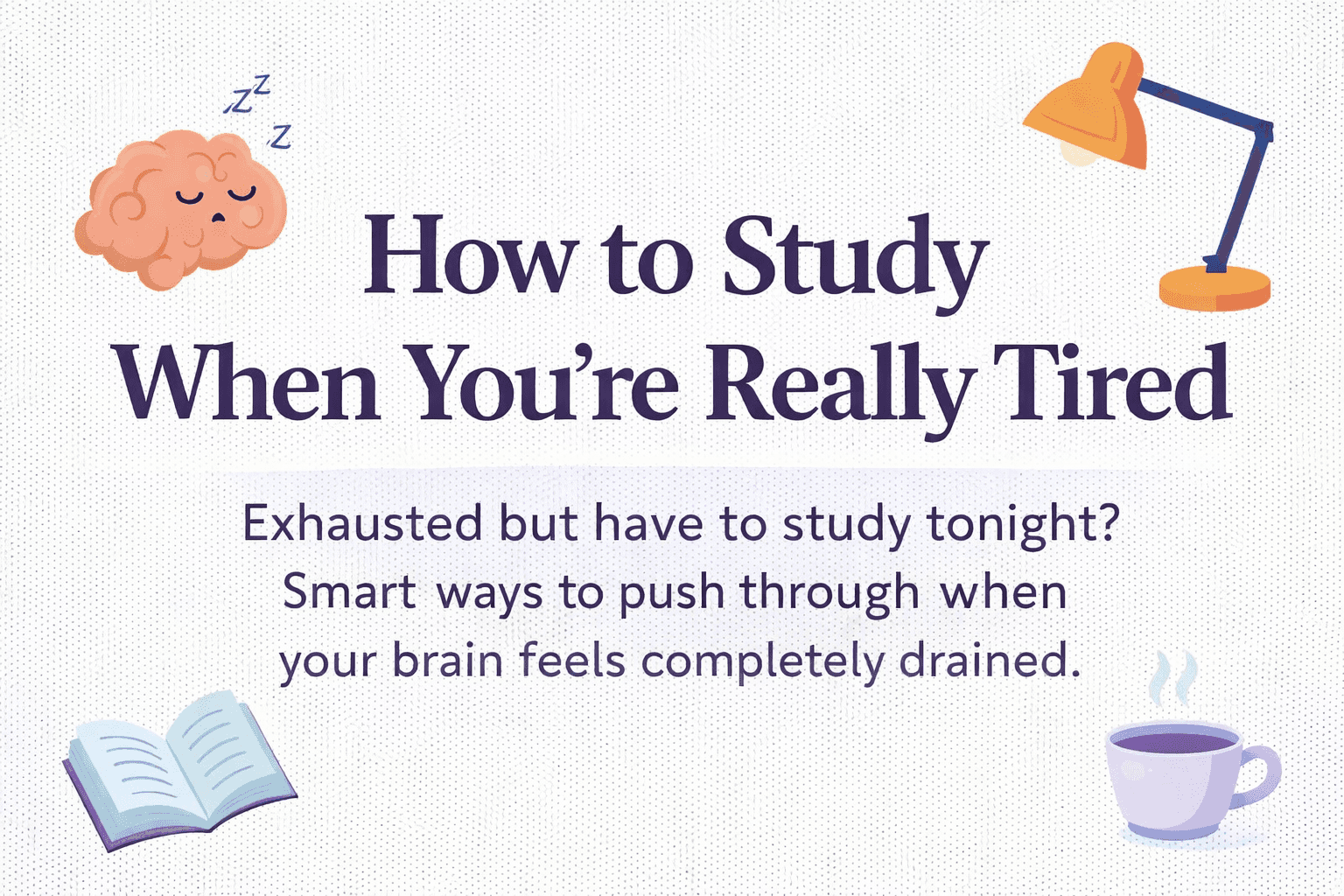
Imagine your battery icon is blinking red. You have 5% energy left, but you still have three chapters of history or a stack of biology notes to get through. It is the worst feeling for any student. You stare at the page, but the words just float around. You read the same sentence four times and still do not know what it said.
This happens to everyone, but it does not mean you have to fail. You just need to change how you work. When you are fully rested, you can power through anything. When you are tired, you have to be smarter. You have to trick your brain into staying awake.
This guide is not about drinking five energy drinks. That will just make you crash later. This guide is about science-based tricks to wake up your brain just enough to get the job done. We will look at how to fix your room, what to eat, how to move, and even how to use AI tools to do the heavy lifting for you.
You will learn: How to wake up your body instantly.
You will learn: The best foods to eat for quick energy.
You will learn: How to study without reading endless pages.
You will learn: When to use AI to help you memorize faster.
Wake Up Your Environment
Your room might be putting you to sleep. If your room is warm, cozy, and dim, your brain thinks it is time to bed. You need to send a different signal. You need to tell your body, "It is not sleep time yet."
Light is Key Your brain produces a chemical called melatonin when it gets dark. This chemical makes you sleepy. To fight this, you need bright light.
Turn on the main overhead light.
Add a desk lamp if you have one.
Turn up the brightness on your computer screen (just for now).
Fact: Studies show that "cool blue" light wakes you up faster than warm yellow light. If you have smart bulbs, turn them to white or blue.
Cool Down the Room Warmth makes you cozy. Cold wakes you up. If you are freezing, it is hard to fall asleep.
Open a window to let in fresh, cool air.
Turn on a fan and point it at your face.
Take off your hoodie or blanket.
Don't Get Too Comfortable Never study in bed. Your brain connects your bed with sleep. If you sit there with your laptop, you will likely nod off within ten minutes. Sit at a hard chair. Sit at the kitchen table. Stand up if you have to. The goal is to be slightly uncomfortable so your body stays alert.
Fuel Your Brain Correctly
When you are tired, your body screams for sugar. You might want candy, soda, or a donut. This is a trap. Sugar gives you a high for twenty minutes, but then you crash and feel even more tired than before.
Drink Water First Most "tiredness" is actually dehydration. Your brain is mostly water. When you do not drink enough, your brain shrinks slightly and works slower.
Drink a tall glass of ice-cold water immediately.
Keep a water bottle on your desk.
Tip: Add a slice of lemon. The strong smell of citrus can help wake up your senses.
Snack Smart You need fuel that burns slowly, like a log on a fire, not like paper that burns up in seconds.
Nuts: Almonds and walnuts have healthy fats that feed your brain.
Fruit: Apples or bananas give you natural energy without the heavy crash of candy.
Dark Chocolate: A small piece of dark chocolate has a tiny bit of caffeine and antioxidants that help blood flow to the brain.
You can read more about brain-healthy foods from the Mayo Clinic. They list excellent options that will not make you jittery.
Active Study Techniques
The biggest mistake tired students make is "passive studying." Passive studying includes:
Re-reading your textbook.
Highlighting notes.
Listening to a recorded lecture.
These are bad because they are boring. When you do something boring and passive, your brain switches to "sleep mode." You need Active Study Techniques. This means doing something. You have to write, speak, or move.
The "Blurting" Method
Read a section of your notes for 5 minutes.
Close the book.
Grab a blank piece of paper.
Write down everything you remember.
Open the book and check what you missed. This forces your brain to work hard to find the information. It keeps you awake because it is a challenge.
Stand and Speak If you are reading silently, you will fall asleep. Stand up and walk around your room. Read your notes out loud like you are giving a speech to an audience.
Use a loud voice.
Use hand gestures.
Pretend you are a teacher explaining it to a class. When you move and speak, your blood pumps faster. This sends more oxygen to your brain.
Switch Tasks Often Do not study one subject for three hours. Your tired brain will get bored.
Study Math for 20 minutes.
Switch to English for 20 minutes.
Switch to Science for 20 minutes. Changing the topic wakes up different parts of your brain. It keeps things fresh.
Use AI to Lighten the Load
Sometimes, you are just too drained to organize your notes or create flashcards yourself. This is where technology can save you. You can use AI to do the "busy work" so you can focus on just the learning.
At Vertech Academy, we built tools specifically for this. You don't need to struggle alone.
The Memory Coach Prompt If you need to memorize definitions or a list of facts, use the Memory Coach prompt from our library.
How it works: You paste your notes into the AI. It will then quiz you. It asks you a question, you answer, and it tells you if you are right or wrong.
Why it helps: It turns studying into a game. You are interacting, not just reading. It keeps your brain engaged even if you are sleepy.
You can find this tool in our Prompt Library.
The Generalist Teacher Prompt If you are reading a textbook chapter and you just don't get it because you are too tired, don't re-read it five times.
Use the Generalist Teacher prompt.
Ask it to "Explain this concept to me like I am 12 years old."
It will break down complex ideas into simple, easy words. This saves you so much brain energy.
Using these tools is not cheating. It is being efficient. You are still doing the learning, but the AI is acting like a study buddy who keeps you on track.
The Power Nap Strategy
There is a huge difference between a "power nap" and "falling asleep."
Bad Nap: You sleep for 2 hours. You wake up feeling groggy, confused, and even more tired. This is called "sleep inertia."
Good Nap: You sleep for 15 to 20 minutes. You wake up feeling refreshed and sharp.
How to Nap Correctly:
Set an Alarm: Set it for 20 minutes exactly. Do not hit snooze.
The "Coffee Nap" Trick: If you drink coffee, drink a cup right before you lay down. Caffeine takes about 20 minutes to kick in. You will sleep for 20 minutes, and just as you wake up, the caffeine will hit your system. You will wake up with double the energy.
Sleep on the Floor: This sounds crazy, but it works. If you sleep in your soft bed, you won't want to get up. If you nap on the floor or a couch, it is easier to wake up because you aren't too comfortable.
According to the Sleep Foundation, short naps can improve alertness and performance without messing up your night's sleep.
When to Call It Quits
Sometimes, no amount of coffee, cold air, or jumping jacks will work. Your brain is a biological machine. It has limits. If you notice these signs, you need to stop:
You read the same sentence 5 times and don't understand it.
You are making simple mistakes you usually wouldn't make.
You are literally falling asleep in your chair.
At this point, staying awake is useless. You are not learning; you are just suffering. The Strategy:
Go to sleep right now.
Set your alarm for 4:00 AM or 5:00 AM.
Sleep for 4 or 5 hours.
Wake up early and study then.
Your brain works much better in the morning after some rest than it does late at night when it is exhausted. You will get more done in one hour of morning study than in three hours of painful late-night study.
You can also check out our blog post on democratizing education where we talk about how tools can help you manage your time better so you don't end up in this situation as often!
Conclusion
Studying when you are tired is hard, but it is not impossible. You have to stop fighting your body and start working with it.
Let's review your battle plan:
Environment: Bright lights, cool room, hard chair.
Body: Cold water, healthy snacks, movement.
Method: Active recall, speaking out loud, using AI tools like the Memory Coach.
Rest: Take a strict 20-minute power nap if needed.
Next time you are exhausted, don't just stare at the wall. Get up, change your environment, and try one of these tips. You might be surprised at how much you can learn even when your battery is blinking red.
Good luck! You can do this.