Introduction
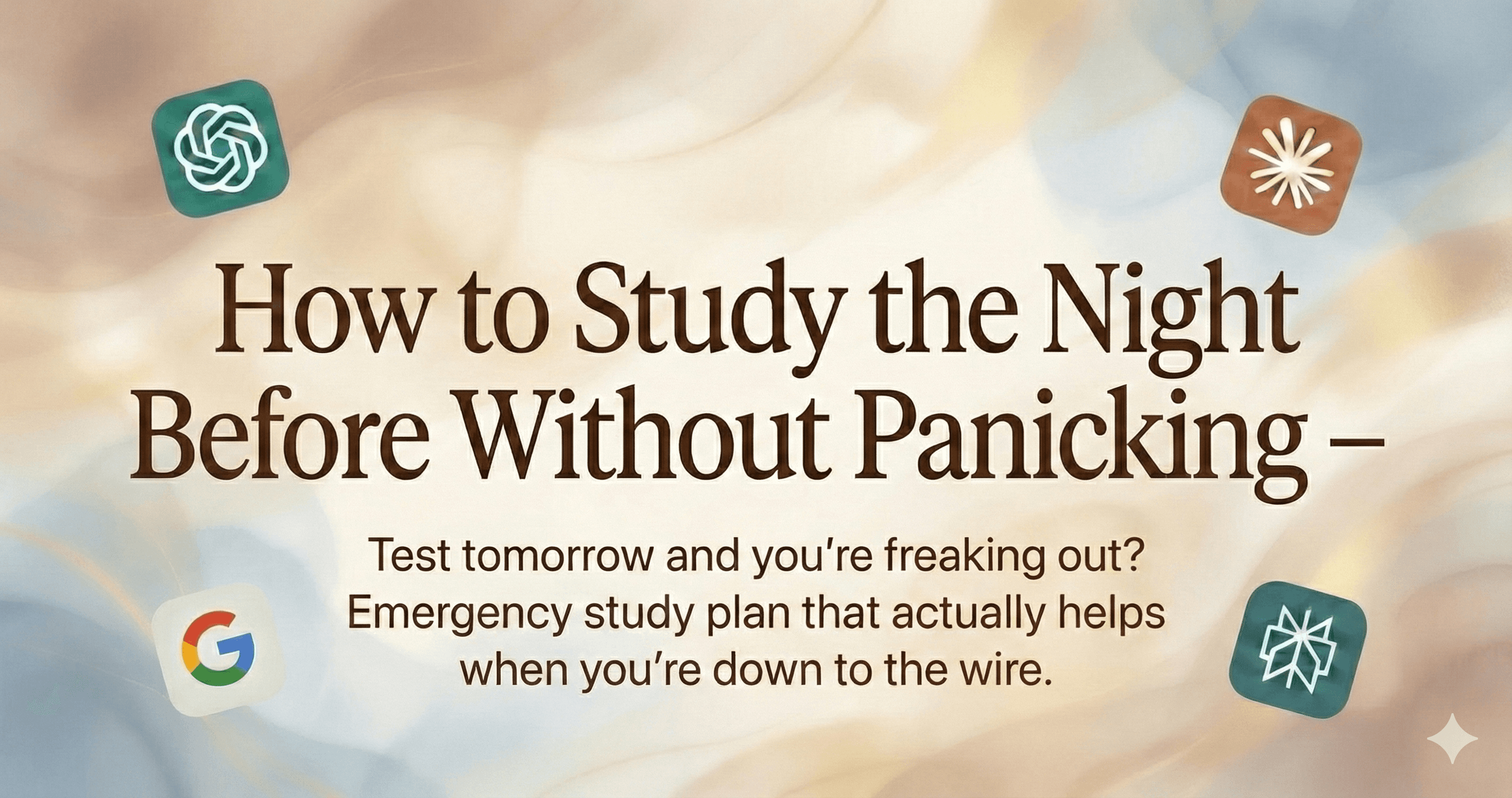
Okay, take a deep breath. Stop looking at the clock. The more you stare at it, the faster it seems to move, and that is not helping you right now. You are here because you have a test tomorrow, you are not ready, and the panic is starting to set in.
First, let’s get one thing clear: you are not going to fail. You might not get a perfect 100%, but you can absolutely pull off a decent grade if you stop worrying and start working. Panic is your enemy right now. It freezes your brain and makes it impossible to learn anything.
This is your emergency protocol. We are not going to talk about "good study habits" or planning ahead. That ship has sailed. We are in damage control mode. We are going to focus on the few specific actions that will actually help you survive tomorrow.
Here is what we are going to do:
Prioritize: We will figure out what you actually need to know.
Focus: We will use a timer to keep you on track.
Engage: We will stop reading and start testing.
Sleep: Yes, you are going to sleep tonight.
Put your phone in another room (seriously, do it now), grab a glass of water, make sure you are well fed, well rested and let’s get to work.
Step 1: The "Triage" Method (You Can't Learn Everything)
The biggest mistake students make the night before is trying to read the entire textbook from page one. That is impossible. If you try to learn everything, you will end up learning nothing.
In a hospital, doctors perform "triage." They treat the most urgent patients first. You need to do the same thing with your study material. You need to accept that you will probably miss some small details, and that is okay. We are aiming for the big points that are worth the most marks.
Grab a piece of paper and make three lists:
The "Must Know": These are the big concepts the teacher talked about over and over again. If you don't know these, you will fail. Study these first.
The "Should Know": These are the supporting details, the vocabulary words, and the formulas. Study these second.
The "Nice to Know": This is the small stuff in the footnotes. Ignore this list. You don't have time for it.
If you are staring at a mountain of homework and don't know how to break it down, you can check out our guide on how to break big projects into steps. But for tonight, just stick to the "Must Know" list. If you get through that, you are already passing.
Step 2: Set the Timer (The Pomodoro Technique)
Your brain cannot focus for six hours straight. If you try to pull an "all-nighter" marathon, you will find yourself staring at the same sentence for 20 minutes without understanding a word of it.
You need to work in short, intense bursts. The best way to do this is the Pomodoro Technique. It is very simple:
Set a timer for 25 minutes.
Work as hard as you can until the timer rings. No checking texts, no snacks, no distractions.
Take a 5-minute break. Walk around, stretch, or pet your dog.
Repeat.
Why does this work? Because 25 minutes is not scary. You can do anything for 25 minutes. This method keeps your brain fresh and stops you from burning out. You can read more about how this works on Wikipedia's guide to the Pomodoro Technique.
Step 3: Less Reading, more Quizzing (Active Recall)
This is the most important tip in this entire post. Do not just re-read your notes.
Re-reading is a trap. When you read your notes, your brain recognizes the words and says, "Oh yeah, I know this." But recognizing something is not the same as being able to explain it on a test.
You need to use Active Recall. This means closing your book and trying to force your brain to remember the answer. It is supposed to feel hard. That struggle is actually your brain building a memory.
Look at a heading in your notes.
Look away.
Try to explain what that section is about in your own words.
Check to see if you were right.
If you can't explain it without looking, you don't know it yet. For a deeper dive into why this works better than just reading, check out this article on Active Recall from the University of Arizona.
You can also use AI to speed this up. Instead of making paper flashcards (which takes too long), you can copy your notes into an AI tool and ask it to quiz you. We wrote a whole guide on how to actually use AI to prepare for tests that explains the exact prompts to use.
Step 4: Use AI to Understand the Hard Stuff Fast
Sometimes you hit a concept that simply doesn't make sense. You read the textbook definition, and it sounds like gibberish. You don't have time to email your teacher and wait for a reply.
This is where AI saves the day. You can use it as a 24/7 tutor. You can paste the confusing definition into a chat and say: "Explain this to me like I am 12 years old."
If you want a tool that is specifically built for this, check out the Generalist Teacher in our Prompts Library. It is designed to explain things simply without giving you the answer, helping you actually learn the concept in minutes instead of hours.
Step 5: Memorize Definitions Quickly
If your test involves memorizing a lot of vocabulary words, dates, or formulas, your brain might feel full. When you are tired, nothing seems to stick.
We have a specific tool for this called the Memory Coach. It uses a method that quizzes you on the items you are struggling with more often than the ones you already know. It’s like having a friend quiz you, but much faster. You can find it in the Vertech Academy Prompts Library.
If you prefer to do it manually, write the hardest definitions on sticky notes and stick them on your bathroom mirror, your fridge, and your door. You will see them every time you walk by, and those extra seconds of looking at them add up.
Step 6: Sleep is Not Optional
You might be tempted to stay up all night drinking energy drinks. Do not do this.
Your brain needs sleep to "save" the information you just learned. Think of your brain like a computer. Studying is typing the document, but sleep is hitting the "Save" button. If you don't sleep, your computer crashes, and you lose all your work.
Even just 4 or 5 hours of sleep is better than none. A study by the National Institutes of Health (NIH) explains that sleep is essential for memory consolidation. If you pull an all-nighter, you will be groggy during the test, and you will make silly mistakes on questions you actually knew the answers to.
Step 7: The Morning-Of Strategy
When you wake up, do not frantically check your notes immediately. That will just bring the panic back.
Eat breakfast: Your brain runs on fuel. Eat something with protein, like eggs or yogurt. Avoid pure sugar, or you will crash halfway through the exam.
Breathe: If you feel your heart racing as you walk into the classroom, try Box Breathing. Breathe in for 4 seconds, hold for 4, exhale for 4, and hold for 4. It sounds simple, but it physically forces your body to calm down. You can learn how to do it properly on WebMD's guide to Box Breathing.
Warm up your brain: On the bus ride to school, don't try to learn new things. Just review your "Must Know" list one last time. You can also have a quick chat with an AI to get your brain moving, kind of like stretching before a race. See our post on how to talk to AI like a friend to get into the right mindset.
Conclusion
You have done what you can. You prioritized the important stuff, you focused your attention, and you got some sleep. That is already way better than panicking and doing nothing.
Walk into that room with your head high. Read every question carefully. If you don't know an answer, skip it and come back later. You are more prepared than you think you are.
Go crush it. You've got this.