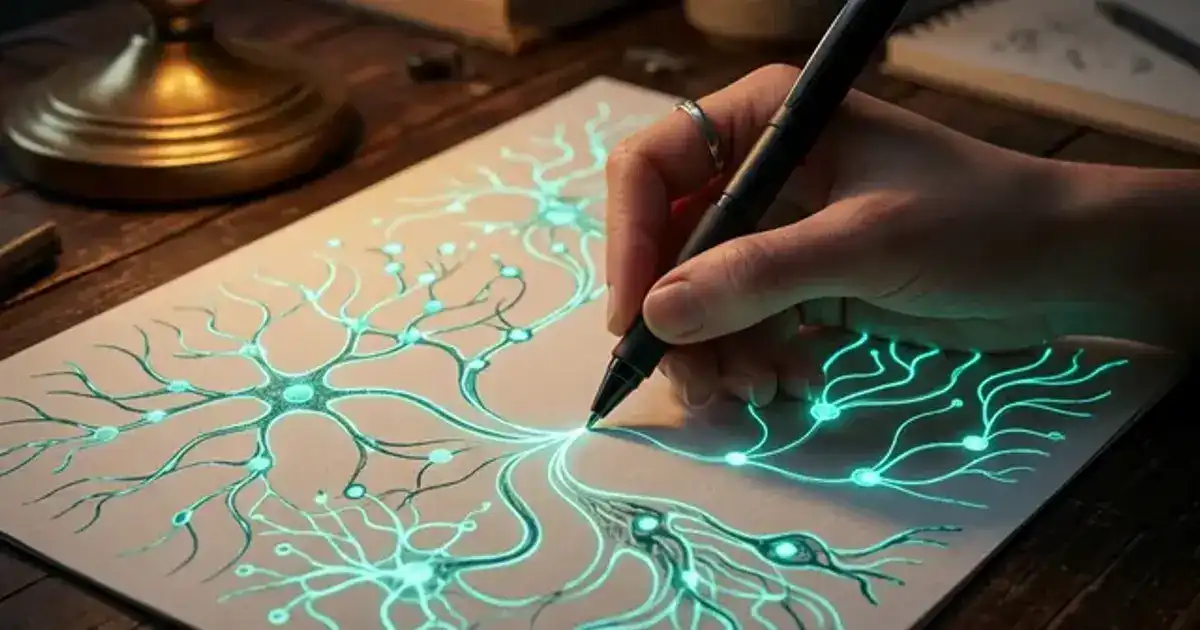
Mind mapping has a reputation problem. People either think it is a productivity gimmick or assume it is only for “visual learners.” Neither is true. Mind mapping is a structured way to externalize the connections between ideas - and understanding connections is how deep learning works.
If you have tried mind mapping before and it felt pointless, you were probably doing one of two things wrong: making it too pretty (art project, not learning tool) or making it too linear (just a list with circles around it). Here is how to actually do it in a way that improves your understanding.
What a Good Mind Map Actually Does
A mind map forces you to do two things your brain resists: organize and connect. When you place a concept on the map, you have to decide where it goes, what it relates to, and how it fits the bigger picture. These decisions are the learning.
A bad mind map is a rewritten outline with circles. A good mind map shows relationships that are not obvious from the text - cross-connections, contradictions, cause-and-effect chains. If your mind map has no crossing lines, it is probably just a formatted list.
How to Build a Mind Map in 15 Minutes
Start with the central topic in the middle - write the main concept in the center of a blank page. This is your anchor. Everything else radiates outward from here.
Add the main branches (3-5 max) - these are the major subtopics. Think of them as the H2s of the topic. Do not add more than 5 - if you have more, some of your branches are too granular.
Add sub-branches with details - under each main branch, add the specific facts, examples, or explanations. Use keywords, not full sentences. Two to three words per node is ideal.
Draw cross-connections - this is where the real learning happens. Look for relationships between different branches. Does a concept in Branch A explain something in Branch C? Draw a line and label the connection.
Add question marks where you are unsure - if you cannot place something or do not know how it connects, mark it with a “?”. These are your study priorities.
The Three Mistakes Beginners Always Make
Too pretty
Spending 20 minutes choosing colors and drawing perfectly symmetrical branches. A mind map is a thinking tool, not an Instagram post. Messy is fine.
Too linear
Making branches that read top-to-bottom like a list. If your mind map could be reformatted as bullet points without losing any information, it is not a mind map - it is an outline.
No connections
Every branch lives in isolation. The whole point is seeing how ideas relate to each other. If there are no cross-connections, you missed the most valuable part.
Mind mapping pairs well with the thinking on paper method - use a brain dump first, then organize the dump into a mind map. And if you want AI to quiz you on the concepts you mapped, paste the key terms into the Pocket Quiz prompt.