
Vertech Academy LogoVERTECH
LibraryFeaturesPricing
Log InGet Free Prompt
Back to Insights
Exams
How to Guess Correctly on a Multiple Choice Test

How to Guess Correctly on a Multiple Choice Test

Vertech Editorial Mar 1, 2026 6 min read

Share

Table of Contents

Vertech Editorial

Mar 1, 2026

Sometimes you have to guess. Here are the strategies that hold up across most tests - based on how multiple choice questions are actually written.

Watch Video
5 Rules (and One Secret Weapon) for Acing Multiple Choice Tests

5 Rules (and One Secret Weapon) for Acing Multiple Choice Tests·Thomas Frank

Sometimes You Just Have to Guess - Here's How to Do It Better

Let's be real: there are going to be questions on any test where you genuinely don't know the answer. Maybe you ran out of time to study it. Maybe it wasn't on your radar. Maybe it just didn't stick.

Leaving it blank won't help. And picking randomly isn't much better. But there are actual patterns in how multiple choice questions are written - and knowing them can meaningfully improve your odds.

The Patterns That Actually Show Up on Most Tests

These aren't tricks. They're observations about how tests are typically constructed. They don't work every time, but they work often enough to be worth knowing:

  • The most complete answer is often correct. If one answer says "A and B" while others say just "A" or just "B," the comprehensive one is frequently right - professors want you to demonstrate full understanding.
  • Absolute language is a red flag. Answers using "always," "never," "all," or "none" are usually wrong. Real-world answers are almost always more nuanced.
  • The longest answer is more often correct. Test writers put more effort into writing the correct answer - it tends to be more specific and complete.
  • "All of the above" is often correct. When it's an option, it's right more often than chance alone would predict - but only if none of the others are clearly wrong.

Elimination: The Only Strategy Worth Trusting

The best guessing strategy isn't picking the right answer - it's eliminating the wrong ones. Here's how to do it systematically.

1
Read the question without looking at the answers. Try to recall what the answer should be before your eyes land on the choices. This stops the wrong answers from contaminating your thinking.
2
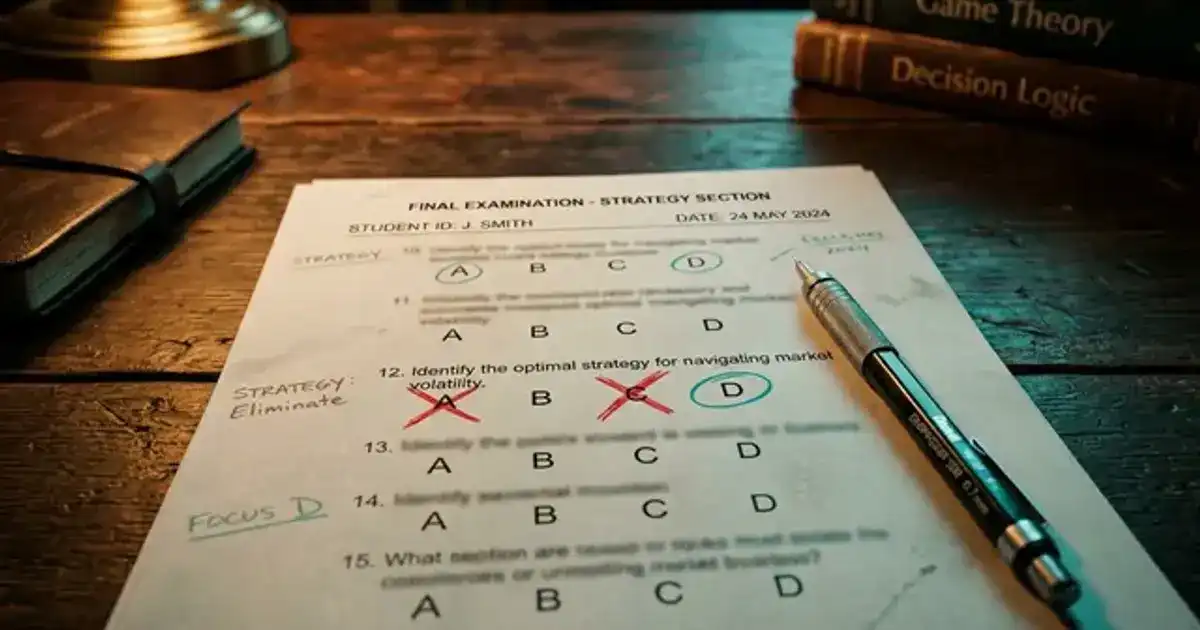
Cross out anything obviously wrong. Usually at least one answer is clearly off. Crossing it out (even mentally) narrows your odds from 1-in-4 to 1-in-3 or 1-in-2.
3
Look for the most specific and complete option. Between what's left, favor the answer that's most precise and adds the most information.
4
Pick and move on. Don't leave a question blank if there's no penalty for guessing. Flag it if you want to come back, but always put something down.

What the Research Says About Changing Your Answer

This one surprises most students.

Common Belief What the Research Shows
"Stick with your first answer" Answer changes improve scores ~2x more than they hurt
"Changing = second-guessing a good instinct" Change if you have a specific reason - new clue, recalled concept
"Random second-guessing is risky" True - only change for a reason, not nerves

When All Else Fails, Do This

💡 The last resort

If you've eliminated everything you can and you're still stuck between two answers, go with the more conservative, more complete option. And if penalty for guessing isn't a factor, never leave a question blank - statistically, something is better than nothing.

The best way to get better at multiple choice isn't memorizing guessing tricks - it's doing practice tests. The more questions you do, the better your pattern recognition gets for how answers are phrased.

Our Pocket Quiz prompt can generate practice multiple choice questions from any material you paste in - which is the fastest way to build that recognition before the real thing.

Frequently Asked Questions

Is "C" really the most common answer?
No - this is a myth. Research on standardized tests shows that answer distribution is fairly even across A, B, C, and D. Don't pick based on letter position. The elimination method is far more reliable.
What if there's a penalty for wrong answers?
If there's a penalty (like the SAT used to have), only guess when you can eliminate at least two options. Random guessing with a penalty is mathematically neutral at best and harmful at worst. When you've narrowed it down to two, it usually still makes sense to guess.
How do I get better at multiple choice over time?
Do as many practice tests as possible and review every wrong answer - not just the answer itself, but why the other choices are wrong. This builds a mental model of how answers are structured, which makes elimination much faster and more accurate under pressure.
#Multiple Choice#Test Strategy#Exam Tips#Guessing
How to Figure Out What Is Going to Be on the Final Exam
Exams6 min read

How to Figure Out What Is Going to Be on the Final Exam

Your professor has been dropping hints all semester. Here's where to look - and how to turn those clues into a focused study list.

Continue Reading

Listen to this article

Loading voices...

Sometimes You Just Have to Guess - Here's How to Do It Better
The Patterns That Actually Show Up on Most Tests
Elimination: The Only Strategy Worth Trusting
What the Research Says About Changing Your Answer
When All Else Fails, Do This
Frequently Asked Questions
00:0000:00

Audio powered by your browser's built-in voice engine·Shift + Space to play/pause

00:00 / 00:00
👋 Welcome back — resuming…

Need a practice test before your exam?

The Pocket Quiz prompt generates one from your notes in 30 seconds.

Try the Pocket Quiz →

Just read about "How to Guess Correctly on a Multiple Choice Test"? Put it into practice.

Join thousands of students using AI study prompts to understand material faster, ace exams, and cut study time in half.

Start Free — No Card NeededSee all plans
60-day money-back guarantee on all paid plans

One subscription.
Every prompt. Done.

Every study prompt in the library. $199/year = $0.55/day.

Monthly

$29/mo

Best Value

Annual

$249$199/yr

$0.55/day — less than a coffee

VIP

$299/yr

⚡ Save $149/yr vs. monthly. Launch pricing ends soon.

Get Instant Access — No Credit Card

60-day money-back guarantee · Prompts updated monthly

Vertech AcademyVERTECH ACADEMY

The prompts your classmates are using.

vertechacademy@gmail.com

Product

Prompt LibraryPricing

Learn

BlogFAQGuarantee

Legal

Privacy PolicyTerms of Service

© 2026 VERTECH ACADEMY. ALL RIGHTS RESERVED.

For students who are done guessing.