Introduction
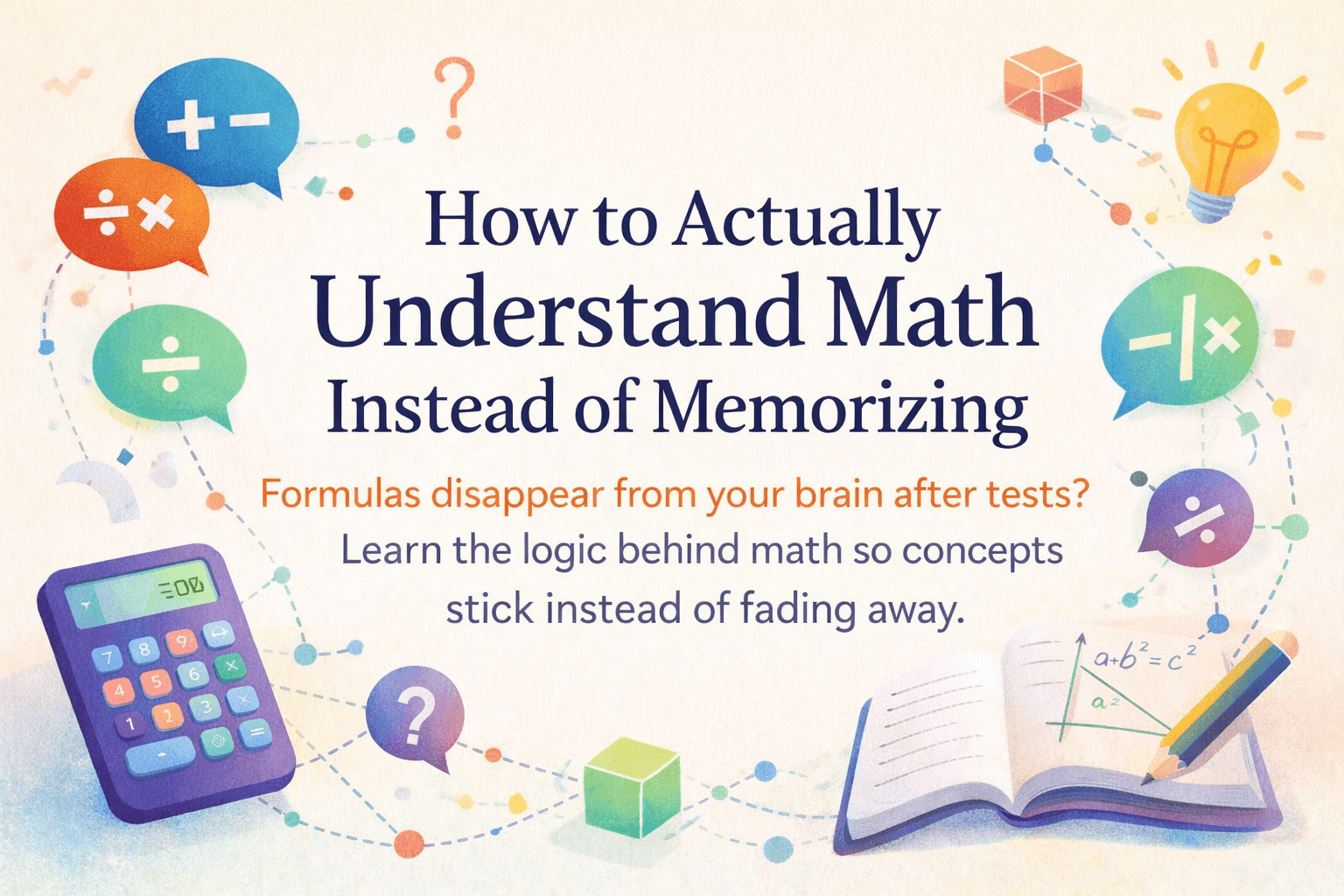
Does this sound familiar? You spend hours staring at flashcards, repeating formulas until they are burned into your brain. You walk into the test, confident you know your stuff. You pass. But two weeks later, you look at the same problem and your mind goes blank. The formula is gone.
This is the cycle of rote memorization, and it is the reason so many students hit a wall in high school math. You are not "bad at math." You have just been playing a memory game instead of learning the rules of logic.
Math is not a list of facts to be stored like history dates. It is a language of patterns. When you only memorize formulas, you are trying to speak a language by memorizing a dictionary page by page. It does not work.
In this guide, we will break down why memorization fails and give you practical strategies to actually understand the concepts. We will cover:
Why the "memory trap" stops working as math gets harder
How to visualize problems so you do not need formulas
The "Toddler Method" for digging deep into logic
How to use AI tools to build intuition
H2: Why Memorization Is a Ticking Time Bomb
Memorization works fine for multiplication tables. It might even get you through Algebra I. But eventually, you will run into a problem: math is cumulative.
Think of math like building a brick wall.
Arithmetic is the foundation.
Algebra is the first floor.
Calculus is the roof.
If you memorize a formula without understanding it, you are placing a hollow brick in your wall. It looks solid from the outside, but it cannot support weight. When you try to build the next level (like using algebra in physics), the hollow bricks crush under the pressure. The wall collapses.
Experts in education call this the difference between rote learning and meaningful learning. Rote learning is surface-level repetition. Meaningful learning happens when you connect new info to what you already know. According to Oxford Learning, meaningful learning is the only way to solve new, complex problems.
The "Brick Wall" Theory of Math
When you memorize, you treat every math problem as an isolated island. You have one recipe for quadratic equations, another recipe for slope, and a third for triangles.
This is exhausting because your brain has to hold hundreds of separate "recipes."
Real understanding connects these islands. When you understand the logic, you realize that slope is just a fancy way of measuring how steep a line is. You do not need to memorize "rise over run" if you understand that you are just measuring the change in height divided by the change in distance.
Key difference:
Memorizer: "I need to plug numbers into $y = mx + b$."
Understander: "I need to describe this line's position and steepness."
The Understander has less to remember because they can rebuild the formula from logic if they forget it.
Strategy 1: Visualize the "Why"
Most students try to memorize the "how" (the steps) before they see the "what" (the picture). This is backwards.
Humans are visual creatures. Our brains process images 60,000 times faster than text. If you cannot picture what a math concept looks like physically, you do not understand it yet.
Example: The Area of a Circle
You probably memorized $A = \pi r^2$. But why is it squared? Why is it $\pi$?
Imagine peeling a circle like an onion.
Lay the rings out flat.
They form a triangle.
The area of that triangle is the same formula as the circle.
You did not need to memorize that; you just needed to see it. The YouTube channel 3Blue1Brown is famous for these kinds of visual explanations. He calls it the "Essence of Calculus," and it turns complex formulas into obvious moving pictures.
Action Step: Before you solve a problem, draw it. If it is a function, graph it. If it is geometry, sketch it.
Strategy 2: Connect Math to Real Life
Math concepts were invented to solve real problems. Nobody sat under a tree and invented the Pythagorean theorem for fun; they needed to measure land or build structures.
When you learn a new concept, ask: "What problem does this solve?"
Derivatives (Calculus): This is not just a weird fraction. It measures how fast something is changing at a specific instant (like your car's speedometer).
Percentages: This is just a way to standardize fractions so we can compare them easily (like comparing test scores from tests with different total points).
Probability: This is just predicting the future based on past data.
If you can map the math to a physical reality, your brain has a "hook" to hang the information on. This is related to the idea of associative learning, where you link new ideas to robust memories you already have.
Strategy 3: The "Toddler Method"
Have you ever met a toddler who asks "Why?" after everything you say? It is annoying, but it is also the fastest way to learn.
When you are studying, be the toddler. Do not accept a rule just because the textbook says so.
The Drill:
Write down the rule (e.g., "Dividing by a fraction is the same as multiplying by the reciprocal").
Ask: "Why?"
Answer: "Because we need to find how many small pieces fit into the whole."
Ask: "Why?" (Keep going until you hit a basic truth like $1+1=2$).
If you hit a point where your only answer is "Because the teacher said so," that is your knowledge gap. That is the hollow brick in your wall. Go fill it.
Strategy 4: Teach It to Learn It
This is often called the Feynman Technique, named after the physicist Richard Feynman. The rule is simple: You do not understand a concept unless you can explain it to a 5-year-old (or a classmate who is failing).
When you explain something out loud, you force your brain to slow down. You cannot hide behind jargon or vague memories. You have to be precise.
We have written about this extensively in our post on does explaining topics out loud help you learn. The act of speaking activates different parts of your brain and highlights exactly where you are confused.
Try this:
Grab a rubber duck (or your cat).
Explain the math problem to them step-by-step.
If you stutter or say "um, you just do this part," stop. That is where you need to study.
How AI Can Help You Grasp the Logic
Sometimes the textbook explanation is just bad. It happens. This is where modern tools can bridge the gap.
Instead of asking AI for the answer, ask it for the intuition. You can use a tool like the Generalist Teacher prompt to break down complex ideas into simple analogies.
How to use it: Do not paste the problem and ask "Solve this." Instead, paste the concept and ask: "Explain the concept of a logarithm to me like I am 12 years old. Use an analogy involving food or money."
The Generalist Teacher prompt is designed to check your understanding. It will ask you questions back to make sure you are not just nodding along but actually getting it. It turns a lecture into a conversation.
You can also use graphing tools like Desmos to play with the math. Change the numbers in an equation and watch the line move. That instant feedback builds intuition faster than any textbook.
Conclusion
Math is not magic, and it is not a secret code for geniuses. It is just a logical system that builds on itself.
If you are struggling, stop memorizing.
Visualize the problem.
Connect it to real life.
Ask "Why" until it clicks.
Explain it to someone else.
It takes more effort upfront to learn the logic than to memorize a formula. But once you own the logic, you own it forever. You will stop panicking during tests because you can just figure it out on the spot.
You have the tools. You just need to change how you use them. Stop building with hollow bricks and start building a wall that stands up.