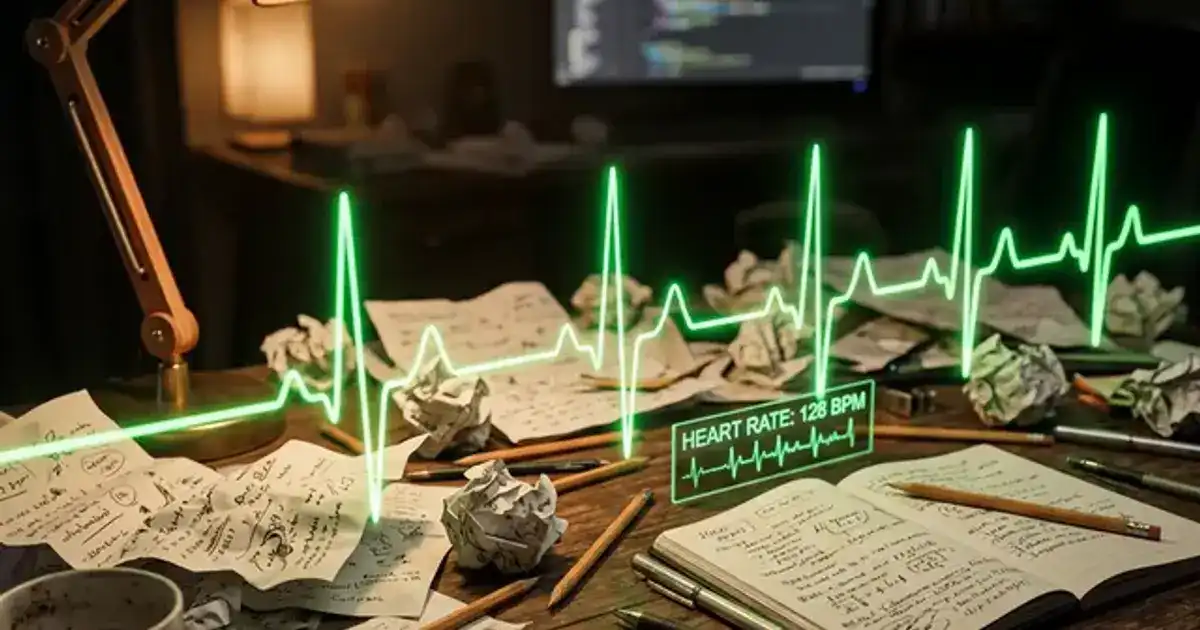
It is 6:47 AM. Your organic chemistry final starts in three hours. You have studied for two weeks straight. You know the material. You proved it last night — you nailed every practice problem.
But right now, sitting on the edge of your bed, your hands are shaking. Your chest feels tight. Your brain keeps whispering: "What if you blank? What if you forget everything the second you sit down?"
That is not weakness. That is not being unprepared. That is your nervous system misfiring — treating a chemistry exam like a physical threat. And the advice you have been given — "just relax," "study harder," "take deep breaths" — makes it worse, not better. The fix is not willpower. It is retraining your brain's threat detector before exam day arrives. Here is exactly how, step by step, using techniques backed by cognitive science research from 2026.
The Cram-Harder Trap: Why Studying More Makes Anxiety Worse
Here is the pattern: you feel anxious about an exam, so you study longer. You re-read chapters. You highlight more. You stay up later. You feel like you are doing something productive.
But the anxiety does not shrink. It grows. And when you sit down for the test, the panic hits anyway — sometimes harder than before.
The problem is not you. It is the method.
Re-reading and highlighting feel productive, but they do not simulate what your brain actually experiences during an exam. Your brain encounters time pressure, unfamiliar question formats, and performance stakes for the first time during the real test. Of course it panics — it has never practiced under those conditions.
A 2006 study by Karpicke and Roediger at Purdue University found that students who used retrieval practice — testing themselves instead of re-reading — retained 80% of material compared to 36% for re-readers. But here is the part most people miss: the retrieval group also reported lower anxiety on exam day.
The reason is simple. Familiarity kills fear. When your brain has already answered questions under pressure three times at home, the real exam feels like round four — not a first encounter.
Key Takeaway
Studying harder without changing how you study is like running faster on a treadmill — you burn more energy but never move forward. The fix is not more hours. It is the right kind of practice.
The Pressure Inoculation Method: Train Your Brain Before the Real Thing
There is a name for what actually works: Pressure Inoculation. It is the same principle the military uses to train soldiers, flight simulators use to train pilots, and surgeons use before their first real operation. You expose yourself to the stress in a controlled setting so it stops being scary.
For students, that means creating exam conditions at home — before the real exam. Not "sort of" exam conditions. Real ones. Timer running. Notes closed. Same seat, same silence, same pressure.
The Pressure Inoculation Method has three steps. Do all three at least twice before every major exam, and you will walk into the test room feeling like you have already been there.
Build or find a realistic practice exam
Use past exams from your professor, textbook problem sets, or ask ChatGPT to generate exam-style questions from your notes. The key word is "exam-style" — not review questions. You need the same format, difficulty, and time pressure you will face on test day.
⏱ 15 minutes to set up
Simulate real conditions — no shortcuts
Set a timer for the exact exam duration. Close your notes, your phone, and your browser tabs. Sit in a quiet space. Take the full test in one sitting. If your exam is 90 minutes, your practice is 90 minutes. Not 60. Not "I'll finish later." The pressure is the point.
⏱ Same duration as your real exam
Review, fix gaps, repeat
After each practice test, grade yourself honestly. Identify the specific topics where you lost points. Study only those topics. Then take another practice test 24-48 hours later. Two rounds is the minimum. Three is ideal. By the third round, most students report the anxiety dropping by roughly half.
⏱ 20 minutes to review + 1-2 days before next round
"I have an exam on [subject] in [X days]. The exam format is [multiple choice / short answer / essays / mixed]. Generate a realistic practice exam with [number] questions that match my professor's difficulty level. Include questions from these specific topics: [list your topics]. Add a suggested time limit. Do not include the answers until I ask for them."
For a full library of study prompts built specifically for exam prep, explore the Chemistry Tutor prompt at Vertech Academy — it builds custom quizzes from your notes and adapts difficulty as you improve.
The 10-Minute Worry Dump: Empty Your Head Before the Exam
This one sounds too simple to work. It is not. Research from the University of Chicago by Sian Beilock (published in Science, 2011) found that students who spent 10 minutes writing about their exam fears immediately before the test scored nearly a full grade higher than those who did not.
Here is why it works: anxiety lives in your working memory. The same mental workspace you need for problem-solving is being hijacked by worst-case scenarios — "I am going to fail," "Everyone else looks calm," "I do not remember chapter 7." Writing those thoughts down moves them from your brain to the page. Your working memory frees up for the actual test.
Arrive 15 minutes early — sit down, pull out a blank sheet of paper or open your phone notes.
Write every anxious thought — "I do not know integration by parts." "I stayed up too late." "What if I run out of time on the essay?" Get it all out. Ugly handwriting is fine. No one reads this but you.
Fold the paper and put it away — the act of physically closing it signals to your brain: "That is dealt with. Now we work."
This takes 10 minutes. It costs nothing. And the research says it works as well as weeks of therapy for mild-to-moderate test anxiety. Try it once. You will keep doing it.
Physical Techniques That Work in 60 Seconds
Your body and your brain talk to each other. When your brain panics, your body tenses. But the reverse is also true — when you physically relax your body, your brain receives a "safe" signal. These three techniques take under 60 seconds each, and you can do all of them silently during an exam without anyone noticing.
Box Breathing
Inhale 4 seconds. Hold 4 seconds. Exhale 4 seconds. Hold 4 seconds. Three rounds. This activates your parasympathetic nervous system — the "rest and digest" mode — and physically slows your heart rate within 30 seconds.
⏱ 48 seconds for 3 rounds
Progressive Clench-Release
Clench your fists tight for 5 seconds. Release completely. Move to your shoulders — shrug hard, then drop. Then your jaw — clench, release. The release signals safety to your nervous system more effectively than trying to "relax" directly.
⏱ 30 seconds total
Cold Water Reset
Before the exam, splash cold water on your wrists and the back of your neck. During the exam, press a cold water bottle against your wrists for 10 seconds. The cold triggers a mild dive reflex that slows your heart rate by up to 10-25%.
⏱ 15 seconds
How to Reframe Anxiety as Performance Energy
In a 2014 Harvard Business School study, researcher Alison Wood Brooks found that telling yourself "I am excited" before a stressful task improved performance more than telling yourself "I am calm." The reason is surprising: anxiety and excitement feel almost identical in your body — elevated heart rate, alertness, energy. The difference is just the label your brain puts on it.
Most advice tells you to fight the feeling. "Calm down." "Relax." But your body is already activated — telling it to shut off is like telling a car going 80 mph to instantly stop. It does not work. What does work is redirecting the energy.
❌ Before (Fighting it)
"I need to calm down. Why am I so nervous? Everyone else seems fine. I should not feel this way. Something is wrong with me."
✅ After (Redirecting it)
"My body is getting ready to perform. This energy means I care about doing well. I am going to use this to focus harder. I have practiced for this."
The reappraisal takes 5 seconds. Say it in your head before the test starts: "This energy helps me." It sounds simple because it is. Brooks' research showed it improved math test performance by 22% and public speaking scores by 17%. The brain believes the label you give it.
How AI Study Tools Reduce Exam Anxiety in 2026
AI does not cure anxiety. But it removes several things that make anxiety worse: uncertainty about what will be on the test, not knowing where your gaps are, and spending hours on study methods that do not work.
As of 2026, free AI tools can generate realistic practice exams from your notes, identify your weak topics, and create personalized review sessions — all in minutes instead of hours. That means more time for Pressure Inoculation practice and less time for aimless re-reading.
| Tool | Best For | Free Tier (2026) | Anxiety Reducer |
|---|---|---|---|
| ChatGPT | Practice exam generation | GPT-4o mini, unlimited | Creates exam-style questions from your notes so you know what to expect |
| Claude | Explaining confusing concepts | Claude 3.5 Sonnet, daily limit | Breaks down hard topics until they click — removes "I do not understand this" panic |
| Gemini | Real-time fact checking | Gemini 2.0 Flash, unlimited | Verifies your understanding with real sources so you study the right things |
| Perplexity | Finding study resources | 5 Pro searches/day | Finds past exams, study guides, and professor resources you missed |
For a deeper comparison of which AI tool works best for different study tasks, see our ChatGPT vs Claude vs Gemini side-by-side breakdown. And for students who want to learn how AI fits into a full study system, our guide on how to use ChatGPT to study covers the complete process.
When Self-Help Is Not Enough: Knowing the Limits
Everything above works for the kind of test anxiety most students experience — the nervousness that spikes before exams and fades after. That is performance anxiety, and it responds well to practice-based techniques.
But some students experience something more severe. If your anxiety causes you to consistently blank on material you know, if it is affecting your sleep for weeks (not just the night before), if you are experiencing panic attacks, nausea, or dread that extends beyond exam season — that is clinical anxiety, and it deserves professional support.
When to ask for help
Most university counseling centers offer short-term cognitive behavioral therapy (CBT) that is specifically effective for test anxiety. Many sessions are free. Your campus disability services office can also arrange formal accommodations — extended time, separate testing rooms, or alternative exam formats. These are not special privileges. They are tools that level the playing field, and roughly 1 in 5 college students uses them as of 2026.
Self-help techniques and professional support are not either/or. You can use everything in this guide and also talk to a counselor. The students who recover fastest from severe test anxiety are the ones who combine both.
The Complete Pre-Exam Protocol: Your Step-by-Step Checklist
Here is the full system, pulled together. Use this as a checklist for every major exam.
7 days before: Build your first practice exam (use AI or past exams). Take it under timed conditions. Grade yourself. Identify your 3 weakest topics.
5 days before: Study only your weak topics. Use active recall — not re-reading. Ask ChatGPT to quiz you specifically on those gaps.
3 days before: Take practice exam #2 under timed conditions. Compare to round 1. Your score should improve. Your anxiety should dip.
Night before: Light review only — scan your notes for 20 minutes max. Then stop. Do something relaxing. Sleep 7-8 hours. No all-nighters. Sleep is when your brain consolidates memory.
Exam morning: Arrive 15 minutes early. Do the Worry Dump (10 minutes). Three rounds of box breathing (48 seconds). Say in your head: "This energy helps me." Walk in.
You now know something most students do not. Everyone else is re-reading and hoping the anxiety will go away. You are going to inoculate against it. That is the whole difference.
🎯 Try This Tonight
Open ChatGPT (free). Paste this: "Generate a 10-question practice exam for [your subject]. Match the difficulty of a college-level midterm. Use [multiple choice / short answer / whatever your exam format is]. Do not show me the answers until I ask." Set a 20-minute timer. Take the test. Grade yourself. You just completed round one of Pressure Inoculation — and you will feel the difference immediately. Total time: 25 minutes.