Introduction
Imagine sitting in a completely silent room. For some people, this is perfect. They open their books and get right to work. But for others, total silence feels heavy. It feels awkward. Instead of focusing on history or math, their brain starts focusing on how quiet it is. They might even hear a clock ticking in the next room or the hum of the refrigerator. Suddenly, the silence is louder than any noise could be.
This is a common problem for students. You want to focus, but you don't know if you should put on headphones or buy earplugs. Does playing music help you learn, or does it just distract you? Is the noise in a coffee shop actually magic for your brain, or is it just an excuse to buy a latte? The answer isn't a simple "yes" or "no." It depends on your brain, the type of work you are doing, and the kind of noise you are listening to.
In this guide, we will break down:
Why silence focuses some people but stresses others out.
The difference between "good" noise and "bad" noise.
How to use sound to trick your brain into working harder.
Simple tests to find your perfect study volume.
Why Silence Isn't Always Golden
We are often told that "serious" studying only happens in a quiet library. But have you ever noticed that libraries can sometimes feel too quiet? When a room is dead silent, every little sound becomes a distraction. If someone drops a pen or coughs three tables away, it breaks your focus because it stands out so much.
For many brains, a little bit of background sound acts like a blanket. It covers up those sudden, startling noises. This is why some people sleep with a fan on. The steady hum of the fan isn't interesting, so your brain ignores it. But it blocks out the sound of a car driving by or a door creaking. The same logic applies to studying. A steady background sound can help you stay in the "zone" by smoothing out the world around you.
The Science of Sound and Focus
Scientists have actually studied this. There is a fancy term called "stochastic resonance," but we can just call it the "Goldilocks Zone" of noise.
Here is how it works:
Too Quiet: Your brain gets bored and starts looking for stimulation (like checking your phone).
Too Loud: Your brain gets overwhelmed and can't process information.
Just Right: A moderate level of noise gives your brain just enough energy to stay alert, but not enough to distract you.
This "Just Right" level is different for everyone. Some research suggests that for people who struggle to pay attention (like those with ADHD), a little bit of extra noise helps their brain release dopamine. Dopamine is a chemical that helps you focus. So, for some students, adding noise is like putting on glasses, it helps them see the task more clearly. You can read more about how different brains react to noise here.
The "Coffee Shop Effect" Explained
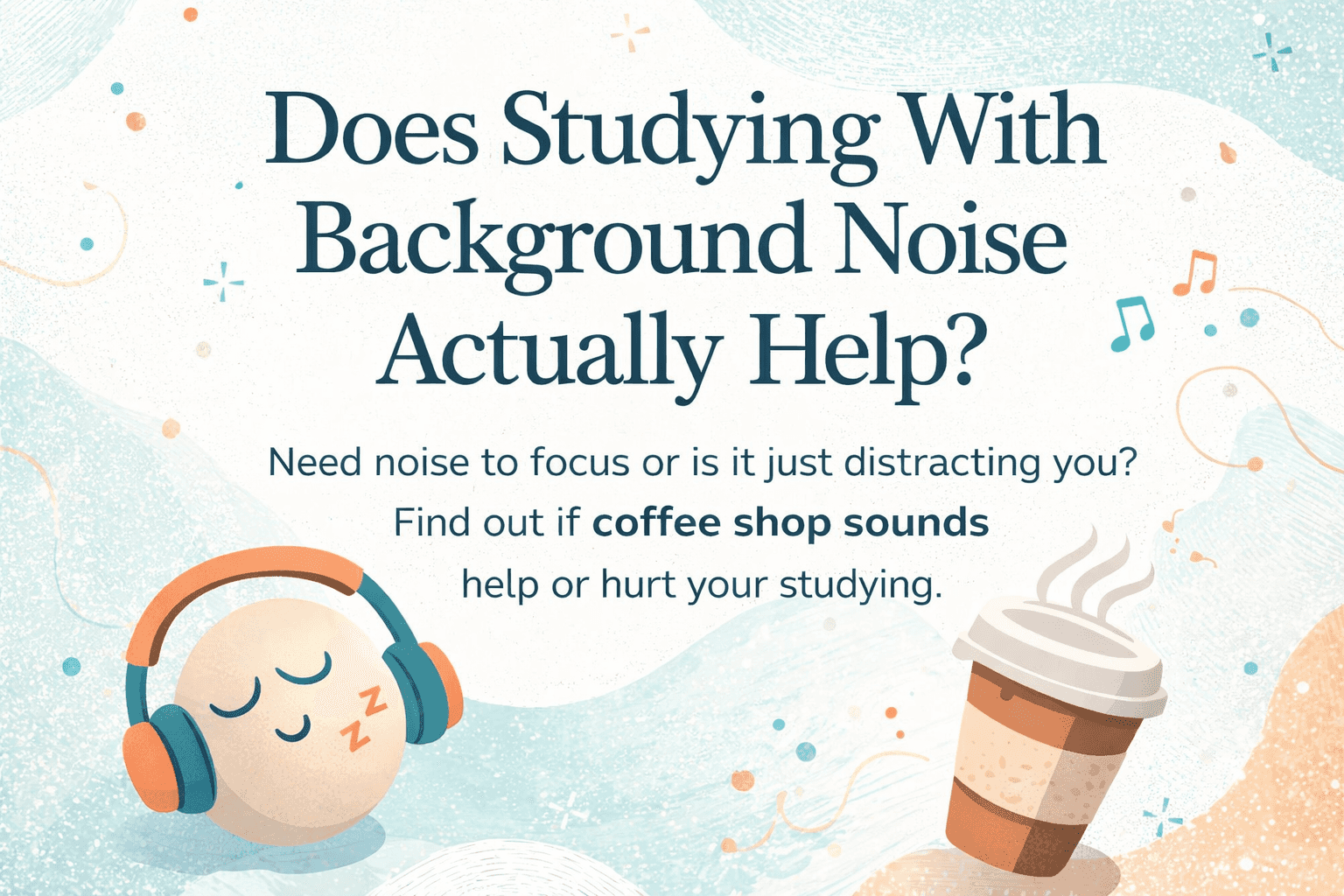
Have you ever gone to a Starbucks to study and realized you got more done in one hour than you did all week at home? This is known as the Coffee Shop Effect.
Coffee shops usually have a noise level of about 70 decibels. This is the sound of milk steamers, soft music, and people chatting in the distance. It turns out, this might be the perfect volume for creativity.
Why does it work?
It's social but private: You feel like you are around people, so you don't feel lonely, but no one is actually talking to you.
It breaks rigid thinking: The random background noise forces your brain to work a tiny bit harder to tune it out. This slight effort can actually help you think more abstractly and creatively.
However, this only works if the conversation is muffled. If you can clearly hear the two people next to you arguing about their breakup, the magic is gone. Your brain will naturally try to listen to the story, and your focus will break.
Different Colors of Noise
Not all noise is created equal. You have probably heard of "White Noise," but did you know there are other colors? finding the right color can change your entire study session.
White Noise: This sounds like static from an old TV or a whirring fan. It contains all frequencies at once. It is great for blocking out everything, but some people find it a bit harsh or "scratchy" on the ears.
Pink Noise: This is softer and deeper. Think of steady rain falling on a pavement or leaves rustling in the wind. Many people find pink noise more soothing than white noise because it isn't as high-pitched.
Brown Noise: This is the deepest sound. It sounds like a low roar, a distant waterfall, or heavy thunder. Brown noise is very popular right now for studying because it feels "heavy" and calming. It is great for quieting a racing mind.
If you want to dive deeper into which color fits your personality, check out this guide on White, Pink, and Brown noise.
Music vs. Meaningless Noise
Here is the most important rule of studying with sound: Lyrics are the enemy.
If you are doing math, you might be able to listen to your favorite pop songs. Math uses a different part of your brain than language does. But if you are reading, writing an essay, or studying history, listening to music with words is a bad idea.
Your brain has a "language center." When you read a textbook, that part of your brain is lighting up. If you listen to a song with lyrics at the same time, your brain tries to process the words in the book and the words in the song simultaneously. It is like trying to listen to two people talking to you at once. You might feel like you are working, but you are likely reading the same sentence over and over again.
What to listen to instead:
Lo-Fi Beats: Relaxing, repetitive beats with no vocals.
Classical Music: Complex enough to be interesting, but usually no words.
Video Game Soundtracks: This is a pro tip. Video game music is designed to keep you focused on a task without distracting you.
When to Turn the Volume Down
While noise can be helpful, there are times when you absolutely need silence. If you are learning something brand new and very difficult, turn the sound off.
When your brain is trying to connect new dots, like learning a new physics formula or a complex grammar rule, it needs 100% of its processing power. Background noise takes up a small percentage of that power. When the task is hard, you can't afford to "spend" that brain power on filtering out noise.
This is similar to when a driver turns down the radio when they are looking for a specific house address. They need their eyes to focus, so they stop using their ears.
If you are doing "active recall" (testing yourself without notes), you might also want silence to ensure you are truly remembering the material. If you want to learn more about active recall, read our post on how to actually use AI to prepare for tests.
How to Test What Works for You
Since everyone is different, you need to run an experiment on yourself. Don't just do what your friends do.
The 3-Day Test:
Day 1: Study in total silence (use earplugs if needed).
Day 2: Study with "Brown Noise" or rain sounds.
Day 3: Study with instrumental music (Lo-Fi or Classical).
After each session, rate your focus from 1 to 10. Did you get distracted? Did you feel sleepy? Did time fly by?
If you want to get really scientific about it, you can use AI to help you analyze your study habits. You can use our Critical Thinking Expert prompt. You can tell it, "I studied for one hour with music and one hour without. Here are my results on the practice quiz for each session. Help me analyze which method worked better." It can help you look at your own data objectively.
Tools to Manage Your Sound Environment
You don't need expensive gear to get the right sound, but a few tools can help.
Noise-Canceling Headphones: These are great if you are in a loud house or school cafeteria. They can create silence where there isn't any.
Background Noise Websites: There are many free websites (like A Soft Murmur or myNoise) that let you mix your own sounds. You can combine "Rain" with "Coffee Shop" and "Fireplace" to create your perfect environment.
The "Do Not Disturb" Button: This is the most important tool. It doesn't matter if you have the perfect playlist if your phone dings every 30 seconds. Background noise is good; background notifications are bad.
Conclusion
Studying with background noise is a personal choice, but science shows it can be a powerful tool. Whether it is the hum of a coffee shop or the deep rumble of brown noise, the right sound can keep your brain awake and block out distractions. Just remember the golden rules: avoid lyrics when reading, embrace silence for the super hard stuff, and turn off your notifications.
At the end of the day, the goal is "Flow." Flow is that feeling when you are so locked into your work that you forget about the time. For some, Flow happens in a silent library. For others, it happens in a loud, busy cafe.
Don't let anyone tell you that you are studying "wrong" just because you have headphones on. But also, be honest with yourself. If you spend 20 minutes choosing the perfect song and only 10 minutes studying, the music is a distraction.
Experiment with different sounds. Try pink noise. Try silence. Try video game soundtracks. Once you find what helps your brain lock in, stick with it. Your grades will thank you.
Key Takeaways:
Silence isn't for everyone: It can sometimes be too distracting.
Use the right noise: Try Brown or Pink noise instead of harsh White noise.
No Lyrics: Words in songs fight with words in books.
Test it out: Try different sounds for 3 days and see what gives you the best focus.
If you are looking for more ways to improve your study routine, check out our Prompt Library for tools that can act as your personal study buddy.