Every student has a study method. Most students have the wrong one. In 2013, psychologists John Dunlosky and colleagues published a landmark review of 10 popular study techniques, evaluating each based on decades of controlled experiments. Their conclusion: the methods students use most often, highlighting and re-reading, are among the least effective. The methods that actually work, active recall and spaced practice, are the ones students use least.
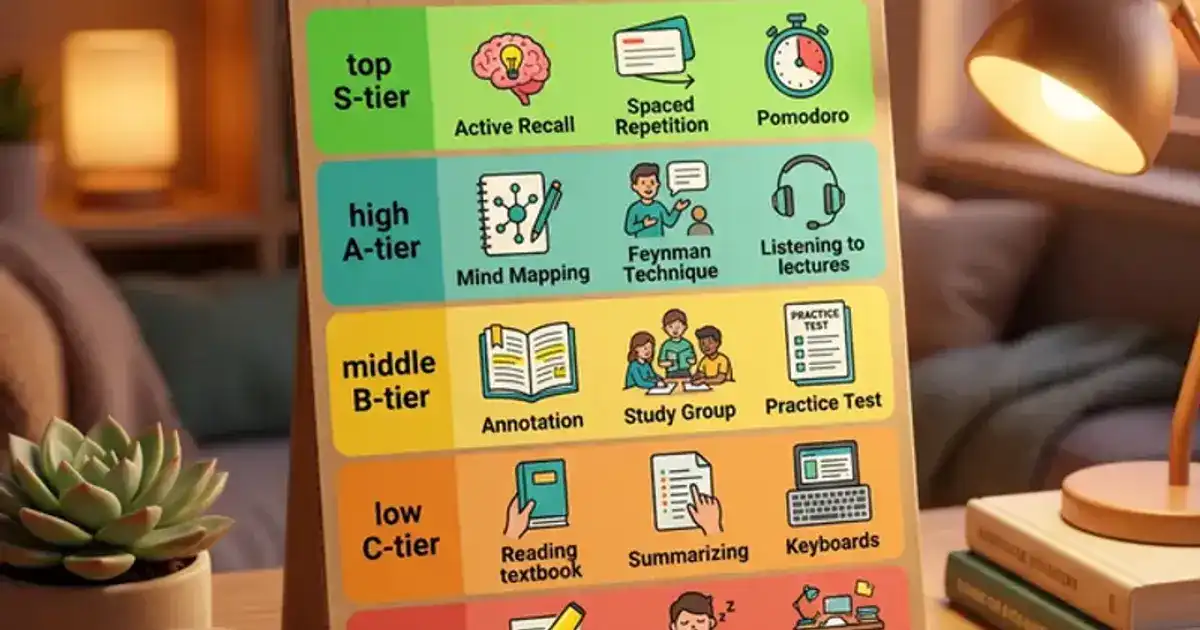
This guide ranks every major study method using the same evidence-based framework. Each method gets a tier rating from S (strongest evidence, highest effectiveness) to D (weakest evidence, lowest effectiveness). The research citations come from cognitive psychology and educational science, not opinion pieces or productivity influencers.
If you have been studying for hours and still performing poorly on exams, the problem is almost certainly your method, not your effort.
S-Tier: Active Recall
Active recall means retrieving information from memory without looking at your notes. Instead of re-reading chapter 7, you close the book and try to write down everything you know about chapter 7. Instead of reviewing flashcards passively, you look at the question and force yourself to generate the answer before flipping the card.
Why it works. Every time you successfully retrieve a piece of information from memory, the neural pathway to that memory gets stronger. This is called the testing effect, and it is one of the most replicated findings in all of psychology. Karpicke and Roediger's 2008 study showed that students who used retrieval practice remembered 80% of material after one week, compared to 36% for students who re-read the same material. The effect is large, consistent, and applies to every subject area tested.
How to implement it. After each lecture or reading session, close your materials and write down everything you can remember. Use blank paper, not your notes. Time yourself for 10 minutes. Then compare what you wrote to the original material. The gaps are exactly where you need to focus your review. This single exercise, done consistently after every class, produces more learning than hours of passive review.
Active recall prompt:
"I need to study [topic] for my [course] exam. Create 15 questions that test deep understanding, not just definitions. Include questions that require me to: (1) explain why something works, (2) compare two related concepts, (3) apply a concept to a new situation, (4) predict what would happen if a variable changed. Quiz me one question at a time. Do not reveal the answer until I respond."
Common mistake. Students often give up on active recall because it feels harder than re-reading. That difficulty is exactly why it works. The effort required to retrieve information is what strengthens the memory. If recall feels easy, you are either reviewing material you already know well (and should move on) or you are not genuinely testing yourself. Struggle is not a sign of failure. It is the mechanism of learning.
S-Tier: Spaced Repetition
Spaced repetition means reviewing material at increasing intervals rather than cramming everything into one session. You study something today, review it tomorrow, review it again in three days, then in one week, then in two weeks. Each successful review extends the interval before the next one.
Why it works. Hermann Ebbinghaus discovered the forgetting curve in 1885: without review, you forget approximately 70% of new information within 24 hours. Spaced repetition works by interrupting the forgetting curve at the optimal moment, the point where you are about to forget but can still recall with effort. Each interruption makes the memory more durable and pushes the next forgetting point further into the future. After 5 or 6 well-timed reviews, the information moves into long-term memory where it can persist for months or years.
How to implement it. Anki automates the spacing algorithm, showing you cards just before you are about to forget them. Create cards as you learn new material and review them daily. The daily review session takes 15 to 30 minutes once you have a mature deck, but the retention rates are dramatically higher than any other review method. Students who use Anki consistently report near-perfect recall of factual material on exams.
Common mistake. Creating too many cards or making cards that are too complex. Each card should test one fact or one concept. "What are the five stages of grief?" is a bad card because it tests five things simultaneously and you will fail if you forget any one of them. Five separate cards, each asking for one stage, are far more effective. Keep cards atomic: one question, one answer, one concept.
A-Tier: Practice Testing
Practice testing means taking full-length practice exams under realistic conditions: timed, closed-book, no phone. This differs from active recall in that it simulates the complete exam experience rather than testing individual facts. Practice tests train not just your knowledge but your test-taking skills: time management, question interpretation, and performance under pressure.
Why it works. Practice tests create retrieval practice at scale while also building exam-specific skills. Dunlosky's 2013 review rated practice testing as one of only two "high utility" study strategies (along with distributed practice). The benefits extend beyond the specific questions tested. Students who take practice tests perform better even on questions they did not practice, because the testing process strengthens the overall knowledge structure.
How to implement it. Find past exams from your professor (many departments keep exam archives), use textbook practice problems, or ask ChatGPT to generate a realistic exam based on your syllabus. Take the practice test under exam conditions: set a timer, close your notes, and work through the entire test. Review your mistakes immediately after finishing. The mistakes you make on practice tests are the highest-value study targets because they reveal exactly where your preparation is weakest.
A-Tier: Interleaving
Interleaving means mixing different topics or problem types within a single study session instead of studying one topic at a time. Instead of doing 20 calculus problems on integration by parts, followed by 20 on u-substitution, you mix them: an integration by parts problem, then a u-substitution, then a trig substitution, then back to integration by parts.
Why it works. Blocked practice (one topic at a time) feels more productive because you get faster as you repeat the same type of problem. But that speed is an illusion. On an actual exam, problems are mixed and you have to identify which method to use, not just execute a method you have already been told to use. Interleaving trains this identification skill. Research by Rohrer and Taylor showed that interleaving improved test performance by 43% compared to blocked practice, even though students who used blocked practice rated themselves as more confident.
How to implement it. When doing practice problems, shuffle them. If your textbook has problems organized by type, skip around. Mix problems from different chapters within a single study session. This feels harder and slower, which is exactly why it works. The mental effort of switching between problem types and identifying the correct approach strengthens your ability to diagnose problems, the exact skill that exams test.
B-Tier: Feynman Technique
The Feynman technique means explaining a concept in simple language as if teaching it to someone with no background in the subject. You write the concept name at the top of a blank page, explain it without jargon, identify where your explanation breaks down, and then study specifically those gaps.
Why B-tier, not higher. Teaching and self-explanation are well-supported by research, but the Feynman technique is less efficient than active recall for factual material. It excels at building conceptual understanding, identifying gaps, and preparing for essay exams or oral presentations. For pure memorization (vocabulary, formulas, dates), active recall and spaced repetition are faster. The Feynman technique earns B-tier because it is excellent for understanding but not the most efficient for all types of learning.
Best use case. Use the Feynman technique for concepts you find confusing, not for material you already understand. It is a diagnostic tool that reveals where your knowledge is shallow. Once you identify the gaps, switch to active recall and spaced repetition to fill them efficiently.
B-Tier: Pomodoro Technique
The Pomodoro technique uses timed intervals, typically 25 minutes of work followed by 5 minutes of rest, to maintain focus and prevent burnout. After four intervals, you take a longer 15 to 30 minute break.
Important distinction. The Pomodoro is a focus management tool, not a learning technique. It helps you stay concentrated, which is valuable, but what you do during those 25 minutes is what determines whether you actually learn. Pomodoro with active recall is an excellent combination. Pomodoro with re-reading is 25 minutes of structured time-wasting followed by a break. The timer is not the active ingredient. Your study method during the timer is.
Customization. The 25-minute default works for some students but is arbitrary. Many students find that 45 or 50 minutes better matches their natural concentration window, especially for deep work like writing or problem-solving. Experiment with different intervals. The right length is the longest period you can maintain genuine focus without your mind wandering. Once you find your optimal interval, the Pomodoro structure helps you protect that focus time from distractions.
Want to build a complete study system?
Our guide covers how to combine these methods into a daily study routine that actually works, with AI-powered practice built in.
Build Your Study System →C-Tier: Summarization
Writing summaries of material in your own words can help with understanding, but the evidence is mixed on whether it improves long-term retention. Summarization is more effective than re-reading because it requires you to process information and select the most important ideas, but it is less effective than retrieval practice because you are working with the material in front of you rather than pulling it from memory.
When summarization helps. Summarization is useful as a first-pass strategy when you encounter new and complex material. Writing a summary forces you to identify the key concepts and their relationships, which creates a framework for deeper learning later. However, do not stop at summarization. Use it to build a map of the material, then use active recall and spaced repetition to actually learn the details. Summarization is a warm-up, not a workout.
D-Tier: Highlighting and Re-Reading
Highlighting. Dunlosky's 2013 review rated highlighting as "low utility." Multiple studies show that highlighting produces no meaningful improvement in test performance compared to simply reading without highlighting. The problem is that highlighting requires no deep processing. You are making color decisions, not learning decisions. Students who highlight heavily often perform worse than students who do not highlight at all, because the act of highlighting creates an illusion that they have studied the material when they have only marked it.
Re-reading. Re-reading is the most popular study strategy among college students and one of the least effective. Research consistently shows that reading a chapter twice produces only marginally better learning than reading it once, and far less learning than a single session of retrieval practice. Re-reading creates familiarity, not understanding. The text feels familiar on the second read, which your brain interprets as knowledge. Familiarity and knowledge are not the same thing, and this confusion leads to overconfidence on exams.
Why students keep using them. Highlighting and re-reading persist because they are easy and because they produce a feeling of productivity. Covering a page in yellow highlighter feels like you accomplished something. Reading the same chapter three times feels thorough. But feeling productive and being productive are different things. The methods that feel hardest (retrieval practice, interleaving) produce the most learning. The methods that feel easiest (highlighting, re-reading) produce the least. This mismatch between effort and results is the central challenge of effective studying.
Building Your Study System
The best approach combines multiple methods in a structured routine. Here is a system based on the research that works for any subject in any semester:
During lectures: Take sparse notes focused on concepts and questions, not transcription. Write down what confuses you, not what makes sense. Your confusion is the most valuable information in any lecture because it reveals the gaps that need the most attention.
Within 24 hours: Do a 10-minute free recall session. Close your notes and write everything you remember from the lecture. Compare against your notes. The gaps tell you exactly what to study.
During study sessions: Use active recall as your primary method. Create flashcards for factual material and use Anki for spacing. For conceptual material, use the Feynman technique on the topics you find hardest. Interleave practice problems from different topics within the same session.
Before exams: Take full-length practice tests under exam conditions. Review your mistakes and identify patterns. If you consistently miss the same type of question, that topic needs more active recall practice, not more re-reading.
The meta-point: the specific system matters less than the principles. Any study routine built on retrieval practice, spacing, and interleaving will outperform any routine built on re-reading, highlighting, and cramming. Match your methods to the evidence, not to what feels comfortable, and your grades will reflect the difference. Students who switch from D-tier methods to S-tier methods typically report grade improvements within the first exam cycle, not because the material got easier but because they are finally studying in a way that produces actual learning instead of comfortable familiarity.
The irony of effective studying is that the best methods feel worse in the moment. Active recall feels frustrating because you confront what you do not know. Interleaving feels slow because you cannot build momentum on one problem type. Spaced repetition feels inefficient because you review material you think you already know. But these feelings of difficulty are the evidence that learning is happening. The moment studying feels effortless, you should question whether you are actually learning or just enjoying the illusion of productivity that comes from re-reading familiar text.
Try one upgrade today
If you currently study by re-reading your notes, try replacing just one session with active recall. Close your notes and write down everything you remember about your most recent lecture. Compare against the original. That single 10-minute exercise will show you how much you actually know versus how much you think you know. The difference is usually surprising and motivating.