Language learning used to require either expensive tutors, awkward language exchange meetups, or grinding through textbook exercises alone at your desk. AI changed the equation dramatically. Today, you can have a conversation in Spanish at 2 AM in your pajamas with a tutor that never judges you, never gets tired, and costs nothing. That is genuinely revolutionary for language learners.
But the AI language learning space is also full of hype. Every app claims to use "AI" even when the feature is just a glorified flashcard shuffler. This guide cuts through the noise and focuses on the tools that actually accelerate language learning, based on what works according to linguistics research and what real students report being useful.
Why AI Actually Changes Language Learning (Not Just Hype)
The single biggest barrier to learning a language is not vocabulary or grammar. It is practice. Specifically, it is the kind of practice that requires another human: conversation. Most language classes give you maybe 5 minutes of actual speaking time per hour because 30 students are taking turns. Private tutors solve this but cost $30-60 per hour. Language exchange partners are free but unreliable and hard to schedule.
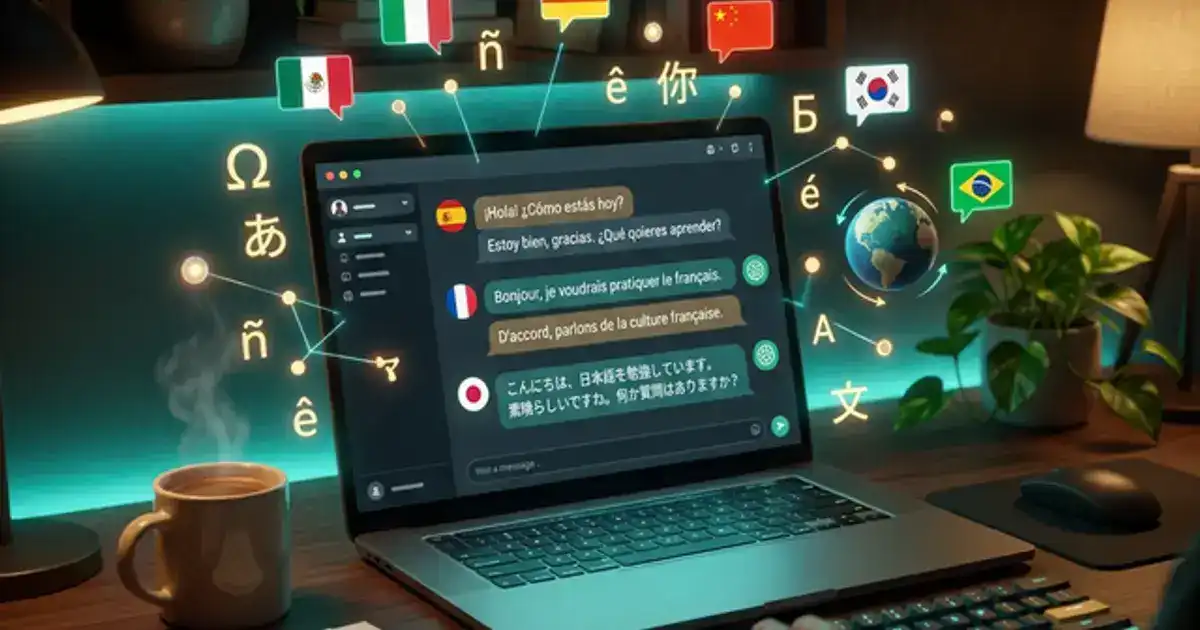
AI solves the practice problem. ChatGPT, Claude, and Gemini can all hold extended conversations in dozens of languages. They can slow down, rephrase, explain grammar in English when you are confused, and switch back to the target language when you are ready. They are available 24/7 and they never roll their eyes when you conjugate the same verb wrong for the fifth time.
The second thing AI solves is personalization. Traditional language courses follow a fixed curriculum regardless of whether you are a visual learner, an auditory learner, or someone who learns best through conversation. AI adapts to your level in real time. If you already know food vocabulary but struggle with past tense, AI can focus exclusively on past tense without making you sit through 20 flashcards about fruits you already memorized.
That said, AI has real limitations for language learning that we will cover later. The tools listed here are genuinely useful, but they work best as part of a broader learning strategy that includes real human interaction.
ChatGPT as a Language Tutor (The Most Underrated Tool)
ChatGPT is not marketed as a language learning tool, but it might be the best one available. Here is why: it can act as a conversation partner, a grammar explainer, a vocabulary builder, a pronunciation coach (through voice mode), and a cultural context guide, all in one interface. No dedicated language app does all of these things well.
Conversation practice (the killer feature)
Try this prompt:
"You are a patient French tutor. Have a conversation with me entirely in French. My level is A2 (elementary). When I make a grammar mistake, gently correct me in French, then briefly explain the correction in English. Keep the conversation going. Start by asking me about my day."
This single prompt gives you something that used to require a paid tutor: guided conversation practice with real-time correction. The key details are the level specification (A2) and the instruction to correct mistakes with brief English explanations. Without these, ChatGPT either talks at a level that is too advanced or does not correct your errors at all.
Grammar explanations that actually make sense
Try this prompt:
"Explain the difference between the preterite and imperfect tenses in Spanish. Assume I am a native English speaker. Give me 5 example sentences for each tense, and explain the logic behind choosing one over the other. Use everyday situations, not textbook examples."
Language textbooks are notoriously bad at explaining grammar intuitively. They give you rules and tables, but they rarely explain the why behind the rules. ChatGPT excels at this because you can ask follow-up questions. "But what about this sentence?" "Why does this example break the rule you just explained?" This iterative back-and-forth is how grammar actually clicks.
Voice mode for speaking practice
ChatGPT's voice mode lets you speak in your target language and get verbal responses. This is the closest thing to a real conversation you can get without another person. Tell it your level, ask it to speak slowly, and have a 5-minute conversation every day. Your pronunciation and listening comprehension will improve faster than with any textbook exercise.
Want prompts designed for learning?
The Chemistry Tutor prompt adapts to your level and subject, including foreign languages. Ask it to teach you verb conjugations, explain idioms, or quiz you on vocabulary.
Try the Free Chemistry Tutor PromptThe Best AI Language Learning Tools Compared
Beyond ChatGPT, several purpose-built tools use AI effectively for language learning. Here is what each one does best and where it falls short.
Duolingo (with Duolingo Max)
BEST FOR: Daily habit buildingThe gamified structure keeps you coming back. Duolingo Max adds AI-powered roleplay conversations and explanations. Best for beginners who need structure and daily motivation. Covers 40+ languages.
ChatGPT / Claude / Gemini
BEST FOR: Conversation practiceUnlimited conversation practice in any language. Grammar explanations on demand. Voice mode for pronunciation. No structured curriculum, so you need to bring your own learning plan. Best for intermediate learners.
Anki (with AI-generated decks)
BEST FOR: Long-term vocabulary retentionSpaced repetition is scientifically proven to be the most effective method for memorizing vocabulary. Use ChatGPT to generate Anki cards from your study material, then review them daily. The AI does not make the cards smart; the algorithm does.
Speechling
BEST FOR: Pronunciation accuracyCombines AI-powered pronunciation analysis with real human coach feedback. You record yourself speaking, AI gives instant feedback, and a human coach reviews your submissions weekly. Best for learners serious about sounding natural.
A Realistic 30-Day AI Language Learning Plan
Most language learning content gives you a tool list and then says "good luck." Here is an actual plan you can follow for 30 days that combines the best tools into a structured routine. This assumes you are learning a popular language (Spanish, French, German, Japanese, Korean, etc.) and have 20-30 minutes daily.
Days 1-10: Foundation
- 10 min Duolingo daily (build the base)
- 5 min review vocabulary with Anki
- 5 min listen to content in your target language (YouTube, music, podcasts)
- AI task: Use ChatGPT to generate an Anki deck of the 100 most common words in your target language
Days 11-20: Practice
- 5 min Duolingo (maintenance)
- 10 min conversation with ChatGPT voice mode (start with simple topics: food, weather, daily routine)
- 5 min Anki review
- AI task: Ask ChatGPT to roleplay everyday scenarios in your target language (ordering food, asking for directions)
Days 21-30: Immersion
- 15 min extended conversation with ChatGPT (discuss opinions, tell stories, debate topics)
- 5 min Anki review
- Change your phone language to your target language
- AI task: Ask ChatGPT to write you a short story in your target language at your level, then discuss it together
The consistency principle
Language learning research consistently shows that daily practice beats binge sessions. A student who practices 15 minutes every day for 30 days will outperform a student who does 7 hours on Saturday. Your brain builds neural pathways through repetition over time, not through marathon sessions. AI makes the 15-minute daily session possible because you do not need to schedule a tutor or find a partner. Just open ChatGPT and start talking.
What AI Cannot Do for Language Learning (Important Limitations)
AI is incredible for language practice, but it has real limitations that you should know about before relying on it as your only tool.
AI Limitations
- Cultural nuance. AI does not understand when a technically correct phrase would sound weird, rude, or overly formal in a real conversation.
- Current slang. AI models are trained on data up to a cutoff date, so the latest slang and colloquialisms may not be reflected accurately.
- Less common languages. AI is excellent for Spanish, French, German, Japanese, and other widely spoken languages. Performance drops significantly for less common languages where training data is limited.
- The "real person" factor. Talking to AI and talking to a real person are neurologically different experiences. The anxiety, unpredictability, and social pressure of real conversation is what you eventually need to get comfortable with.
How to Compensate
- Follow native speakers on social media and watch content in your target language to absorb cultural context and modern usage.
- Use language exchange apps like Tandem or HelloTalk for real human practice once your AI practice gives you enough confidence to hold basic conversations.
- Cross-reference AI translations with dedicated tools like WordReference, especially for idioms and expressions.
- Think of AI as your private practice space and human interaction as your performance stage. You need both.
AI Prompts for Every Level
The effectiveness of AI for language learning depends almost entirely on how you prompt it. Here are the best prompts for each stage of your language learning journey.
Absolute beginner. "Teach me the 20 most useful phrases in [language] for a tourist. For each phrase, give me the phrase, a phonetic pronunciation guide, and a brief explanation of when to use it."
Elementary. "Have a simple conversation with me in [language] about daily routines. Use only present tense. Correct my mistakes and explain corrections in English."
Intermediate. "Let us have a conversation about [topic] in [language]. Use past, present, and future tenses. Do not simplify your vocabulary. Correct my errors only when they would cause misunderstanding."
Upper intermediate. "Debate with me about [topic] in [language]. Use idiomatic expressions and complex grammar naturally. After our debate, list any idioms you used and explain their origins."
Advanced. "Write me an opinion article about [topic] in [language], using formal register and journalistic style. Then ask me 5 comprehension questions about the article. Finally, have me write a response in [language] and provide detailed feedback on my grammar, style, and natural phrasing."
The critical skill is knowing which prompt matches your current level. Using an advanced prompt as a beginner is discouraging and unproductive. Using a beginner prompt when you are intermediate wastes your time. Be honest about where you are and the AI will meet you there.
For more guidance on prompting AI tools effectively for learning, check out our comprehensive guide on using ChatGPT as a study tool. The principles apply directly to language learning. And if you are comparing which AI model to use, our ChatGPT vs Claude vs Gemini comparison breaks down where each tool excels.
Make any AI your personal language tutor
The Chemistry Tutor prompt works across subjects, including foreign languages. Use it to get patient, level-appropriate explanations and structured practice without paying for a private tutor.
Try the Free Chemistry Tutor PromptCommon Mistakes When Using AI for Language Learning
AI is powerful for language learning but it has specific failure modes that can waste your time or build bad habits:
Over-relying on AI translation instead of thinking in the target language
If you always compose in English first and then translate, you never develop the ability to think directly in your target language. After you reach a basic level, start prompting ChatGPT entirely in the language you are learning. It will respond in that language and correct you gently. The initial discomfort is exactly the productive struggle your brain needs to build fluency.
Ignoring cultural context in AI-generated examples
AI generates grammatically correct sentences that a native speaker would never actually say. Language is not just grammar; it is culture, context, and social norms. Always supplement AI practice with real content: TV shows, podcasts, social media in your target language. AI teaches you the rules. Real content teaches you how people actually communicate.
Treating AI conversation as a substitute for human interaction
Talking to AI is safe. There is no judgment, no awkwardness, no social stakes. But real language use involves all of those things, and learning to handle them is part of fluency. Use AI to build your confidence and vocabulary, then practice with real humans through language exchange apps like Tandem, HelloTalk, or local conversation groups. AI is training wheels. Human interaction is the real ride.
Tracking Your Language Learning Progress With AI
One of the biggest reasons students quit language learning is not seeing measurable progress. AI can act as your personal progress tracker by periodically testing your level and showing you how far you have come.
Progress check prompt:
"Test my [language] proficiency right now. Give me 10 questions that progressively increase in difficulty from A1 to B2 level. Include vocabulary, grammar, reading comprehension, and one short writing prompt. After I answer, rate my current level honestly and suggest specific areas to focus on next."
Run this test every two weeks and keep your results in a document. Seeing your trajectory from "got 3 out of 10 right" to "got 7 out of 10 right" provides the motivation that abstract feelings of "I think I am getting better" never can. Progress tracking turns language learning from a vague hobby into a measurable skill-building project.