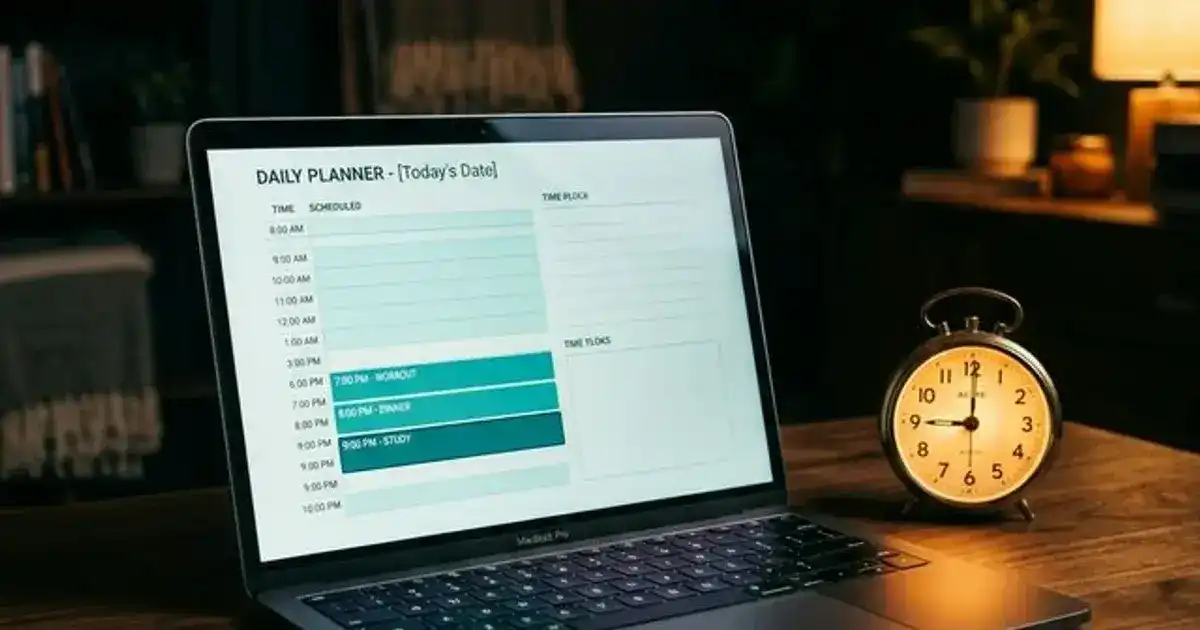
It is Sunday night. You write out a study plan for the week — color-coded, ambitious, optimistic. By Tuesday the plan is in the trash. You skipped Monday's review because you were tired after lab. Thursday comes and you push everything to the weekend. The weekend arrives and you panic-cram at 2 AM. Sound familiar?
The problem is not willpower. It is that you have no one checking. No one who notices when your plan quietly falls apart. In 2026, students are using AI as a rigid life coach and accountability partner — one that holds you to what you said you would do, every single day. Here is how to set it up.
Why Students Need an AI Accountability Coach
Students need an AI accountability coach because your brain is bad at planning its own time. Research shows we have a blind spot called the planning fallacy — we always think tasks will take less time than they actually do, even when we have been wrong before. The problem is not you. It is the planning system — or really, the fact that you do not have one. Your brain is too optimistic. You pack eight hours into Monday, forgetting that you will be wiped out after your 4:00 PM lab. By Tuesday the plan is in the trash.
Without an AI Coach
You make a plan on Sunday. By Tuesday it is in the trash. No one notices. No one adjusts. You panic-cram at 2 AM before every exam.
With an AI Coach
The AI calculates available hours minus required hours and builds a schedule based on math, not optimism. It will not let you push Organic Chemistry to next week for the third time in a row.
This is why the coaching approach works. A normal AI chat is one-and-done — you ask, you get an answer, you leave. A coaching chat is ongoing: the AI knows your goals, deadlines, weak spots, and track record. It responds based on what you have actually done, not just what you asked.
If you have struggled with building a study schedule you actually follow, this approach fixes the real reason plans fail — not the schedule itself, but having something that makes you stick to it.
Key Takeaway
AI coaching works because it stops you from fooling yourself about how much time you have — it schedules based on math, not wishful thinking.
How to Set Up AI as Your Personal Life Coach (Step by Step)
There is a name for this setup: The Coaching Loop. It has three parts — a strict coaching role, a complete info dump of your life, and a daily check-in habit. Each one takes minutes to set up. Without all three, the AI gives you generic advice. With all three, you get a 90-second daily habit that builds into real accountability.
The Role
Tell the AI to act like a strict, no-nonsense coach. Be clear: "You are my accountability coach. Push back if I set unrealistic goals. Do not let me procrastinate."
The Data Dump
Give it every syllabus deadline, your class schedule, work hours, gym routine, and sleep requirements. The more data it has, the more accurate the blocks it builds.
The Daily Check-In
A coach is useless if you never talk to them. Open the same chat thread every evening and report what you actually finished — and what you skipped.
Step 1: Set the Persona (~3 minutes)
The first message sets the whole tone. Most students skip it and go straight to "make me a study plan," which gets a generic schedule. Instead, tell the AI exactly what role to play.
Open ChatGPT (free tier works), Gemini (free with a Google account), or Claude (free, up to ~30 messages per session). Start a brand new conversation. Then paste this:
Copy this prompt — coaching persona
"You are my strict academic accountability coach. Your job is to help me stay on track with my semester. I want you to be direct, push back when I set unrealistic goals, call me out if I make excuses, and help me adjust the plan when life gets in the way. Every day I will check in and tell you what I completed. You will track my progress and tell me honestly whether I'm on track or falling behind. Do not sugarcoat."
Without this framing, the AI defaults to being agreeable — the opposite of coaching. You want friction: "you planned 6 hours but only completed 2 — we need to either cut scope or add a Saturday session."
Done: The AI replies confirming its coaching role and asks what you need help with. You now have a dedicated coaching thread. If it gives a generic "sure, I'd be happy to help!" response instead, paste the persona prompt again and add: "Respond in character. Be strict."
Step 2: Give It Everything (~8 minutes)
After you set the persona, paste in your entire situation. The more specific you are, the more useful the coaching becomes. Here is what to include:
- Every class and exam date — paste your syllabus deadlines or screenshot them into the chat
- Your weekly commitments — classes, work shifts, gym, commute, club meetings
- Your sleep schedule — when you wake up, when you need to be in bed
- Your known weak spots — "I always procrastinate on Organic Chemistry" or "I lose focus after 45 minutes"
- Your GPA goals — are you aiming for a 4.0 or just trying not to fail Calculus?
Copy this template — data dump
"Here is my situation: I'm a [year] student taking [list courses]. My exams are: [dates]. I work [hours/days]. I sleep [time] to [time]. My weak spots: [list them]. My goal: [GPA target or specific outcome]. Build me an hour-by-hour plan for this week."
The AI will use all of this to build a schedule that fits your actual life — not a fantasy version. If you have tried building an AI study plan before and it did not stick, this data dump is likely the step you skipped.
Done: The AI replies with a detailed daily or weekly schedule. You are looking at a plan with specific time blocks (e.g., "Tuesday 4:00–5:30 PM — Organic Chemistry review"). If the plan looks unrealistic, tell it: "Tuesday after 4 PM is too packed — I'm exhausted after lab. Spread it out."
Step 3: The Daily Check-In (~90 seconds per day)
The plan itself is not the hard part. Sticking to it is. And the single best trick for actually following through is the daily check-in — a 90-second habit where you open the same chat thread every evening and tell the AI what happened.
A check-in message looks like this:
Copy this template — daily check-in
"Today I finished [what you completed]. I skipped [what you missed] because [reason]. Tomorrow I have [upcoming deadlines]. Adjust my plan."
The AI responds by adjusting tomorrow's plan and flagging anything close to a deadline. This feedback loop turns a one-time schedule into an ongoing coaching relationship.
Over time, the conversation builds up history. The AI can say "you have pushed this back three times — if you do not start tonight, you will need 4 hours on Sunday, which clashes with your shift." That kind of specific, fact-based pushback is something most human coaches cannot match.
Done: You have a daily alarm set for 9 PM labeled "AI Coach Check-In" and the AI just replied with an adjusted plan for tomorrow. If you do this for 3 days straight, the coaching loop is locked in.
Prompts That Turn ChatGPT Into a Real Coach
The difference between useless AI coaching and real accountability comes down to 4 words: context, details, deadlines, honesty. Here are 4 prompt upgrades that turn a chatbot into a real coach:
| ❌ Weak Prompt | ✅ Strong Coaching Prompt |
|---|---|
| "Make me a study plan" | "Here are my 5 courses, deadlines, and work hours. Build me a daily schedule for the next 2 weeks that accounts for everything." |
| "Help me study more" | "I studied 3 out of 5 planned hours today. Adjust tomorrow's plan so I stay on track for my Thursday exam without going past midnight." |
| "Am I on track?" | "Based on what I've completed this week versus what's left before my Psych midterm, am I at risk of running out of time? Be direct." |
| "Motivate me" | "I feel like skipping tonight's review. Given my current progress and deadline, should I push through or is it safe to take tonight off? Don't just encourage me — give me a real answer." |
The pattern: give context, ask for a specific decision, demand honesty.
If you want to skip the prompt engineering entirely, our Learning Planner prompt comes pre-built with this exact coaching dynamic — the persona, the scheduling logic, and the check-in structure. You paste in your situation and it immediately starts acting as your accountability partner.
Key Takeaway
Effective AI coaching prompts include specific data — courses, deadlines, available hours — not open-ended requests.
Stop rebuilding your coaching prompts from scratch every semester
The Learning Planner prompt has the coaching persona, scheduling logic, and daily check-in structure pre-built — paste your semester details and it starts coaching in under 2 minutes.
See the Learning Planner Prompt →Used by 300+ students · Free tier available
Which AI Tools Work Best as a Student Life Coach
ChatGPT, Gemini, and Claude all work as free AI life coaches for students as of 2026 — the best choice depends on whether you care most about memory, calendar sync, or warm responses.
ChatGPT (Free Tier)
Best for long coaching conversations because it remembers what you said earlier in the chat. The free tier gives you GPT-4o as of 2026, which is more than smart enough for coaching. You can also upload syllabus screenshots and PDFs right into the conversation.
Best for: daily check-ins, schedule building, long-running coaching chats
Google Gemini (Free Tier)
Strong alternative, especially if your school uses Google Workspace. As of 2026, Gemini connects to Google Calendar and Google Tasks, so it can add your coaching plan straight to your calendar. The free tier runs Gemini 2.0 Flash, which handles scheduling well.
Best for: students already using Google apps, calendar sync
Claude (Free Tier)
Claude is excellent for thoughtful, warm coaching. Claude 3.7 Sonnet on the free tier as of 2026 gives more human-sounding responses and is less likely to produce generic "you have got this!" encouragement. It is especially good for students dealing with burnout or feeling overwhelmed on top of their scheduling needs.
Best for: warm, human-like coaching, burnout prevention
Dedicated AI Coaching Apps
Tools like Rocky.ai, Wysa, and Mei are built specifically for coaching and check-ins as of 2026. They come with step-by-step guides and reminders built in. The trade-off: you get fewer options to customize compared to an open-ended AI like ChatGPT or Gemini, and most need a paid plan for full features.
Best for: students who want a more structured, app-guided experience
For most students, the free tier of ChatGPT or Gemini is enough. The key factor is not which AI you pick — it is whether you commit to the daily check-in. For a broader look at all the AI tools available right now, check out our guide to AI time management tools for students.
Key Takeaway
The best AI tool is the one you use consistently. Free tiers of ChatGPT, Gemini, or Claude are sufficient if you commit to daily check-ins.
Where AI Coaching Falls Short (And What to Watch For)
AI coaching fails when students skip check-ins, give vague prompts, or expect the AI to track what they do without telling it. In practice, roughly 3 out of 4 students who try AI coaching give up within two weeks — almost always because they skip the daily check-in.
⚠️ The honesty problem
The AI can only work with what you tell it. If you skip the check-in or lie about what you finished, the coaching falls apart right away. It only knows what you tell it.
- It cannot replace therapy. AI handles scheduling and follow-through, not serious anxiety or emotional breakdowns. If you are struggling with mental health, talk to your school's counseling center.
- It does not detect burnout. The AI keeps pushing if you keep saying yes. Add a rule: "If I report exhaustion two days in a row, suggest a recovery day."
- The AI's memory has limits. After several weeks, the conversation may get too long for the AI to remember everything, and its answers will start feeling generic. When that happens, start a new thread and paste this: "Here is my progress so far: [summary]. My open deadlines: [list]. What has been working: [list]. Pick up coaching from here." The reset takes about 3 minutes.
- Vague prompts produce vague coaching. "Help me study more" gets nothing useful. "I have 14 hours this week and need Chapters 5-8 before Thursday" gets a real plan.
Students who get the most from AI coaching treat it like a real accountability relationship — showing up daily, being honest, and adjusting the plan instead of abandoning it.
Key Takeaway
AI coaching is not a substitute for therapy — it handles scheduling and accountability, not mental health.
Set Up Your AI Coach Tonight (15-Minute Start)
A complete AI coaching setup takes 15 minutes: open a dedicated thread, set the coaching persona, paste in your schedule and deadlines, and set a daily check-in alarm. Here is the full sequence.
Open a new thread (2 min)
Open ChatGPT, Gemini, or Claude. Start a brand new conversation — don't reuse one you've used for homework.
Set the persona (3 min)
Paste the coaching persona prompt from above. Tell the AI to be strict, direct, and to push back on excuses.
Data dump (8 min)
Paste your class schedule, deadlines, work hours, and goals. Ask it to build tomorrow's hour-by-hour plan.
Set a check-in alarm (2 min)
Set a daily alarm for 9 PM labeled "AI Coach Check-In." Open the thread, report what you did, and get tomorrow's adjusted plan.
You now know something most students do not. Everyone else is making plans on Sunday night and hoping they stick. You are going to build a Coaching Loop — persona, data dump, daily check-in — and let the AI hold you to it. That is the whole difference between planning and following through.
If you want to skip the prompt setup entirely, our Learning Planner does the persona, data dump, and scheduling logic for you in one step — just paste in your situation and it starts coaching immediately.
Try This Tonight
Open ChatGPT, Gemini, or Claude right now. Start a new thread. Paste this: "You are my strict academic accountability coach. Be direct. Push back on excuses. Do not sugarcoat." Then paste tomorrow's class schedule, deadlines, and the hours you have free. Ask it to build an hour-by-hour plan for tomorrow. Set a phone alarm for 9 PM labeled "AI Coach Check-In." The whole thing takes under 5 minutes. When you are done, you will have tomorrow's plan built and a daily trigger to keep the loop going.
Your AI coach is one prompt away from holding you accountable every single day
You just learned the Coaching Loop — persona, data dump, daily check-in. The Learning Planner prompt packages all three into one step. Paste your semester details and get your first coaching session in under 2 minutes.
Try the Learning Planner Prompt →Used by 300+ students across 200+ schools · Free tier available