Introduction
We have all been there. It is 10 PM, you have an assignment due tomorrow, and you are staring at a blank screen.
You open ChatGPT or Gemini, paste the prompt, and within seconds, you have a perfect essay or a solved math equation. It feels like magic. You got the work done, and you can go to sleep.
But did you actually learn anything?
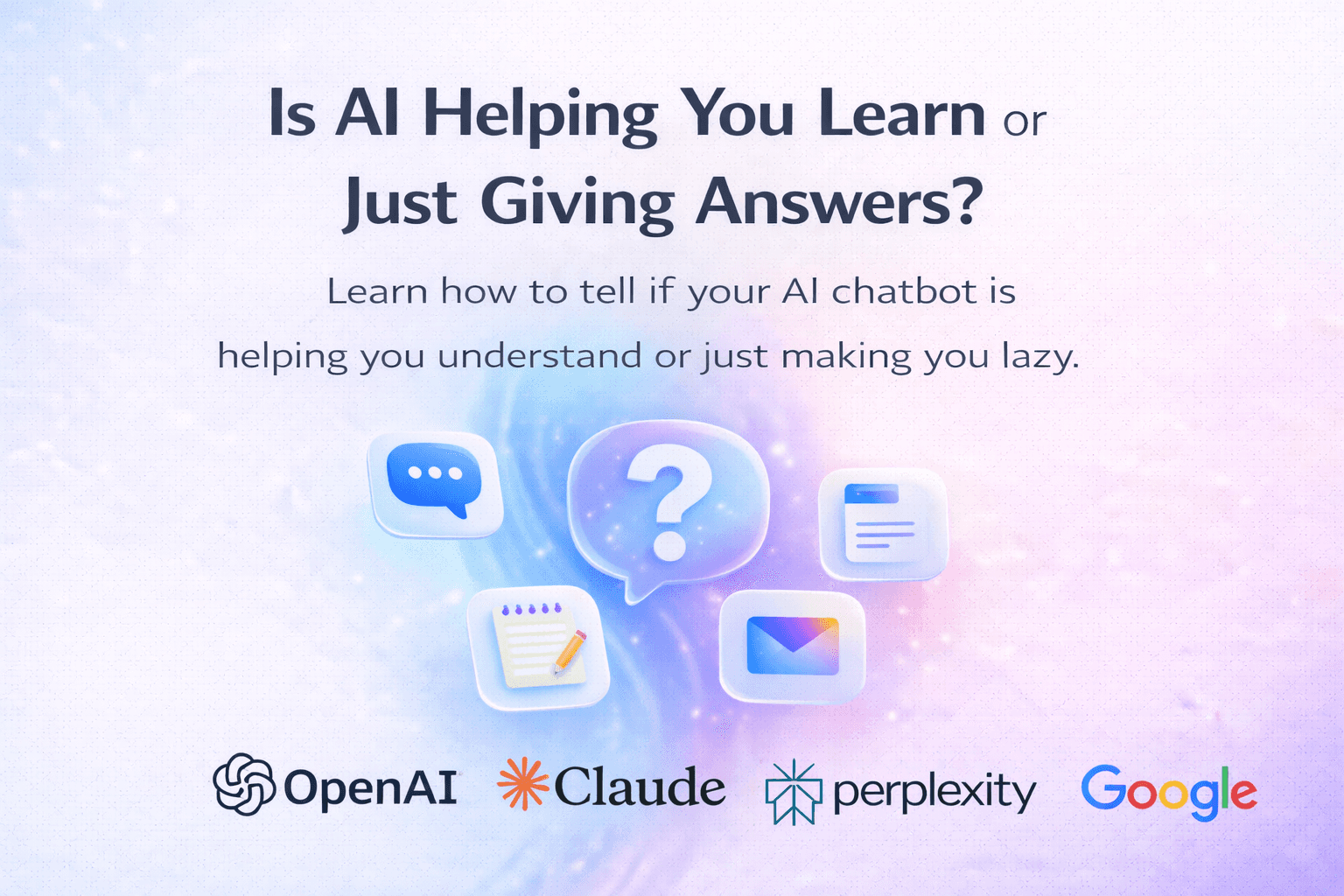
This is the big question every student needs to ask right now. AI is an incredibly powerful tool, but it is a double-edged sword:
If you use it one way, it can be the best tutor you have ever had.
If you use it the other way, it can rob you of your ability to think for yourself.
In this post, we are going to look at the massive difference between using AI to get smart versus using AI just to get by.
The Difference Between Learning and Copying
There is a huge difference between getting an answer and understanding an answer. When you copy a response from a chatbot and paste it into your homework, you are skipping the struggle. That struggle—the moment when you are confused and have to think hard, is actually where learning happens.
Think of it like going to the gym. If you go to the gym and watch a robot lift weights for you, the weights get lifted, but your muscles do not grow. Using AI to just do your work is exactly the same. You are getting the result (the finished homework), but you are not building the "mental muscle" you need for the test.
Why "Just Getting the Answer" Hurts You Later
When you let AI do all the heavy lifting, you might feel productive. You might even get good grades on your homework. But this creates something called the "Illusion of Competence." This is a fancy way of saying you think you know the material because you saw the answer, but you don't actually know it.
The problem shows up when you walk into the classroom for a test. There is no AI allowed. Suddenly, you realize you don't know how to solve the problem on your own. This is why relying too much on AI summaries instead of reading the book can be dangerous. You need to make sure you are doing the thinking, not just the reading.
The Trap of Passive Learning
Passive learning is when you sit back and let information wash over you. It is like watching a TikTok video or reading a textbook without taking notes. It feels easy, but your brain doesn't hold onto the information. AI makes passive learning very tempting.
If you ask an AI to "Explain the French Revolution," it will give you a great summary. You might read it and nod your head. But five minutes later, you will probably forget most of it. To really learn, you need to be active. You need to question the information, test yourself, and try to explain it back in your own words.
How to Use AI as a Tutor, Not a Cheater
So, does this mean you should delete your AI apps? Absolutely not. You just need to change how you use them. The best way to use AI is to treat it like a teacher, not an answer key. This is often called the "Socratic Method."
Instead of asking, "What is the answer to question 5?" try asking, "I am stuck on question 5. Can you give me a hint about the first step, but don't tell me the answer?" When you do this, you force your brain to do the work. You can find more strategies for this in our guide on educational prompt engineering, which teaches you how to talk to the AI to get better results.
Practical Tips for Active Recall with AI
One of the best study methods in the world is called "Active Recall." This basically means testing yourself. Instead of re-reading your notes, you close your book and try to remember what you learned. AI is amazing for this.
You can paste your notes into an AI tool and say, "Quiz me on this. Ask me one question at a time." This turns a boring study session into an interactive game. By forcing yourself to remember the answer, you are locking that information into your long-term memory. We have a full guide on how to use an AI practice test generator that can show you exactly how to set this up.
Spotting the Signs: Are You Relying Too Much on AI?
How do you know if you have crossed the line from "smart student" to "lazy student"? Here is a simple checklist. If you say "yes" to these, you might need to change your habits:
Do you feel panic if the AI is down or not working?
Do you copy and paste answers without reading them fully?
If a teacher asked you to explain a word in your essay, would you be unable to do it?
Do you spend more time trying to prompt the AI than it would take to just write the assignment?
If you recognized yourself in that list, don't worry. You can fix it by focusing on building critical thinking skills instead of just asking for output.
Asking Better Questions (Prompt Engineering)
The quality of the help you get from AI depends on the questions you ask. If you ask a lazy question, you get a lazy answer. If you ask a smart question, you get a smart answer. This skill is called "Prompt Engineering."
For example, instead of saying "Write me an essay on climate change," you could say, "I am writing an essay on climate change. Here are my three main arguments. Can you critique them and tell me if I missed anything?" See the difference? In the second example, you wrote the arguments. The AI is just helping you make them better.
Tools That Help You Think
Not all AI tools are the same. Some are designed to just give you answers, while others are built to help you learn. It is important to choose the right tool for the job.
For example, tools like Khan Academy's Khanmigo are designed to guide you without giving away the answer. At Vertech Academy, we focus on tools and prompts that put you in the driver's seat. Whether you are looking for flashcards or a study schedule, picking the right software matters. You can check out our list of the 7 best AI tools for exam prep to find ones that actually support your learning.
Conclusion
AI is not going away. In the future, every job and every college class will probably involve using AI in some way. The students who succeed won't be the ones who can copy-paste the fastest. They will be the ones who know how to use AI to learn faster and think deeper.
By learning how to use these tools ethically now, you are preparing yourself for the real world. You are learning how to manage a powerful assistant. That is a skill that will be valuable for the rest of your life.
At the end of the day, the choice is yours. You have two clear paths when you open an AI tool:
The Easy Path: Use AI to do your work for you. This might save you time tonight, but it will cost you knowledge tomorrow.
The Smart Path: Use AI to challenge yourself, quiz yourself, and explain things you don't understand.
Remember, the goal of school isn't just to get a grade; it is to build a brain that can solve problems.
So, next time you open that chatbot, ask yourself:
Am I learning, or am I just looking for the easy way out?
If you choose to learn, you are already ahead of the game.