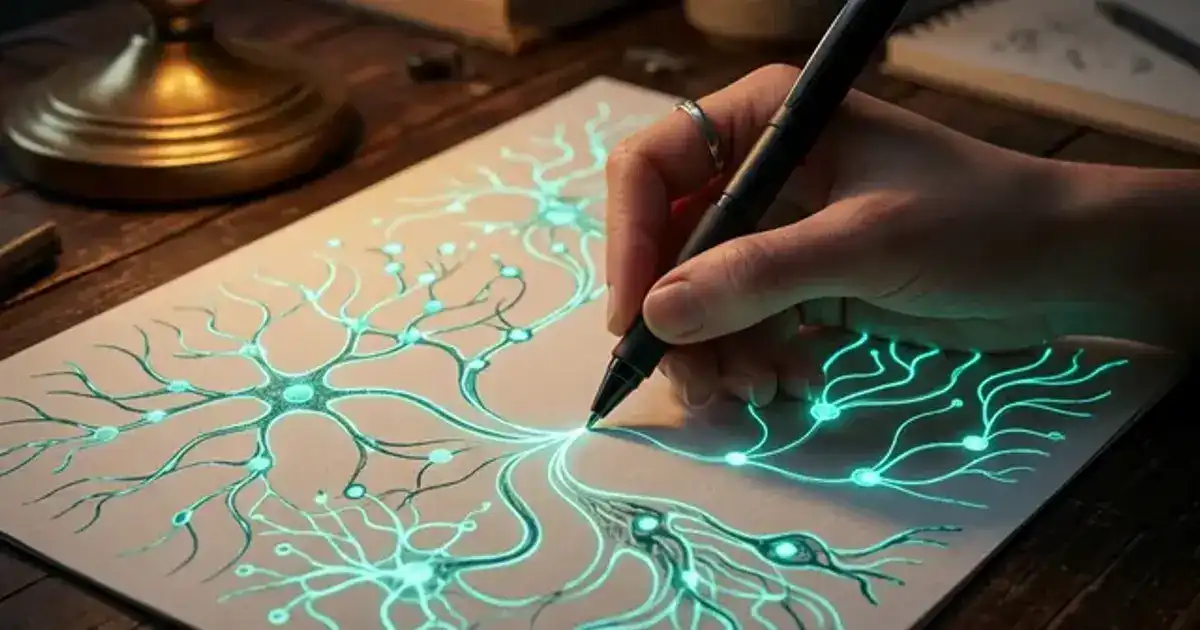
There is something that happens when you put pen to paper that does not happen when you type. Your brain slows down just enough to actually process the material instead of transcribing it. Research backs this up - students who write notes by hand consistently outperform those who type them, even though typing is faster.
But “thinking on paper” is not the same as “taking notes.” Most note-taking is passive copying. Thinking on paper is active processing - drawing connections, sketching diagrams, wrestling with ideas on the page. Here is how to do it well.
Why Your Brain Works Better With a Pen
When you type, you can transcribe almost as fast as someone speaks. This means your brain skips the processing step - information goes from ears to fingers without actually being understood. It is high-throughput, low-retention.
Writing by hand is slow. And that slowness is the point. Because you cannot write fast enough to copy everything, your brain is forced to decide what matters, how to phrase it, and where it connects. That decision-making process is the learning.
A 2014 study by Mueller and Oppenheimer found that laptop note-takers performed worse on conceptual questions than hand-writers, even when they had more notes to review. More notes did not mean more learning - deeper processing did.
“Thinking on Paper” is Not “Taking Notes”
Passive Note-Taking
- Copying the professor's slides word-for-word
- Writing down definitions verbatim
- Filling in pre-made templates without thinking
- Highlighting text and calling it “notes”
Thinking on Paper
- Rephrasing concepts in your own words
- Drawing diagrams that show how ideas connect
- Writing questions that come up as you study
- Argue with the material - “but what about...”
A 20-Minute Thinking-on-Paper Session
Minutes 1-5: Write down everything you remember from the lecture without looking at any notes. Messy is fine - this is free recall, not a clean summary.
Minutes 5-10: Check your notes or textbook. Fill in the gaps. Notice what you forgot - those are your weak spots.
Minutes 10-15: Draw a concept map or diagram connecting the key ideas. How does today's material link to last week's? Draw the arrows.
Minutes 15-20: Write 3 questions about the material you still cannot fully answer. These become your study targets for the next session.
Pair it with AI
Use AI after thinking on paper, not instead of it. Do the handwriting exercise first, then paste your questions into the Chemistry Tutor prompt to get explanations for your gap areas. This sequence - struggle first, then AI - produces much better retention than asking AI from the start.
For more on how to structure your notes after a session, see our guide on turning messy notes into a clean study guide using AI.