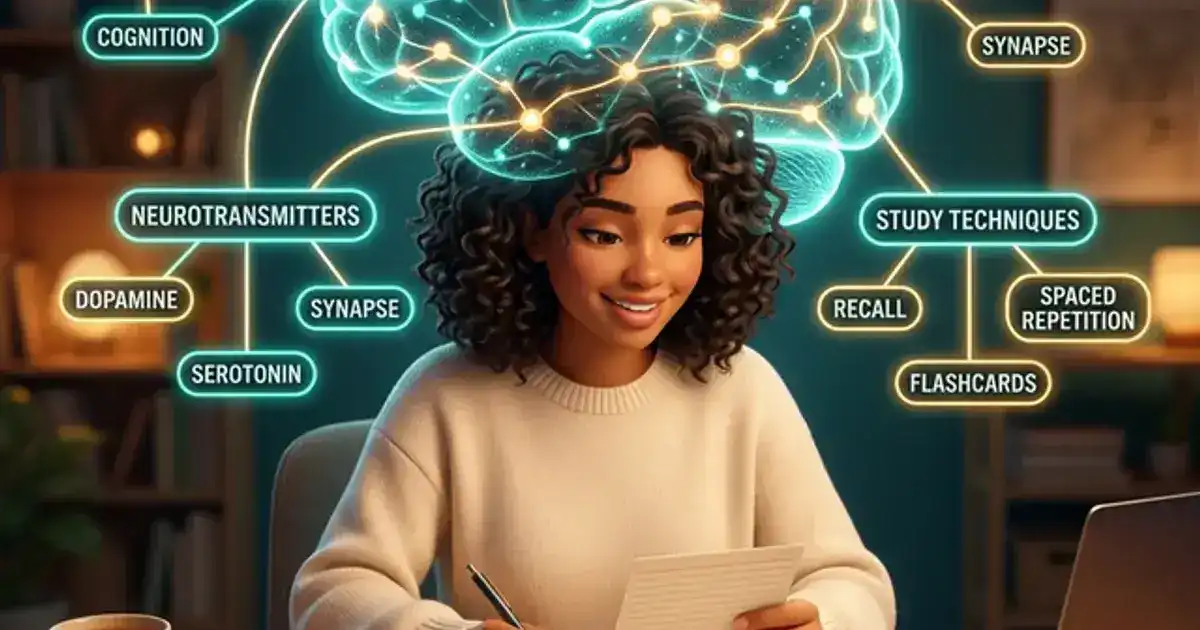
Active recall, chunking, and teach-back. Those are the three methods that actually work when you need to memorize a lot of material in a single night. Pick one, combine them, or run all three in sequence - they all hold up under pressure because they work with how your brain actually forms memories, not against it.
This guide breaks down each method step by step, gives you a study session structure you can follow tonight, and explains exactly what to avoid so you don't waste the little time you have left.
Why Your Brain Doesn't Want to Cooperate Right Now
You're stressed. There's too much material. And every time you sit down to study, your brain starts wandering to literally anything else.
That's not laziness - that's what happens when your brain is overloaded and there's no clear entry point. When you look at a massive pile of notes, your working memory (which can only hold about 4-7 items at once) gets overwhelmed and basically shuts down. It's the cognitive equivalent of freezing in front of a huge to-do list.
The fix isn't to try harder. It's to use a method that works with how memory actually forms, even on a tight timeline. Your brain builds memories through retrieval (pulling information out), not through exposure (looking at information). Every time you successfully recall a fact without looking, that memory gets stronger. Every time you reread a page, almost nothing happens.
That's why the three methods below work - they all force your brain to retrieve, organize, or reconstruct information instead of passively absorbing it. If you're interested in the deeper science behind why your brain goes blank under pressure, we have a separate guide on that.
The Three Methods That Actually Work Under Pressure
These aren't random tips. They're backed by memory research and they hold up even when you're cramming. Pick one or combine them.
Active Recall
Close your notes. Try to write down everything you know about a topic from scratch. Every retrieval attempt strengthens the memory - looking at your notes does not.
Chunking
Break big topics into groups of 3-5 related ideas. Learn one chunk completely before moving to the next. Your brain handles small batches far better than one endless list.
Teach-Back
Explain each topic out loud as if you're teaching it to someone. When you hit a gap, that's exactly where you need to go back and review. Gaps are the point.
Active Recall in Practice
Here's how to actually do this. Read a section of your notes for 3-5 minutes. Then close everything - your laptop, your notebook, all of it. Get a blank piece of paper and write down every single thing you can remember about what you just read.
It will feel painful. You'll forget stuff. That's literally the point. When you struggle to recall something and then check the answer, your brain encodes that information much more strongly than if you had just reread it five more times. This is called the "testing effect" and it's one of the most replicated findings in cognitive psychology.
You can also use ChatGPT or Claude to generate quiz questions from your notes. Paste your notes in and ask it to quiz you one question at a time. It's basically a free, instant study partner that never gets tired.
Try this prompt:
"Here are my notes on [subject]. Quiz me on this material one question at a time. Wait for my answer before showing the next question. After each answer, tell me if I was right or wrong and explain the correct answer briefly. Track my score."
Chunking in Practice
If you have 30 vocabulary terms to memorize, don't try to learn all 30 at once. Break them into 6 groups of 5. Master group 1 before touching group 2. After group 2, quickly review group 1 again. After group 3, review groups 1 and 2. This interleaving creates more durable memories than trying to learn everything in one linear pass.
The same applies to concepts. If you're studying a chapter with 8 key ideas, chunk them into two groups of 4 related concepts. Learn the first group, test yourself, then move to the second. The act of grouping related ideas together also helps your brain form associations between them, which makes them easier to recall on the exam.
Teach-Back in Practice
This is the most underrated method. After studying a topic, stand up, walk to another part of the room, and explain the concept out loud as if you're teaching it to a friend who knows nothing about it. Don't look at your notes. Just talk.
When you hit a point where you stumble or go blank, that's your gap. That's the exact thing you need to go back and review. The teach-back method is powerful because it forces you to organize information into a logical sequence - and organized information is dramatically easier to retrieve under pressure. You can also do this with AI: explain a concept to ChatGPT and ask it to tell you what you got wrong or what you're missing. For a full guide on using AI as a study tool, check out our post on how to use ChatGPT to study.
Let AI drill you on your weak spots
Our Pocket Quiz prompt generates rapid-fire questions from whatever you paste in. It adapts to your mistakes, so you spend more time on what you actually don't know yet.
Try the Pocket Quiz promptHow to Structure Your Session So Nothing Gets Lost
Don't just open your notes and start reading from page 1. Run the session in this order - it makes the material stick better and stops you from wasting time on what you already know.
Brain dump
Before reading anything, write down everything you already know. This activates what's already there and shows you what's missing.
Fill the gaps
Now check your notes for what you missed. Focus only on the gaps - not on re-reading everything.
Quiz yourself
Close everything and test yourself on the material you just reviewed. This is where real memorization happens.
Final pass before sleep
One quick run through the toughest items right before bed. Sleep does the consolidation for you.
One thing to note about this structure: do not skip step 1. The brain dump feels like a waste of time because you're writing things you already know. But that's the point - it primes your memory and makes everything you study afterward stick better. It also gives you a clear picture of what you actually don't know, so you can spend your limited time on the right things.
What Kills Retention Even When You're Working Hard
The biggest retention killer
Re-reading is the slowest way to memorize anything. It feels productive because you're seeing familiar words, but recognition is not the same as recall. If you can't retrieve it without looking, you don't know it yet.
There are a few other things that sabotage your cramming session even when you feel like you're putting in the work:
- Taking breaks on your phone. Your working memory needs quiet downtime between chunks. Scrolling Instagram or TikTok fills that space with noise and actively interferes with memory consolidation. If you need a break, stare at a wall, stretch, or walk around the room - anything that doesn't load new information into your brain.
- Trying to memorize everything equally. Some things are worth more on the exam than others. Spend time proportionally - heavy on high-priority topics, light on low-priority ones. If you have 3 hours and 10 topics, don't spend 18 minutes on each. Spend 30 minutes on the top 3 and 12 minutes on the rest.
- Skipping sleep. Memory consolidation happens during sleep. Your brain literally replays and strengthens the neural pathways you built during studying. A few hours of focused review followed by a full night of sleep consistently outperforms 8 hours of cramming with no sleep. This is not motivational advice - it's how hippocampal memory consolidation actually works.
- Highlighting everything. Highlighting feels active but it's almost entirely passive. You're making decisions about what looks important while reading, but you're not retrieving or reconstructing anything. If you must highlight, limit yourself to one sentence per page and immediately quiz yourself on why that sentence matters.
How to Lock It In Before You Sleep
In the last 15 minutes before bed, close everything and do one final recall session - no notes, just write down the key points from every topic you studied. This last retrieval attempt is disproportionately powerful because your brain will consolidate those specific memories during sleep.
Anything you can't recall? Make a note. Do a 2-minute review on that item only, then go to sleep. Don't fall into the trap of "just one more hour" - the lost sleep will cost you more than the extra review gains.
And if you want AI to run the whole quiz session for you, our Pocket Quiz prompt will drill you on whatever material you paste in, one question at a time, until you're solid. It adapts to your mistakes so you spend more time on what you're actually getting wrong.
In the morning, set your alarm 20 minutes early and do one more quick recall session. That morning review, combined with the sleep consolidation, will make those memories significantly more accessible during the exam. If you want more tips for when you're really under pressure, we also have a guide on what to do when you have a test tomorrow and know nothing.
The night before isn't about reading more. It's about testing yourself more.
Need a study partner at 2am?
The Pocket Quiz prompt generates rapid-fire questions from your notes and adapts to your weak spots. Works with ChatGPT, Claude, or Gemini.
Try the Pocket Quiz - Free